What Is Turkey Tail Mushroom Good For?
By Josh Shearer on 17/07/2026
Turkey tail for immune and gut support: what the PSK and PSP research shows, what it doesn't, and how to choose a quality extract.
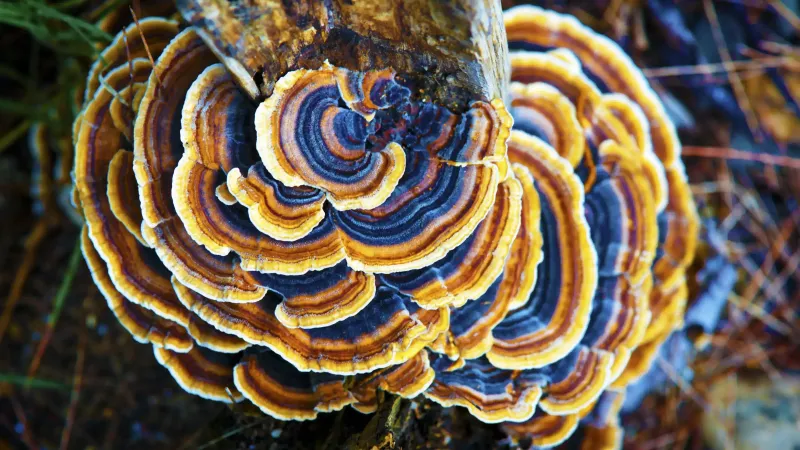
Turkey tail (Trametes versicolor) is one of the most researched medicinal mushrooms in the world, yet most people know it only as the pretty, banded bracket fungus they see on logs. So what is turkey tail mushroom actually good for? The honest answer is that it is best understood as an immune- and gut-support mushroom, with an unusually serious research history behind its polysaccharides. This guide covers what the evidence shows, what it does not, and how to choose turkey tail worth taking.
What turkey tail is good for
Immune support. Turkey tail's claim to fame is two closely related polysaccharide compounds, PSK (polysaccharide-K, also called krestin) and PSP (polysaccharopeptide). PSK has been studied for decades and is used in Japan as an adjunct alongside conventional cancer treatment, not as a standalone cure. Systematic reviews of PSK and turkey tail extracts describe immune-modulating activity and a supportive role in that clinical setting. This is important context, and it is also why turkey tail should never be framed as a cancer treatment for a general audience; that is a medical use overseen by clinicians. For everyday purposes, turkey tail is taken as general immune support.
Gut health. More recent human research has looked at turkey tail as a prebiotic. In one controlled study, a turkey-tail polysaccharopeptide shifted the composition of the gut microbiome, feeding beneficial bacteria. Because the immune system and the gut are tightly linked, this prebiotic angle is a large part of why turkey tail is grouped with gut-support mushrooms. We go further on this in our turkey tail and gut health post.
What the research does not say
Turkey tail is not a treatment for any disease in the general-wellness context, and no supplement should be sold or taken as one. The strong clinical work on PSK sits inside supervised oncology care in specific countries; it does not translate into a claim that an over-the-counter turkey tail tincture treats illness. The accurate framing for a supplement is immune and gut support in otherwise healthy people, and anyone with a medical condition or on treatment should talk to a clinician before adding it.
How to take turkey tail
Turkey tail is woody and not eaten as food, so it is taken as an extract. A hot-water extraction pulls out the beta-glucan polysaccharides that carry its activity; a turkey tail tincture or triple-extract turkey tail gives you a concentrated, pre-extracted dose by the dropper. Powders of extracted fruiting body also work stirred into coffee, broth, or a smoothie.
Choosing quality turkey tail
The rules are the same as for any functional mushroom, and they matter here because turkey tail's whole value is its polysaccharide content.
Fruiting body, not mycelium-on-grain. The polysaccharides concentrate in the actual mushroom; grain-grown mycelium products can be mostly starch. See our mushroom powder guide for how to read this.
Hot-water extraction, since the active beta-glucans are water-soluble and locked in a woody, chitin-rich structure.
A stated beta-glucan percentage rather than a vague "polysaccharides" number that grain starch can inflate.
Third-party testing for potency and contaminants, because turkey tail, like all mushrooms, takes up whatever is in its substrate.
The bottom line
What is turkey tail good for? Immune support and, increasingly, gut health, backed by one of the deepest research records of any medicinal mushroom, centered on its PSK and PSP polysaccharides. Keep the framing honest, general support rather than disease treatment, choose a hot-water-extracted fruiting-body product with stated beta-glucans and third-party testing, and turkey tail is a well-founded addition to a daily routine. Compare lab-tested turkey tail in our functional mushroom extracts collection, or see how it stacks up in our best functional mushrooms guide.
Shop turkey tail mushroom
Browse hot-water-extracted, fruiting-body turkey tail, all lab-tested.
Preguntas frecuentes
Turkey tail is best understood as an immune- and gut-support mushroom. Its polysaccharides, PSK and PSP, have an unusually deep research record for immune modulation, and recent human work suggests a prebiotic effect that supports beneficial gut bacteria. For general use it is taken as everyday immune and gut support, not as a treatment for any disease.
Referencias
- Habtemariam, S. (2020). Trametes versicolor (Synn. Coriolus versicolor) Polysaccharides in Cancer Therapy: Targets and Efficacy. .
- Fritz, H. & Kennedy, D. (2015). Polysaccharide K and Coriolus versicolor extracts for lung cancer: a systematic review. .
- Pallav, K. & Dowd, S. (2014). Effects of polysaccharopeptide from Trametes versicolor and amoxicillin on the gut microbiome of healthy volunteers. .
- Fisher, M. & Yang, L. (2002). Anticancer effects and mechanisms of polysaccharide-K (PSK): implications of cancer immunotherapy. .