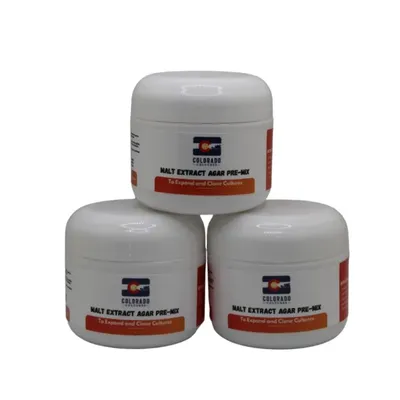
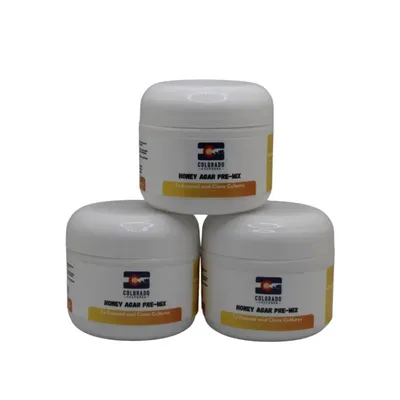


Mezcla de Agar - 40 Gramos
Vendido por Colorado Cultures
Cargando comentarios...
$12.99
Envío estimado en EE.UU. $6.60
Devoluciones en 30 días
Pago seguro — Stripe y PayPal
El envío final se calcula al finalizar la compra.
Garantía de devolución de 30 días

Trabajo con agar sin el costo inicial de un kit de química
Cada cultivador serio eventualmente se enfrenta a la pared del agar. Lo básico — grano de cultivo de una jeringa de cultivo líquido, sustrato a granel de CVG, fruto en un monotubo — te da el 80% de lo que la cultivación tiene para ofrecer. El otro 20% vive en placas de agar.
Pero el trabajo tradicional con agar tiene un alto costo inicial:
- Suministrar el extracto de malta adecuado, peptonas, polvo de agar agar, extracto de levadura
- Calcular las proporciones para la receta que deseas (MEA, PDA, MEYA, DFA, etc.)
- Pesar, mezclar, hidratar, autoclave, verter — para cada lote
- Esperar que tu formulación realmente soporte la especie que estás cultivando
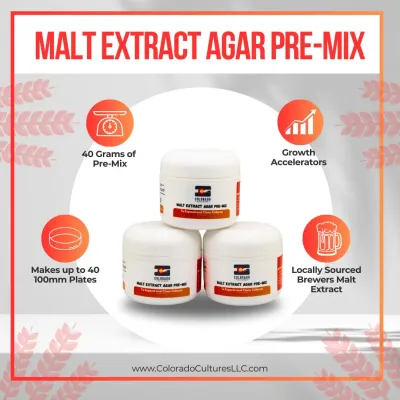
El Pre Mezcla de Agar de Colorado Cultures elimina por completo el paso de formulación. Un sobre de 40g de formulación de agar premedido, listo para combinar con agua, esterilizar y verter. Hace hasta 40 placas de Petri estándar de 100 mm. Disponible en M.E.A. (Agar de Extracto de Malta) con Miel como la receta canónica de cultivo de hongos.
Tú traes el agua, el equipo de esterilización y las placas. La premezcla se encarga de todo lo demás.
Qué hay en la bolsa
La Pre Mezcla de Agar de 40g es un polvo premezclado y formulado profesionalmente que contiene:
- Agar agar — el agente gelificante. Derivado de algas rojas; la matriz estructural sobre la que crece el micelio
- Extracto de malta — la fuente principal de carbohidratos. Azúcares amigables con el micelio provenientes de cebada malteada
- Miel — carbohidratos adicionales más minerales traza y enzimas naturales
- Aceleradores de crecimiento — mezcla patentada de aditivos que aceleran el establecimiento de colonias [VERIFICAR composición exacta con el proveedor]
La variante "con miel" es importante.La miel añade aceleradores de crecimiento que el MEA puro no tiene — enzimas naturales, compuestos antimicrobianos y un perfil de carbohidratos más complejo al que responde el micelio. Para cubensis y la mayoría de las especies de hongos cultivados, el MEA-con-miel es el mejor formulación de agar de uso general disponible.
Lo que te permiten 40 placas
Un solo paquete de 40 g hidratado a 1 litro produce suficiente agar para verter hasta 40 platos de Petri estándar de 100 mm. Eso es:
- Suficiente para un proyecto completo de aislamiento genético (típicamente 4-10 placas por generación a lo largo de 2-3 generaciones)
- Suficiente para probar más de 10 jeringas de cultivo líquido en paralelo
- Suficiente para una campaña de clonación seria de una temporada de fructificación
- Suficiente para comenzar una biblioteca genética a largo plazo de inclinaciones almacenadas en el refrigerador
40 placas son aproximadamente 3-6 meses de trabajo con agar para un cultivador doméstico típico, o 2-4 semanas para un experimentador serio.
Por qué premezclar en lugar de mezclar desde cero
La comunidad de entusiastas del agar está dividida entre "comprar los ingredientes por separado y formular tú mismo" y "comprar una premezcla." Cada opción tiene sus pros y sus contras:
Comprar ingredientes por separado
Pros:
- Máximo control sobre la formulación
- Costo por lote más bajo a gran escala (puedes pagar $30 por los ingredientes y obtener 200 platos)
- Se puede ajustar la receta según la especie o experimentar
Contras:
- Alto costo inicial ($60-150 por el conjunto completo de ingredientes: extracto de malta + agar + peptonas + extracto de levadura + miel + recipientes de almacenamiento)
- Riesgo de errores en la receta que desperdician un lote
- Necesidad de obtener ingredientes de calidad (el extracto de malta de calidad para champiñones es diferente del extracto de malta para cerveza)
- Requiere una balanza precisa (precisión de 0.1g)
- Necesidad de planificar con anticipación antes de verter
Premezcla (este producto)
Pros:
- Cero trabajo de formulación — medir, hidratar, esterilizar, verter
- Resultados consistentes — cada lote es idéntico
- Costo inicial más bajo — $15-25 por un paquete de 40g
- Sin necesidad de obtener ingredientes — recibir por correo, usar cuando esté listo
- Amigable para principiantes — elimina la variable que más a menudo falla en el trabajo con agar por primera vez
Contras:
- Costo por plato más alto que el DIY a gran escala
- Menos flexibilidad para formulaciones no estándar
- Dependencia del proveedor para el reabastecimiento
Para el cultivador que realiza 1-2 proyectos de agar al año, la premezcla es indudablemente la elección correcta. Para el cultivador que realiza 20+ proyectos al año, eventualmente tiene sentido hacer la transición a ingredientes de bricolaje.
Cuando elegirías esto sobre otras formulaciones
[Contenido de la tabla]
Para trabajadores de agar principiantes y la mayoría de los cultivadores caseros, MEA+Honey es el estándar de oro. Esta premezcla lo ofrece sin trabajo de formulación.
Casos de uso
Aislar genética de una jeringa de esporas múltiples
- Verter 8-10 placas de agar frescas
- Dejar caer la solución de esporas sobre una placa
- Raspar con un lazo de inoculación para diluir y aislar
- Esperar de 7 a 14 días para colonias aisladas
- Seleccionar la colonia más fuerte, transferir a una placa fresca
- Repetir 1-2 generaciones para confirmar monocultivo limpio
- Usar el monocultivo aislado para inocular grano de spawn
Clonar un hongo específico
- Verter 1-3 placas frescas
- Extraer tejido interior estéril de un cuerpo fructífero cosechado
- Transferir el tejido a la placa de agar
- Esperar de 5 a 14 días para que el micelio se expanda desde el tejido
- Usar la colonia clonal resultante para inocular grano de spawn
Preparación de cultivos líquidos
- Vierte 1-3 placas
- Cultiva una colonia limpia en agar a partir de tus genética de origen
- Transfiere material micelial del agar a caldo de cultivo líquido estéril
- Incuba el LC durante 7-14 días para colonizar el caldo
- Usa el LC para inocular bolsas de grano
Almacenamiento de genética a largo plazo
- Vierte un pequeño lote de placas
- Cultiva tus genética aisladas hasta la madurez en el agar
- Refrigera las placas colonizadas a 38-42°F
- Repropaga a partir de las placas refrigeradas según sea necesario (típicamente cada 6-12 meses)
¿Quién compra esto?
- Trabajadores de agar por primera vez — la premezcla elimina el modo de fallo de receta que arruina la mayoría de los primeros intentos
- Cultivadores que se gradúan de flujos de trabajo solo de grano-esporas para incluir aislamiento y clonación en agar
- Experimentadores con múltiples genéticas — el costo por placa es adecuado para ejecutar de 4 a 10 placas por experimento
- Cultivadores clonando cuerpos fructíferos específicos — incluso la clonación ocasional necesita agar fresco
- Entusiastas de la preservación de genética — construir una biblioteca refrigerada de inclinaciones de agar requiere una fuente de agar confiable
- Educadores y profesores de micología — la premezcla hace que las demostraciones en clase sean triviales
- Cultivadores con espacio de trabajo limitado — la premezcla no requiere un inventario completo de ingredientes; un paquete de 40 g es toda la huella
- Cultivadores en regiones donde es difícil conseguir extracto de malta de calidad para champiñones — la premezcla evita el problema de abastecimiento
Lo que esto NO es
- No está preesterilizado. Est sterilizarás el agar hidratado en una olla a presión (15 PSI, 30-45 min). La preesterilización no es práctica para una mezcla en polvo.
- No son placas prevertidas. Esto produce el agar; tú viertes en platos de Petri (el paquete de 10 placas de agar prevertidas de Colorado Cultures es un producto complementario si deseas placas listas para usar).
- No es un kit completo de agar. También necesitarás: platos de Petri, una olla a presión, agua destilada, una caja de aire estancado y herramientas de inoculación.
- No es para trabajo bacteriano. Esto está formulado para champiñones. Usa un agar específico para bacterias para cultivo no fúngico.
- No está restringido por especies. Funciona con cubensis, ostras, melena de león, shiitake, reishi y la mayoría de las especies cultivadas. Algunas especies especiales pueden beneficiarse de formulaciones enriquecidas (suplementadas con extracto de levadura), pero el estándar MEA+Honey cubre más del 90% de los casos de uso de cultivo de champiñones.
Combinando con productos de Colorado Cultures
La Premezcla de Agar es la base de un flujo de trabajo de agar en casa:
- Placas de Agar Prevertidas paquete de 10 — si deseas placas sin el paso de verterlas tú mismo (caso de uso alternativo)
- Lazo de Inoculación - Individual — recoge colonias y raya placas
- Escalpeles Desechables Estériles #11 — para clonación de tejidos y cortes en cuña
- Caja de Aire Estancado Portátil — el espacio de trabajo estéril para la inoculación de placas
- Campana de Flujo Laminar 2'x2' — actualizar el espacio de trabajo para volúmenes serios de agar
- Jeringas esterilizadas (10mL Luer-Lock) — entrega de inoculante en placas
- Hisopos de algodón estériles de 6" — limpieza de superficies durante las sesiones
- Botella de spray de IPA al 99% — esterilización del espacio de trabajo
- Guantes de grado médico de nitrilo — EPP para trabajo con agar
Un kit de inicio completo de agar utilizando estos productos cuesta aproximadamente lo mismo que 2-3 jeringas de esporas comerciales — y produce genética infinitamente renovable del trabajo con agar que las jeringas de esporas solo pueden iniciar.
Economía de rendimiento
Un paquete de 40g produce 40 placas. A [VERIFICAR precio minorista] por paquete:
- Costo de agar por placa: aproximadamente $0.50-1.00 [VERIFICAR según el precio minorista actual]
- Más el costo del plato de Petri (el plato en sí): típicamente $0.30-0.80 por plato
- Costo total por placa: aproximadamente $0.80-1.80 por una placa completa
Comparar con placas comerciales prevertidas: $3-5 por placa de proveedores típicos.Hacer agar DIY a partir de una mezcla pre-preparada es un 50-70% más barato que comprar placas ya vertidas.Las matemáticas se justifican después de un solo lote.
Para los cultivadores que vierten más de 20 placas al año, la mezcla pre-preparada de agar es la ruta más rentable entre "Quiero trabajar con agar" y "Tengo placas listas cuando las necesito."