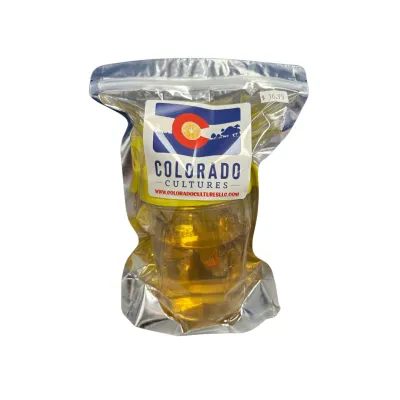

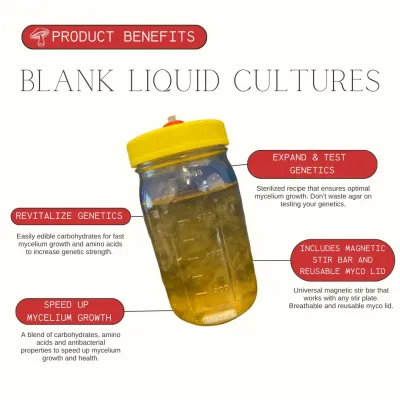

Tarro de cultivo líquido en blanco con varilla de agitación magnética
Vendido por Colorado Cultures
Cargando comentarios...
$17.00 - $23.00
Cargando variantes...
Envío estimado en EE.UU. $11.95
Devoluciones en 30 días
Pago seguro — Stripe y PayPal
El envío final se calcula al finalizar la compra.
Garantía de devolución de 30 días

Cultivo líquido listo para inocular en un frasco sellado
El cultivo líquido (CL) es la forma más rápida, limpia y repetible de propagar la genética de los hongos. Una sola gota de jeringa de esporas puede convertirse en millones de células miceliales viables en una solución estéril de agua azucarada — y a partir de ese CL, puedes inocular docenas de bolsas de grano, placas de agar o frascos de CL frescos para un cultivo continuo.
Pero preparar cultivo líquido desde cero es un proyecto de múltiples pasos. Necesitas:
- La fuente de azúcar adecuada (extracto de malta clara, dextrosa o miel)
- Un frasco de vidrio limpio con modificaciones adecuadas de puerto y filtro
- Una olla a presión
- 60-90 minutos de tiempo de esterilización
- Un ambiente de trabajo estéril para el manejo
Para cultivadores experimentados, este flujo de trabajo se vuelve rutinario. Para los cultivadores más nuevos, cada paso es un riesgo de contaminación y una pérdida de tiempo.
El Frasco de Cultivo Líquido en Blanco de Colorado Cultures con Varilla de Agitación Magnética elimina todo eso. Un frasco de CL listo para usar y preesterilizado llega a tu puerta — debidamente filtrado, debidamente portado, debidamente hidratado con el medio correcto de agua azucarada, y precargado con una varilla de agitación magnética para la agitación que hace que el CL funcione correctamente. Tu único trabajo es inocularlo.
Qué hay en el frasco
Cada frasco de CL en blanco contiene:
- Medio de cultivo líquido preesterilizado [VERIFICAR composición exacta con el proveedor — el medio típico de CL de micología es extracto de malta clara (EMC) + agua en una concentración del 1-2%]
- Una varilla de agitación magnética dentro del frasco — esencial para la propagación adecuada del CL
- Un puerto de inyección autoinmunizable en la tapa para la inoculación estéril
- Un filtro transpirable en la tapa para el intercambio de gases durante la incubación
- Tarro de vidrio tipo mason [VERIFICAR tamaño — típicamente pinta o cuarto para aplicaciones de LC]
- Hardware de la tapa — sellado en la fábrica después de la esterilización
Proporcionas:
- Tu inoculante (jeringa de esporas, cuña de agar o LC de otra fuente)
- Un limpiador de IPA al 70%
- Un agitador magnético (opcional pero recomendado — ver abajo)
Lo que realmente es "cultivo líquido"
Un cultivo líquido (LC) es un medio estéril de agua con azúcar donde se propaga el micelio de hongo en suspensión. En lugar de crecer en agar (una superficie sólida) o grano (un sustrato sólido), el micelio crece en un líquido que:
- Se mezcla uniformemente cuando se agita, distribuyendo nutrientes a cada célula
- Multiplica el recuento celular mucho más rápido que los medios sólidos (las células no están unidas a una superficie — pueden dividirse libremente en suspensión)
- Se mantiene estéril por más tiempo que las placas de agar (sin contaminación aérea a través de gradientes de humedad)
- Es fácil de transferir con una jeringa — extraer, inyectar en el spawn o sustrato
El resultado: un solo tarro de LC puede inocular 10-30+ bolsas de spawn de grano a lo largo de su vida útil, reduciendo drásticamente el costo por cultivo del trabajo genético.
Por qué importa la varilla de agitación magnética
Esta es la característica que eleva un tarro de LC de Colorado Cultures por encima de la mayoría de los competidores.La varilla de agitación magnética no es un truco: es la diferencia entre un LC que se propaga correctamente y un LC que se estanca.
Aquí está el porqué:
- Grumos de micelio al crecer en líquido quieto. Una sola gota de LC introducida en el medio crece en una masa enredada de micelio que solo la capa exterior accede a nutrientes frescos.
- La agitación rompe los grumos, redistribuyendo las células a través del medio para que cada célula tenga acceso a nutrientes.
- El agitado manual es la solución alternativa del cultivador: levanta el tarro a diario, agita con fuerza, y déjalo. Tedioso. Inconsistente. Fácil de olvidar.
- La agitación magnética utiliza una pequeña barra magnética dentro del tarro, impulsada por un agitador magnético externo (un pequeño motor eléctrico con un imán rotativo). La barra gira dentro del tarro, agitando el LC continuamente.
El resultado: LC que se propaga 2-3 veces más rápido que el LC no agitado. LC que se desarrolla hasta una densidad lista para la inoculación en 5-10 días en lugar de 14-21. LC con distribución de micelio uniforme y pareja en lugar de parches grumosos.
Para cultivadores serios que realizan trabajos genéticos continuos, el LC agitado magnéticamente es el estándar. La varilla de agitación incluida significa que ya estás equipado: solo necesitas un agitador magnético (un equipo de $30-$80 que dura indefinidamente).
Tamaños disponibles
[VERIFICAR las opciones de tamaño exactas con Colorado Cultures — basado en la descripción del producto "dos tamaños":]
- Tamaño de pinta (16 oz / ~470 mL) — mejor para el cultivo típico en casa, stock de LC de genética única
- Tamaño de cuarto (32 oz / ~950 mL) — para cultivadores de mayor volumen o suministro de LC a largo plazo
Ambos tamaños utilizan la misma varilla de agitación magnética y puerto de inoculación; la diferencia es el volumen de LC por frasco.
Por qué lo usarías
Clonando tu cultivar favorito
El uso original previsto: propagar una línea genética exitosa a partir de una muestra (tejido del sombrero, cuña de agar, gota de jeringa de esporas o LC existente). El frasco de LC toma un pequeño inoculante y lo desarrolla en un stock de LC utilizable para tu próxima ronda de cultivos.
Construyendo una biblioteca de genética
Con el tiempo, los cultivadores serios acumulan múltiples frascos de LC que contienen diferentes cultivares. Cada frasco es un "cultivo inicial" que puede:
- Inocular frascos de LC frescos cuando el original se agota
- Proporcionar material de semilla para bolsas de grano
- Proporcionar muestras para trabajo con agar y aislamiento
- Mantener una cepa durante meses/años de refrigeración
Construir esta biblioteca comienza con frascos de LC en blanco de alta calidad.
Trabajo de cultivo en interiores y exteriores
Los frascos funcionan para:
- Cultivo en jardín interior — capturando genética de tu propio trabajo de cultivo
- Cultivo de especímenes silvestres — capturando genética de especímenes recolectados en la naturaleza o silvestres
- Estudios de comparación de cepas — ejecutando múltiples cultivares en frascos paralelos
¿Quién compra estos?
- Cultivadores listos para graduarse de jeringas de esporas a trabajo con cultivos líquidos
- Probadores de genética y criadores construyendo sus propias bibliotecas de cultivos
- Cultivadores que hacen spawn de grano de alto volumen que necesitan una fuente de LC confiable
- Educadores y presentadores de demostraciones mostrando el flujo de trabajo de LC en un taller
- Cualquiera con un cultivo exitoso que quiera preservar y propagar esa genética específica
- Cultivadores de especímenes silvestres capturando genética recolectada en el campo para cultivo
- Investigadores realizando experimentos de cultivo controlado
Lo que esto NO es
- No pre-inoculado. Esto es un frasco de LC — medio estéril, listo para su inoculante. Usted proporciona el material genético.
- No es un sustituto de una técnica estéril adecuada. Incluso con un frasco preesterilizado, la inoculación debe realizarse en un ambiente limpio (caja de aire estático o campana de flujo) para mantener la esterilidad.
- No es autoclavable para reutilización. El hardware de la tapa/puerto no está clasificado para ciclos de olla a presión repetidos. Después de que se agote el LC, deseche el frasco (o reutilice el frasco de vidrio con nuevos puertos/filtros para usuarios avanzados).
- No es una cámara de fructificación. LC es para propagación, no para fructificación. Use el LC para inocular grano de cultivo o sustrato; la fructificación ocurre en la cámara resultante.
- No es para almacenamiento a largo plazo tal como está. Incluso refrigerado, un LC en crecimiento activo tiene una vida útil de 3-6 meses. Para preservación genética a largo plazo, transfiera a un slant de agar.
Para todos los demás, este frasco es el punto de entrada de grado profesional para el trabajo con cultivos líquidos. La preesterilización, la varilla de agitación incluida y el diseño adecuado de puerto/filtro eliminan las barreras más comunes que impiden a los cultivadores adoptar flujos de trabajo de LC.
Emparejando con agitadores magnéticos
La varilla de agitación requiere un agitador magnético (vendido por separado por Colorado Cultures o a través de proveedores de equipos de laboratorio) para girar. Los agitadores magnéticos de placa caliente estándar están ampliamente disponibles:
- Agitadores de grado de laboratorio: $30-$80 para modelos básicos, $100-$300 para premium con temporizador/calefacción
- Equivalentes de grado doméstico: $20-$50 para agitadores básicos sin calefacción
Un solo agitador magnético impulsa un frasco de LC a la vez — para configuraciones de múltiples frascos, necesitará múltiples agitadores o rotar frascos a través de un solo agitador.
La inversión en un agitador se recupera a lo largo de muchos ciclos de LC. La mayoría de los cultivadores utilizan el mismo agitador durante años.