Última actualización:
Albatrellus confluens
"common earthfan, confluent earthfan"
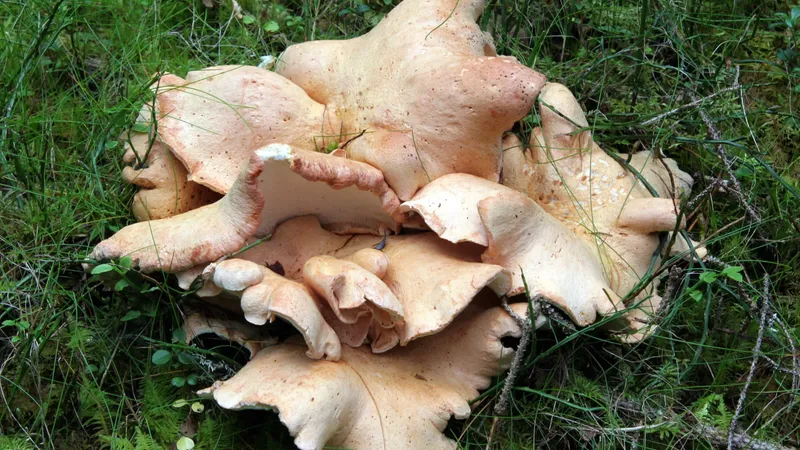
Albatrellus confluens fruiting bodies
Clasificación Científica
Reino:Fungi
División:Basidiomycota
Clase:Agaricomycetes
Orden:Russulales
Familia:Albatrellaceae
Género:Albatrellus
Preguntas Frecuentes
- ¿Qué es la especie common earthfan?
- La especie common earthfan (Albatrellus confluens) pertenece a la familia Albatrellaceae. Se estudia por sus características biológicas y está documentada en la base de datos micológica de ShroomSpy.
- ¿Es comestible la especie common earthfan?
- Comestibilidad incierta - se considera generalmente no comestible/no recomendado. Los informes sobre su uso alimentario son escasos y no verificados, y no existe un consenso fiable de que sea seguro comerlo. No consumir.
- ¿Qué efectos produce la especie common earthfan?
- La especie common earthfan se asocia con los siguientes efectos: Enfoque, Energía. Las experiencias individuales varían según la dosis, el estado de ánimo y el entorno.
- ¿Cuál es la clasificación científica de common earthfan?
- La especie common earthfan pertenece al reino Fungi, división Basidiomycota, clase Agaricomycetes, orden Russulales, familia Albatrellaceae, género Albatrellus. Su nombre científico es Albatrellus confluens.
Acerca de
Albatrellus confluens es un poliporo terrestre de la familia Albatrellaceae (orden Russulales), conocido comúnmente como abanico de tierra común. En lugar de láminas presenta una superficie de poros blanca a crema bajo un sombrero carnoso de color crema a pardo ocráceo. Los sombreros de cuerpos fructíferos vecinos suelen fusionarse, hábito que se refleja en el epíteto confluens. Fructifica en el suelo de bosques de coníferas del hemisferio norte, donde se asocia a las coníferas como simbionte ectomicorrízico. Su comestibilidad está mal documentada y se considera generalmente no comestible, pero ha atraído la atención científica como fuente de metabolitos secundarios bioactivos.
Historia
La especie fue descrita por Albertini y Schweinitz y posteriormente transferida al género Albatrellus por Kotlaba y Pouzar, dando el nombre aceptado Albatrellus confluens (Alb. & Schwein.) Kotl. & Pouzar. El nombre del género deriva del latín albus ("blanco"), en referencia a la superficie de poros y la carne pálidas típicas de estos poliporos, mientras que confluens alude a la forma en que los sombreros contiguos crecen unidos. El interés por la especie aumentó notablemente a principios de los años 2000, cuando investigadores de China y Japón aislaron y caracterizaron sus compuestos bioactivos.
Visión general
A diferencia de los hongos repisa que descomponen la madera, A. confluens es un poliporo micorrízico que crece en el suelo de los bosques de coníferas y no se cultiva comercialmente. Su principal interés es químico: el meroterpenoide fenólico grifolina aislado de sus cuerpos fructíferos ha demostrado en estudios de laboratorio inhibir el crecimiento de varias líneas celulares de cáncer humano e inducir apoptosis (Ye et al., 2005; 2007), en parte mediante la supresión de la vía de señalización ERK1/2. Otro compuesto relacionado, el albaconol, también se ha estudiado por su actividad biológica. Estos hallazgos se refieren a compuestos aislados en entornos de laboratorio y no constituyen prueba de valor culinario ni de ningún uso médico comprobado; no se recomienda comer este hongo.
Características Físicas
Sombreros:
The cap is fan-shaped to irregular, measuring 5-15 cm across, with a smooth to slightly velvety texture. It is typically brown to reddish-brown, often with a lighter edge.
Láminas:
None - the underside features a pore surface instead of gills, with small pores that are white to cream-colored.
Efectos Cognitivos
Enfoque
Albatrellus confluens contiene grifolina, un compuesto fenólico estudiado por su capacidad para inhibir la señalización de NF-κB, una vía vinculada a la inflamación cognitiva que puede afectar la concentración.
EnergíA
Las fracciones de polisacáridos en los cuerpos fructíferos de A. confluens pueden apoyar la función mitocondrial, contribuyendo a reducir la fatiga física en estudios preliminares en animales.
Farmacología
Ayuda Con
Sistema inmunológico
El compuesto grifolina en A. confluens puede modular las respuestas inmunitarias innatas al downregular las citoquinas proinflamatorias en líneas celulares de macrófagos.
Cáncer
La grifolina aislada de A. confluens ha mostrado actividad citotóxica in vitro contra varias líneas celulares de cáncer humano, incluyendo carcinoma de colon y de pulmón, aunque la validación in vivo es limitada.
Inflamación
Los terpenoides escutigeral y confluentin en A. confluens pueden inhibir la 5-lipoxigenasa, una enzima central en la cascada inflamatoria del ácido araquidónico.
Posibles Efectos Secundarios
Náuseas
Algunas personas reportan leve malestar gastrointestinal después de consumir A. confluens, posiblemente debido a su contenido de sesquiterpenos cuando se come crudo o poco cocido.
Constituyentes Químicos
Química Medicinal
Información Nutricional
Tamaño de Porción100
Cantidad por Porción
Calorías280
% Valor Diario*
Grasa Total 3.2 g4%
Grasa Saturada 0.4 g2%
Grasa Trans 0 g
Colesterol 0 mg0%
Sodio 18 mg1%
Carbohidratos Totales 52 g19%
Fibra Dietética 22 g79%
Azúcares Totales 0 g
Proteína 18 g36%
Vitamina A 0 µg 0%•Tiamina B1 0 mg 0%
Riboflavina B2 0 mg 0%•Niacina B3 0 mg 0%
Vitamina B6 0 mg 0%•Folato B9 0 µg 0%
Vitamina B12 0 mg 0%•Vitamina C 0 mg 0%
Vitamina D 12 µg 60%•Vitamina E 0 mg 0%
Vitamina K 0 µg 0%•Calcio 0 mg 0%
Cobre 4.2 mg 467%•Hierro 0 mg 0%
Magnesio 0 mg 0%•Manganeso 0 mg 0%
Fósforo 380 mg 30%•Potasio 2100 mg 45%
Selenio 18 µg 33%•Zinc 4.1 mg 37%
Vit A 0 µg 0%•B1 0 mg 0%
B2 0 mg 0%•B3 0 mg 0%
B6 0 mg 0%•B9 0 µg 0%
B12 0 mg 0%•Vit C 0 mg 0%
Vit D 12 µg 60%•Vit E 0 mg 0%
Vit K 0 µg 0%•Calcio 0 mg 0%
Cobre 4.2 mg 467%•Hierro 0 mg 0%
Mg 0 mg 0%•Mn 0 mg 0%
Fósf. 380 mg 30%•Pot. 2100 mg 45%
Selenio 18 µg 33%•Zinc 4.1 mg 37%
* Los porcentajes de valores diarios están basados en una dieta de 2,000 calorías.
Calificaciones de Hongos
0.0
Basado en 0 Reseñas
5
★4
★3
★2
★1
★Comparte tus pensamientos
Si has consumido este hongo, comparte tus pensamientos con nuestra comunidad