Última actualización:
Amanita caesarea
"Caesar's mushroom, Amanita caesarea"
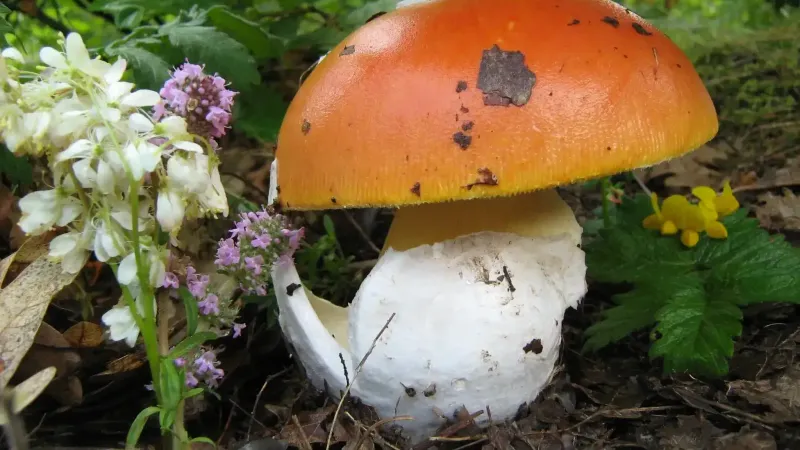
Amanita caesarea fruiting bodies
Clasificación Científica
Reino:Fungi
División:Basidiomycota
Clase:Agaricomycetes
Orden:Agaricales
Familia:Amanitaceae
Género:Amanita
Preguntas Frecuentes
- ¿Qué es la especie Caesar's mushroom?
- La especie Caesar's mushroom (Amanita caesarea) pertenece a la familia Amanitaceae. Se estudia por sus características biológicas y está documentada en la base de datos micológica de ShroomSpy.
- ¿Es comestible la especie Caesar's mushroom?
- Comestible y muy apreciado como hongo culinario selecto, pero PELIGROSO de recolectar: Amanita caesarea pertenece a un género que también incluye la mortal Amanita phalloides (oronja verde o cicuta verde) y la Amanita virosa (ángel destructor), y con frecuencia se confunde con la muy venenosa Amanita muscaria (matamoscas) una vez que la lluvia elimina las verrugas blancas del sombrero. Consuma solo ejemplares identificados por un experto y cocínelos bien. Los cuerpos fructíferos también pueden acumular cadmio y plomo del suelo.
- ¿Qué efectos produce la especie Caesar's mushroom?
- La especie Caesar's mushroom se asocia con los siguientes efectos: Energía. Las experiencias individuales varían según la dosis, el estado de ánimo y el entorno.
- ¿Cuál es la clasificación científica de Caesar's mushroom?
- La especie Caesar's mushroom pertenece al reino Fungi, división Basidiomycota, clase Agaricomycetes, orden Agaricales, familia Amanitaceae, género Amanita. Su nombre científico es Amanita caesarea.
Acerca de
Amanita caesarea, conocida comúnmente como oronja o hongo de César, es un hongo comestible apreciado como uno de los más selectos de Europa. Se reconoce por su sombrero de color rojo brillante a naranja con el margen estriado, sus láminas libres de color amarillo cromo, un pie amarillo con un anillo en forma de falda y una volva blanca, gruesa y en forma de saco en la base ensanchada. Crece como simbionte ectomicorrízico en suelos arenosos y ligeramente ácidos bajo robles y otras frondosas, así como pinos, en el Mediterráneo, la Europa templada, el norte de África y partes de Norteamérica. A pesar de su reputación culinaria, debe identificarse con sumo cuidado, ya que el género Amanita también contiene algunos de los hongos más mortales del mundo.
Historia
Amanita caesarea se aprecia desde la antigüedad y se asociaba a los emperadores romanos, siendo mencionada por autores clásicos como Plinio el Viejo. Su epíteto deriva del latín caesareus, "perteneciente a César", reflejando su prestigio en la mesa romana. El hongo también figura en un episodio sombrío de la historia: se dice que el emperador Claudio fue envenenado con un plato de sus apreciadas oronjas adulterado con el jugo de la mortal Amanita phalloides. La especie fue descrita por Giovanni Antonio Scopoli en 1772 y posteriormente renombrada por Persoon, de ahí la autoría (Scop.) Pers.
Descripción general
Desde el punto de vista ecológico, Amanita caesarea es un hongo ectomicorrízico que intercambia nutrientes del suelo por azúcares del árbol, contribuyendo a la salud del bosque. Se recolecta en la naturaleza más que cultivarse de forma fiable y se vende fresca en mercados desde Italia hasta México. Su identificación depende del margen estriado del sombrero, las láminas y el pie amarillos, el anillo prominente en forma de falda y la gran volva blanca. El sosias más peligroso es Amanita muscaria (matamoscas), cuyo sombrero rojo suele tener verrugas blancas que pueden desaparecer con la lluvia intensa, dejándolo engañosamente similar; la confusión es una causa documentada de intoxicaciones graves. Por ser congénere de la mortal oronja verde y del ángel destructor, y porque sus cuerpos fructíferos pueden acumular metales pesados como cadmio y plomo, solo debe consumirse cuando la identifica un experto y siempre bien cocinada.
Características Físicas
Sombreros:
The cap is convex to flat, measuring 5-15 cm in diameter, with a bright orange to yellow color and a smooth texture.
Láminas:
The gills are free, closely spaced, and yellow to orange in color.
Efectos Cognitivos
EnergíA
A. caesarea es densa en nutrientes con alto contenido de proteínas, vitaminas del grupo B y ergotioneína que apoyan la energía física y la salud celular.
Farmacología
Ayuda Con
Estrés oxidativo
A. caesarea contiene una cantidad significativa de ergotioneína y selenio, ambos potentes antioxidantes que pueden proteger contra el daño oxidativo en los tejidos.
Posibles Efectos Secundarios
Náuseas
El consumo crudo puede causar molestias gastrointestinales leves; se requiere una cocción completa como con la mayoría de las especies de Amanita debido a los irritantes sensibles al calor.
Información Nutricional
Tamaño de Porción100
Cantidad por Porción
Calorías285
% Valor Diario*
Grasa Total 3.5 g4%
Grasa Saturada 0.5 g3%
Grasa Trans 0 g
Colesterol 0 mg0%
Sodio 16 mg1%
Carbohidratos Totales 48 g17%
Fibra Dietética 17 g61%
Azúcares Totales 0 g
Proteína 24 g48%
Vitamina A 0 µg 0%•Tiamina B1 0 mg 0%
Riboflavina B2 3 mg 231%•Niacina B3 16 mg 100%
Vitamina B6 0 mg 0%•Folato B9 0 µg 0%
Vitamina B12 0 mg 0%•Vitamina C 0 mg 0%
Vitamina D 14 µg 70%•Vitamina E 0 mg 0%
Vitamina K 0 µg 0%•Calcio 0 mg 0%
Cobre 1.5 mg 167%•Hierro 0 mg 0%
Magnesio 0 mg 0%•Manganeso 0 mg 0%
Fósforo 390 mg 31%•Potasio 2200 mg 47%
Selenio 30 µg 55%•Zinc 5.8 mg 53%
Vit A 0 µg 0%•B1 0 mg 0%
B2 3 mg 231%•B3 16 mg 100%
B6 0 mg 0%•B9 0 µg 0%
B12 0 mg 0%•Vit C 0 mg 0%
Vit D 14 µg 70%•Vit E 0 mg 0%
Vit K 0 µg 0%•Calcio 0 mg 0%
Cobre 1.5 mg 167%•Hierro 0 mg 0%
Mg 0 mg 0%•Mn 0 mg 0%
Fósf. 390 mg 31%•Pot. 2200 mg 47%
Selenio 30 µg 55%•Zinc 5.8 mg 53%
* Los porcentajes de valores diarios están basados en una dieta de 2,000 calorías.
Calificaciones de Hongos
0.0
Basado en 0 Reseñas
5
★4
★3
★2
★1
★Comparte tus pensamientos
Si has consumido este hongo, comparte tus pensamientos con nuestra comunidad