Última actualización:
Clavariadelphus pistillaris
"tapered club, giant club"
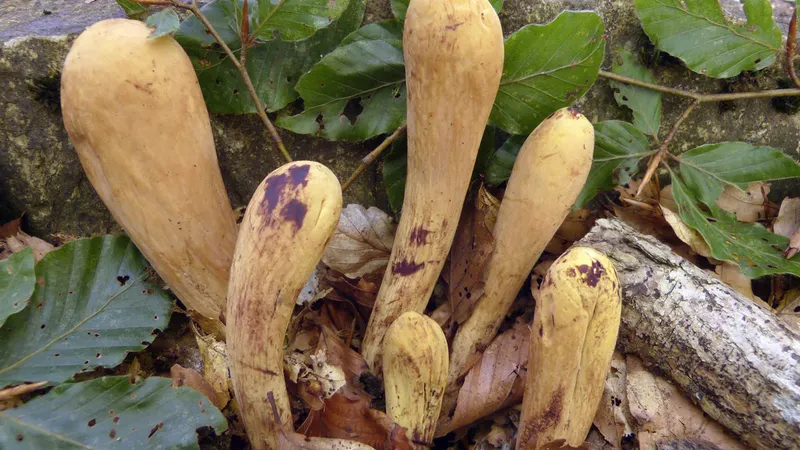
Clavariadelphus pistillaris fruiting bodies
Clasificación Científica
Reino:Fungi
División:Basidiomycota
Clase:Agaricomycetes
Orden:Cantharellales
Familia:Clavariaceae
Género:Clavariadelphus
Preguntas Frecuentes
- ¿Qué es la especie tapered club?
- La especie tapered club (Clavariadelphus pistillaris) pertenece a la familia Clavariaceae. Se estudia por sus características biológicas y está documentada en la base de datos micológica de ShroomSpy.
- ¿Es comestible la especie tapered club?
- Comestible pero generalmente considerado de poca calidad por su marcado amargor. La carne es blanda y contiene compuestos amargos; es necesario remojarla o hervirla repetidamente para hacerla aceptable, y la mayoría de los recolectores la consideran inferior. C. pistillaris también es poco común y figura como especie rara o amenazada en parte de su área de distribución, por lo que se desaconseja su recolección. Como con cualquier hongo silvestre, es imprescindible una identificación segura antes de consumirlo.
- ¿Cuál es la clasificación científica de tapered club?
- La especie tapered club pertenece al reino Fungi, división Basidiomycota, clase Agaricomycetes, orden Cantharellales, familia Clavariaceae, género Clavariadelphus. Su nombre científico es Clavariadelphus pistillaris.
Acerca de
Clavariadelphus pistillaris es el mayor de los hongos clavados simples y sin ramificar, con un cuerpo fructífero en forma de maza o mortero que puede alcanzar unos 20 cm de altura y 5 cm de anchura en su ápice redondeado. La superficie arrugada es de color ocre pálido a rosado o rosa, y suele oscurecerse a pardo o púrpura al manipularla. Aparece sobre el suelo en bosques caducifolios, sobre todo bajo hayas, entre la hojarasca y restos leñosos. Aunque es comestible, su carne blanda es claramente amarga y se considera un hongo culinario pobre.
Historia
La especie fue descrita por micólogos antiguos y situada por Donk en el género Clavariadelphus, cuyo nombre combina el latín clava ("maza") con una referencia a sus parientes los hongos clavados. Elias Fries, a principios del siglo XIX, agrupó los hongos clavados simples y coraloides según la forma del cuerpo fructífero; estudios microscópicos posteriores los separaron en géneros distintos. C. pistillaris nunca ha sido una especie alimentaria ni medicinal importante, y hoy se destaca más por su estado de conservación, al figurar entre los hongos raros o amenazados de varias regiones.
Descripción general
Clavariadelphus pistillaris se distingue por su única maza grande y arrugada y por su coloración ocre a rosa que se oscurece al rozarla. El ápice aplanado de los ejemplares maduros carece de tejido productor de esporas, rasgo que sugiere un posible vínculo evolutivo con los rebozuelos. Se confunde con facilidad con la especie afín Clavariadelphus truncatus, de ápice más truncado y plano y sabor más dulce, y con hongos coraloides ramificados como Ramaria y Clavulina, que difieren en su forma. Por ser poco común y estar protegido en parte de su área, conviene apreciarlo en el campo en lugar de recolectarlo.
Sabores
Bitter
The flesh has a pronounced bitterness that limits its culinary value; soaking or prolonged boiling reduces it somewhat.
Texturas
Soft
Soft, spongy flesh that often becomes hollow and tougher with age.
Fragancias
Earthy
Faint, unremarkable woodland odor.
Características Físicas
Sombreros:
The cap is elongated and club-shaped, typically measuring 5-15 cm in height and 1-3 cm in diameter. It is usually pale yellow to cream in color, with a smooth texture.
Láminas:
None
Información Nutricional
Tamaño de Porción100
Cantidad por Porción
Calorías320
% Valor Diario*
Grasa Total 0.6 g1%
Grasa Saturada 0 g0%
Grasa Trans 0 g
Colesterol 0 mg0%
Sodio 14 mg1%
Carbohidratos Totales 62.4 g23%
Fibra Dietética 20 g71%
Azúcares Totales 0 g
Proteína 16.3 g33%
Vitamina A 0 µg 0%•Tiamina B1 0 mg 0%
Riboflavina B2 0 mg 0%•Niacina B3 0 mg 0%
Vitamina B6 0 mg 0%•Folato B9 0 µg 0%
Vitamina B12 0 mg 0%•Vitamina C 0 mg 0%
Vitamina D 0 µg 0%•Vitamina E 0 mg 0%
Vitamina K 0 µg 0%•Calcio 0 mg 0%
Cobre 0 mg 0%•Hierro 0 mg 0%
Magnesio 0 mg 0%•Manganeso 0 mg 0%
Fósforo 340 mg 27%•Potasio 1900 mg 40%
Selenio 0 µg 0%•Zinc 0 mg 0%
Vit A 0 µg 0%•B1 0 mg 0%
B2 0 mg 0%•B3 0 mg 0%
B6 0 mg 0%•B9 0 µg 0%
B12 0 mg 0%•Vit C 0 mg 0%
Vit D 0 µg 0%•Vit E 0 mg 0%
Vit K 0 µg 0%•Calcio 0 mg 0%
Cobre 0 mg 0%•Hierro 0 mg 0%
Mg 0 mg 0%•Mn 0 mg 0%
Fósf. 340 mg 27%•Pot. 1900 mg 40%
Selenio 0 µg 0%•Zinc 0 mg 0%
* Los porcentajes de valores diarios están basados en una dieta de 2,000 calorías.
Calificaciones de Hongos
0.0
Basado en 0 Reseñas
5
★4
★3
★2
★1
★Comparte tus pensamientos
Si has consumido este hongo, comparte tus pensamientos con nuestra comunidad