Última actualización:
Craterellus cinereus
"Gray Chanterelle, Black Chanterelle"
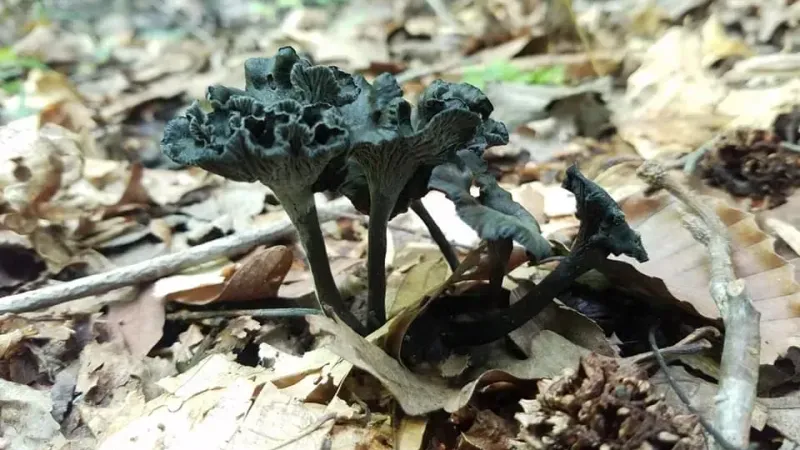
Craterellus cinereus fruiting bodies
Clasificación Científica
Reino:Fungi
División:Basidiomycota
Clase:Agaricomycetes
Orden:Cantharellales
Familia:Cantharellaceae
Género:Craterellus
Preguntas Frecuentes
- ¿Qué es la especie Gray Chanterelle?
- La especie Gray Chanterelle (Craterellus cinereus) pertenece a la familia Cantharellaceae. Se estudia por sus características biológicas y está documentada en la base de datos micológica de ShroomSpy.
- ¿Es comestible la especie Gray Chanterelle?
- comestible: considerado un hongo de calidad, pero debe cocinarse antes de consumirlo para realzar su sabor y mejorar su digestibilidad.
- ¿Qué efectos produce la especie Gray Chanterelle?
- La especie Gray Chanterelle se asocia con los siguientes efectos: Energía. Las experiencias individuales varían según la dosis, el estado de ánimo y el entorno.
- ¿Cuál es la clasificación científica de Gray Chanterelle?
- La especie Gray Chanterelle pertenece al reino Fungi, división Basidiomycota, clase Agaricomycetes, orden Cantharellales, familia Cantharellaceae, género Craterellus. Su nombre científico es Craterellus cinereus.
Acerca de
Craterellus cinereus, conocido comunmente como chanterelle gris o chanterelle negra, es un hongo distintivo caracterizado por su sombrero en forma de embudo, de color gris a gris parduzco, y por las crestas a modo de falsas laminas que descienden por el pie en lugar de verdaderas laminas. Crece sobre el suelo en bosques caducifolios y de coniferas, y esta estrechamente emparentado con la trompeta negra (Craterellus cornucopioides). Se valora como hongo comestible, con un sabor terroso y rico que aporta profundidad a salsas y otros platos.
Historia
Craterellus cinereus pertenece al orden Cantharellales, junto con el rebozuelo verdadero (Cantharellus cibarius) y la trompeta negra, un grupo recolectado y apreciado desde antiguo en las cocinas de Europa y Norteamerica. La especie tambien se ha tratado bajo el nombre Cantharellus cinereus, lo que refleja su estrecha relacion con ambos generos. El nombre del genero Craterellus deriva del latin para una pequena copa o cuenco de mezcla, en alusion a la forma de embudo del cuerpo fructifero, mientras que cinereus es el latin para color ceniza, que describe su coloracion gris tipica.
Al igual que su pariente la trompeta negra, este hongo oscuro en forma de embudo se confunde con la hojarasca del suelo del bosque y pasa facilmente desapercibido. A medida que ha crecido el interes por la recoleccion de hongos silvestres, el grupo de las especies oscuras de Craterellus ha ganado aprecio tanto por su valor culinario como por su papel ecologico en el bosque.
Vision general
Craterellus cinereus es un hongo silvestre de bosque, recolectado en la naturaleza mas que cultivado comercialmente. Su coloracion oscura, la ausencia de verdaderas laminas (sustituidas por crestas bifurcadas y poco profundas) y su sombrero en forma de embudo lo distinguen de especies similares como el falso rebozuelo (Hygrophoropsis aurantiaca), que es mas anaranjado y posee verdaderas laminas.
Dentro del orden Cantharellales, C. cinereus y sus parientes destacan en la literatura cientifica por su alto contenido de compuestos fenolicos antioxidantes y por su actividad citotoxica en laboratorio frente a celulas cancerigenas cultivadas. Las guias de campo no senalan ninguna especie venenosa parecida entre las especies oscuras de Craterellus, todas consideradas comestibles, aunque los hongos silvestres siempre deben cocinarse e identificarse con seguridad antes de consumirse.
Características Físicas
Sombreros:
The cap is funnel-shaped, measuring 3-10 cm in diameter, with a wavy margin. It is gray to brownish-gray in color and has a smooth, slightly sticky texture when moist.
Láminas:
The species lacks true gills; instead, it has shallow, forked ridges that run down the stem, which are pale to grayish in color.
Efectos Cognitivos
EnergíA
C. cinereus proporciona un paquete nutritivo de vitaminas B y minerales que apoyan el metabolismo energético celular cuando se utiliza como ingrediente culinario.
Información Nutricional
Tamaño de Porción100
Cantidad por Porción
Calorías260
% Valor Diario*
Grasa Total 2.5 g3%
Grasa Saturada 0 g0%
Grasa Trans 0 g
Colesterol 0 mg0%
Sodio 12 mg1%
Carbohidratos Totales 48 g17%
Fibra Dietética 22 g79%
Azúcares Totales 0 g
Proteína 17 g34%
Vitamina A 0 µg 0%•Tiamina B1 0 mg 0%
Riboflavina B2 0 mg 0%•Niacina B3 0 mg 0%
Vitamina B6 0 mg 0%•Folato B9 0 µg 0%
Vitamina B12 0 mg 0%•Vitamina C 0 mg 0%
Vitamina D 8 µg 40%•Vitamina E 0 mg 0%
Vitamina K 0 µg 0%•Calcio 0 mg 0%
Cobre 0 mg 0%•Hierro 0 mg 0%
Magnesio 0 mg 0%•Manganeso 0 mg 0%
Fósforo 290 mg 23%•Potasio 1700 mg 36%
Selenio 14 µg 25%•Zinc 3.5 mg 32%
Vit A 0 µg 0%•B1 0 mg 0%
B2 0 mg 0%•B3 0 mg 0%
B6 0 mg 0%•B9 0 µg 0%
B12 0 mg 0%•Vit C 0 mg 0%
Vit D 8 µg 40%•Vit E 0 mg 0%
Vit K 0 µg 0%•Calcio 0 mg 0%
Cobre 0 mg 0%•Hierro 0 mg 0%
Mg 0 mg 0%•Mn 0 mg 0%
Fósf. 290 mg 23%•Pot. 1700 mg 36%
Selenio 14 µg 25%•Zinc 3.5 mg 32%
* Los porcentajes de valores diarios están basados en una dieta de 2,000 calorías.
Calificaciones de Hongos
0.0
Basado en 0 Reseñas
5
★4
★3
★2
★1
★Comparte tus pensamientos
Si has consumido este hongo, comparte tus pensamientos con nuestra comunidad