Última actualización:
Exidia glandulosa
"Witch's Butter, Black Witch's Butter"
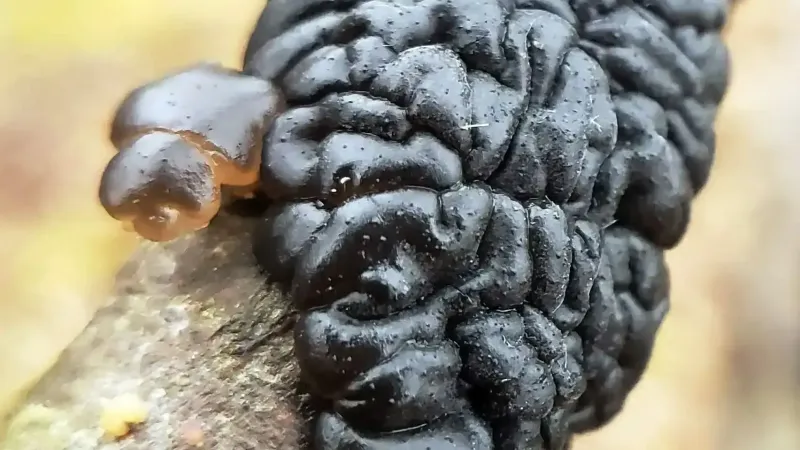
Exidia glandulosa fruiting bodies
Clasificación Científica
Reino:Fungi
División:Basidiomycota
Clase:Agaricomycetes
Orden:Auriculariales
Familia:Auriculariaceae
Género:Exidia
Preguntas Frecuentes
- ¿Qué es la especie Witch's Butter?
- La especie Witch's Butter (Exidia glandulosa) pertenece a la familia Auriculariaceae. Se estudia por sus características biológicas y está documentada en la base de datos micológica de ShroomSpy.
- ¿Es comestible la especie Witch's Butter?
- no comestible - Exidia glandulosa no se considera tóxica, pero se la tiene por no comestible debido a su textura gelatinosa dura y gomosa y a su falta de sabor.
- ¿Cuál es la clasificación científica de Witch's Butter?
- La especie Witch's Butter pertenece al reino Fungi, división Basidiomycota, clase Agaricomycetes, orden Auriculariales, familia Auriculariaceae, género Exidia. Su nombre científico es Exidia glandulosa.
Acerca de
Exidia glandulosa is a gelatinous, dark brown to black fungus commonly known as the "warty jelly fungus." It is characterized by its irregular, lobed fruiting bodies that can reach up to 10 cm in diameter, often appearing warty or bumpy on the surface. This species typically grows on decaying wood, particularly hardwoods, and can be found in temperate forests across North America and Europe. While not widely recognized for culinary use, it plays a significant ecological role in wood decomposition and nutrient cycling, contributing to forest health.
History
Historically, Exidia glandulosa has been used in traditional folk medicine, particularly in Europe, where it was believed to have various health benefits, although scientific validation of these claims is limited. The species was first described scientifically in 1789 by the mycologist Christiaan Hendrik Persoon, and its name derives from the Latin word "glandulosus," meaning "glandular," which refers to its warty appearance. Over time, the understanding of this species has evolved from a mere curiosity in the fungal kingdom to recognition of its ecological importance in forest ecosystems.
In recent years, interest in Exidia glandulosa has grown among mycologists and ecologists, particularly regarding its role in wood decay and nutrient recycling. While it remains less explored in terms of medicinal properties compared to other fungi, its unique morphology and ecological functions have sparked curiosity and research.
Overview
Exidia glandulosa plays a crucial ecological role as a saprotrophic fungus, breaking down lignin and cellulose in decaying wood, which helps recycle nutrients back into the ecosystem. It is primarily found in the wild, growing on dead or decaying hardwood, and is not cultivated commercially. Key distinguishing features include its gelatinous texture, dark coloration, and warty surface, which set it apart from similar jelly fungi like Tremella mesenterica, which is typically brighter and more translucent.
From a commercial perspective, Exidia glandulosa is not widely harvested for culinary purposes, but its ecological contributions are invaluable in maintaining forest health. Its unique appearance and growth habits make it an interesting subject for study within the field of mycology, particularly in understanding fungal biodiversity and decomposition processes.
Características Físicas
Sombreros:
The fruiting body is gelatinous, irregularly shaped, and can range from 1 to 10 cm in size. It is typically dark brown to black in color and has a smooth, shiny surface.
Láminas:
None
Calificaciones de Hongos
0.0
Basado en 0 Reseñas
5
★4
★3
★2
★1
★Comparte tus pensamientos
Si has consumido este hongo, comparte tus pensamientos con nuestra comunidad