Última actualización:
Hypsizygus ulmarius
"Elm Oyster Mushroom, White Elm Mushroom"
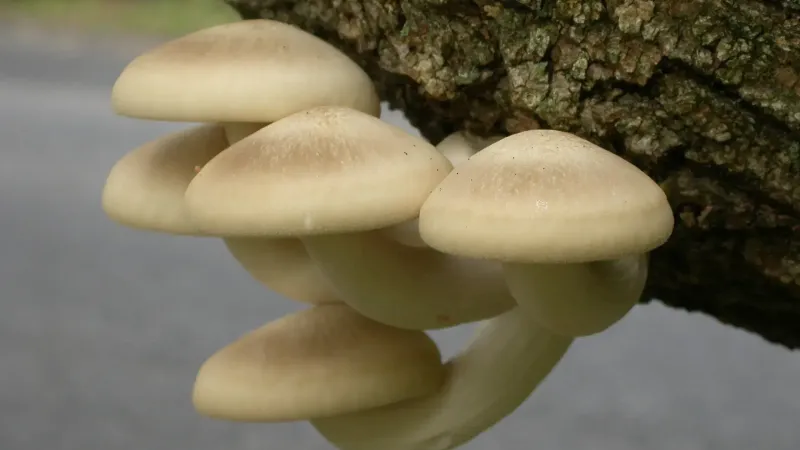
Hypsizygus ulmarius fruiting bodies
Clasificación Científica
Reino:Fungi
División:Basidiomycota
Clase:Agaricomycetes
Orden:Agaricales
Familia:Lyophyllaceae
Género:Hypsizygus
Preguntas Frecuentes
- ¿Qué es la especie Elm Oyster Mushroom?
- La especie Elm Oyster Mushroom (Hypsizygus ulmarius) pertenece a la familia Lyophyllaceae. Se estudia por sus características biológicas y está documentada en la base de datos micológica de ShroomSpy.
- ¿Es comestible la especie Elm Oyster Mushroom?
- Comestible - un hongo comestible de calidad, considerado por muchos expertos superior a los hongos ostra comunes en sabor y textura firme. No está emparentado con las verdaderas ostras (Pleurotus) a pesar de su parecido superficial.
- ¿Qué efectos produce la especie Elm Oyster Mushroom?
- La especie Elm Oyster Mushroom se asocia con los siguientes efectos: Enfoque, Energía. Las experiencias individuales varían según la dosis, el estado de ánimo y el entorno.
- ¿Cuál es la clasificación científica de Elm Oyster Mushroom?
- La especie Elm Oyster Mushroom pertenece al reino Fungi, división Basidiomycota, clase Agaricomycetes, orden Agaricales, familia Lyophyllaceae, género Hypsizygus. Su nombre científico es Hypsizygus ulmarius.
Acerca de
Hypsizygus ulmarius, comúnmente llamado hongo ostra de olmo u hongo blanco de olmo, es un hongo saprófito de pudrición parda que fructifica en maderas duras vivas y muertas, en particular olmos, álamos, hayas, arces y sauces. Aunque su sombrero ancho se parece superficialmente a un verdadero hongo ostra, no está estrechamente emparentado con Pleurotus; características microscópicas únicas y su tipo de pudrición parda lo sitúan en el género Hypsizygus. Se valora como comestible de calidad y se cultiva comercialmente, sobre todo en Japón.
Historia
La taxonomía de esta especie tiene una historia larga y confusa. Fue descrita originalmente en Europa dentro de la tradición Bulliard: Fries y en diversos momentos se trató como Pleurotus ulmarius (Bull.: Fr.) Kummer y Lyophyllum ulmarium (Bull.: Fr.) Kühner, antes de que Redhead la transfiriera a Hypsizygus ulmarius en 1984. El nombre del género proviene del griego hypsi ("en lo alto") y zygos ("yugo"), mientras que el epíteto ulmarius deriva del latín ulmus, "olmo", en alusión a su frecuente asociación con los olmos. En Japón se conoce como shirotamogitake ("hongo blanco de olmo") y tamo-motashi.
Descripción general
Ecológicamente, H. ulmarius es un descomponedor de pudrición parda de maderas duras, en contraste con la pudrición blanca que produce Pleurotus ostreatus, una diferencia clave entre ambos. El sombrero es de hemisférico a plano (a veces umbilicado), uniformemente de color tostado, beige, pardo grisáceo a gris, de 4-15 cm de ancho, con el margen enrollado a incurvado cuando es joven; las láminas son decurrentes y juntas, y el pie es grueso, de inserción excéntrica y curvado en la base. Cultivado en Japón desde 1973 sobre serrín o troncos de madera dura, se aprecia por su textura firme y su sabor suave y agradable. El interés medicinal reportado (propiedades antitumorales o inmunomoduladoras) se basa en gran medida en informes anecdóticos y no publicados y en datos de parientes cercanos, por lo que tales afirmaciones deben considerarse preliminares.
Características Físicas
Sombreros:
The cap is convex to flat, measuring 5-15 cm in diameter, with a smooth, pale to light brown surface that may become slightly sticky when moist.
Láminas:
Gills are decurrent, closely spaced, and white to cream in color, becoming slightly darker with age.
Efectos Cognitivos
Enfoque
Hypsizygus ulmarius contiene ergotioneína, un poderoso aminoácido antioxidante que se acumula selectivamente en el tejido neural y puede proteger la función cognitiva con el tiempo.
EnergíA
El alto contenido de vitaminas B, incluyendo riboflavina y niacina en H. ulmarius, apoya el metabolismo energético mitocondrial y puede reducir la fatiga.
Farmacología
Ayuda Con
Sistema inmunológico
Las fracciones de polisacáridos de H. ulmarius pueden mejorar la citotoxicidad de las células asesinas naturales y la fagocitosis de macrófagos en ensayos de inmunostimulación murina.
Colesterol
El consumo de champiñones de ostra de olmo puede contribuir a la reducción del colesterol a través del contenido de lovastatina y beta-glucano, similar a otros Pleurotaceae.
Estrés oxidativo
La ergotioneína en H. ulmarius se acumula en los eritrocitos y mitocondrias, proporcionando protección específica contra el estrés oxidativo en tejidos metabólicamente activos.
Microbioma intestinal
Las fracciones de fibra dietética en H. ulmarius, incluyendo quitina y beta-glucanos, pueden actuar como prebióticos que apoyan poblaciones bacterianas beneficiosas en el intestino.
Posibles Efectos Secundarios
Alergias
Asma ocupacional raro por exposición a esporas durante el cultivo; la alergia alimentaria es poco común.
Constituyentes Químicos
Química Medicinal
Información Nutricional
Tamaño de Porción100
Cantidad por Porción
Calorías295
% Valor Diario*
Grasa Total 3 g4%
Grasa Saturada 0.4 g2%
Grasa Trans 0 g
Colesterol 0 mg0%
Sodio 22 mg1%
Carbohidratos Totales 50 g18%
Fibra Dietética 16 g57%
Azúcares Totales 0 g
Proteína 24 g48%
Vitamina A 0 µg 0%•Tiamina B1 0 mg 0%
Riboflavina B2 3.2 mg 246%•Niacina B3 14.5 mg 91%
Vitamina B6 0 mg 0%•Folato B9 0 µg 0%
Vitamina B12 0 mg 0%•Vitamina C 0 mg 0%
Vitamina D 6 µg 30%•Vitamina E 0 mg 0%
Vitamina K 0 µg 0%•Calcio 0 mg 0%
Cobre 1.2 mg 133%•Hierro 0 mg 0%
Magnesio 0 mg 0%•Manganeso 0 mg 0%
Fósforo 370 mg 30%•Potasio 2000 mg 43%
Selenio 26 µg 47%•Zinc 5.2 mg 47%
Vit A 0 µg 0%•B1 0 mg 0%
B2 3.2 mg 246%•B3 14.5 mg 91%
B6 0 mg 0%•B9 0 µg 0%
B12 0 mg 0%•Vit C 0 mg 0%
Vit D 6 µg 30%•Vit E 0 mg 0%
Vit K 0 µg 0%•Calcio 0 mg 0%
Cobre 1.2 mg 133%•Hierro 0 mg 0%
Mg 0 mg 0%•Mn 0 mg 0%
Fósf. 370 mg 30%•Pot. 2000 mg 43%
Selenio 26 µg 47%•Zinc 5.2 mg 47%
* Los porcentajes de valores diarios están basados en una dieta de 2,000 calorías.
Calificaciones de Hongos
0.0
Basado en 0 Reseñas
5
★4
★3
★2
★1
★Comparte tus pensamientos
Si has consumido este hongo, comparte tus pensamientos con nuestra comunidad