Última actualización:
Lignosus sacer
"Tiger Milk Mushroom, Tiger's Milk Fungus"
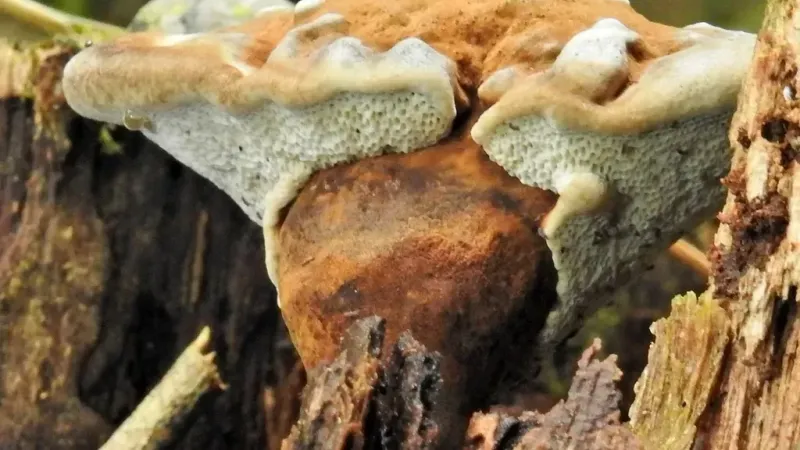
Lignosus sacer fruiting bodies
Clasificación Científica
Reino:Fungi
División:Basidiomycota
Clase:Agaricomycetes
Orden:Polyporales
Familia:Polyporaceae
Género:Lignosus
Preguntas Frecuentes
- ¿Qué es la especie Tiger Milk Mushroom?
- La especie Tiger Milk Mushroom (Lignosus sacer) pertenece a la familia Polyporaceae. Se estudia por sus características biológicas y está documentada en la base de datos micológica de ShroomSpy.
- ¿Es comestible la especie Tiger Milk Mushroom?
- No comestible. Lignosus sacer es un hongo polyporo duro y leñoso, valorado únicamente por el uso medicinal tradicional de su esclerocio subterráneo, nunca como alimento. Se ha informado que el material silvestre contiene niveles bajos (traza) de metales tóxicos, lo que puede ser motivo de preocupación según la cantidad consumida.
- ¿Qué efectos produce la especie Tiger Milk Mushroom?
- La especie Tiger Milk Mushroom se asocia con los siguientes efectos: Memoria, Energía, Enfoque. Las experiencias individuales varían según la dosis, el estado de ánimo y el entorno.
- ¿Cuál es la clasificación científica de Tiger Milk Mushroom?
- La especie Tiger Milk Mushroom pertenece al reino Fungi, división Basidiomycota, clase Agaricomycetes, orden Polyporales, familia Polyporaceae, género Lignosus. Su nombre científico es Lignosus sacer.
Acerca de
Lignosus sacer es un polyporo leñoso de la familia Polyporaceae y miembro del género Lignosus, el grupo conocido colectivamente como hongos leche de tigre. A diferencia de una seta carnosa típica, su valor medicinal reside en un esclerocio subterráneo endurecido y no en el cuerpo fructífero. L. sacer es el representante africano del género, presente en los bosques tropicales de África, y se distingue de sus parientes principalmente por caracteres microscópicos como el tamaño de los poros y de las esporas.
Historia
Los hongos leche de tigre deben su nombre a Lac tigridis ('leche de tigre'), un término registrado en escritos europeos del siglo XVII que describían una preciada 'concreción' pesada traída de Asia que los médicos de la época no lograban identificar. El miembro más famoso y mejor estudiado del género es el sudasiático Lignosus rhinocerus, usado durante mucho tiempo por comunidades indígenas como tónico y remedio. L. sacer comparte esta herencia etnomicológica dentro del género, pero es la especie africana, nombrada del latín lignosus ('leñoso') y sacer ('sagrado'); permanece mucho menos estudiada que su pariente asiático.
Descripción general
Las especies de Lignosus se consideran entre los hongos medicinales más valorados donde se encuentran, y el género se usa tradicionalmente como tónico general y para reforzar el sistema inmunitario y tratar diversas dolencias como cáncer, asma, sinusitis, bronquitis, náuseas y reacciones alérgicas. El esclerocio es la fuente de ese valor medicinal. L. sacer no es un hongo culinario y es demasiado duro y leñoso para comerse. Como la mayor parte de la investigación se ha centrado en L. rhinocerus, los datos específicos de L. sacer son limitados, y los ejemplares silvestres pueden contener niveles traza de metales tóxicos.
Características Físicas
Sombreros:
The cap is irregularly shaped, typically 5-15 cm in diameter, with a rough, woody texture and a color ranging from light brown to dark brown.
Láminas:
None
Efectos Cognitivos
Memoria
Los compuestos de Lignosus rhinocerus (hongo Tiger Milk) que incluyen polisacáridos promueven la expresión de NGF en células PC12; L. sacer comparte este perfil de género que apoya la salud neural relevante para la memoria.
EnergíA
El hongo Tiger Milk se utiliza tradicionalmente como un tónico para aumentar la resistencia y reducir la fatiga en comunidades malayas e indígenas del sudeste asiático.
Enfoque
Los estudios preliminares sobre los polisacáridos de Lignosus rhinocerus / sacer sugieren una mejora en el rendimiento de pruebas cognitivas en modelos animales a través de la estimulación de la vía de neurotrofinas.
Farmacología
Ayuda Con
Sistema inmunológico
Los polisacáridos de Lignosus activan la señalización de TLR2 y dectin-1 en macrófagos, estimulando respuestas inmunitarias innatas; demostrado en múltiples estudios de grupos de investigación de Malasia y China.
Respiración Pulmonar
L. rhinocerus (hongo Tiger Milk) es la planta medicinal tradicional más importante en el sudeste asiático para enfermedades respiratorias, incluyendo tos crónica, asma y bronquitis.
Cáncer
Los extractos de agua caliente de Lignosus spp. mostraron actividad citotóxica contra las líneas celulares de cáncer de mama MCF-7 y de cáncer de hígado HepG2 en estudios in vitro de la Universidad de Malaya.
Sistema inmunológico
Múltiples fracciones de beta-glucano inmunoestimulantes de extractos de Lignosus activan células NK y linfocitos T en modelos murinos tanto in vitro como in vivo.
Inflamación
Los polisacáridos de Lignosus reducen la producción de TNF-α, IL-1β e IL-6 en macrófagos activados por LPS, apoyando aplicaciones potenciales antiinflamatorias.
Constituyentes Químicos
Química Medicinal
Calificaciones de Hongos
0.0
Basado en 0 Reseñas
5
★4
★3
★2
★1
★Comparte tus pensamientos
Si has consumido este hongo, comparte tus pensamientos con nuestra comunidad