Última actualización:
Phellinus ribis
"Black Knot Fungus, Phellinus Knot"
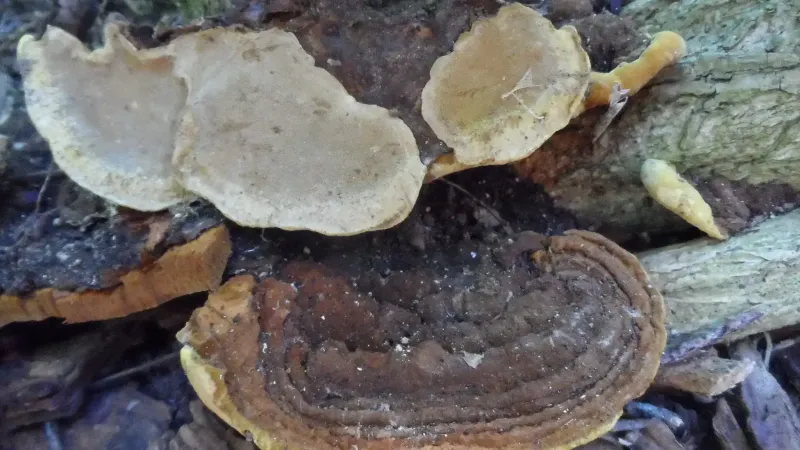
Phellinus ribis fruiting bodies
Clasificación Científica
Reino:Fungi
División:Basidiomycota
Clase:Agaricomycetes
Orden:Hymenochaetales
Familia:Hymenochaetaceae
Género:Phellinus
Preguntas Frecuentes
- ¿Qué es la especie Black Knot Fungus?
- La especie Black Knot Fungus (Phellinus ribis) pertenece a la familia Hymenochaetaceae. Se estudia por sus características biológicas y está documentada en la base de datos micológica de ShroomSpy.
- ¿Es comestible la especie Black Knot Fungus?
- No comestible. Phellinus ribis es un hongo de repisa duro y leñoso sin uso culinario. Al igual que otros conks de Phellinus, solo se estudia como decocción o extracto medicinal, nunca se consume como alimento.
- ¿Qué efectos produce la especie Black Knot Fungus?
- La especie Black Knot Fungus se asocia con los siguientes efectos: Energía. Las experiencias individuales varían según la dosis, el estado de ánimo y el entorno.
- ¿Cuál es la clasificación científica de Black Knot Fungus?
- La especie Black Knot Fungus pertenece al reino Fungi, división Basidiomycota, clase Agaricomycetes, orden Hymenochaetales, familia Hymenochaetaceae, género Phellinus. Su nombre científico es Phellinus ribis.
Acerca de
Phellinus ribis es un hongo de repisa leñoso y perenne (conk) de la familia Hymenochaetaceae. En lugar de una seta carnosa, forma cuerpos fructíferos duros, en forma de cojín o de repisa, sobre la madera del grosellero (Ribes) y arbustos y árboles pequeños relacionados, donde actúa como hongo descomponedor de la madera. No es comestible, pero, como varios miembros del género Phellinus, ha despertado interés como hongo medicinal preparado en decocción o extracto.
Historia
Phellinus ribis recibe su nombre de especie de Ribes, el género del grosellero sobre el que se encuentra de forma característica. Pertenece a un género de poliporos coriáceos en forma de repisa con una larga tradición de uso en la medicina tradicional, donde el conk seco se hierve en decocción. El trabajo de laboratorio documentado sobre P. ribis se remonta a mediados del siglo XX: Robbins y colaboradores (1945) informaron de actividad antibacteriana contra Staphylococcus aureus en P. ribis junto con varias especies relacionadas de Phellinus.
Visión general
Como otros conks de Phellinus, P. ribis es un hongo descomponedor de la madera que contribuye a la degradación del tejido leñoso muerto y vivo. Se recolecta en la naturaleza en lugar de cultivarse. El interés investigador se centra en los polisacáridos y los compuestos estirilpirona del género, que en distintas especies de Phellinus se han asociado con actividad antioxidante, antiinflamatoria, antibacteriana y antitumoral en estudios de laboratorio. Gran parte de esta evidencia es a nivel de género o procede de especies estrechamente relacionadas, por lo que las afirmaciones específicas de P. ribis deben tratarse con cautela.
Características Físicas
Sombreros:
The cap is irregularly shaped, often lobed or wavy, measuring 5-20 cm in diameter. It is dark brown to black in color with a hard, woody texture.
Láminas:
None
Efectos Cognitivos
EnergíA
Los polisacáridos de Phellinus ribis pueden apoyar el metabolismo energético celular al mejorar la actividad enzimática mitocondrial en modelos preclínicos.
Farmacología
Ayuda Con
Sistema inmunológico
Los polisacáridos de Phellinus ribis, similares a los de especies relacionadas de Phellinus, pueden activar macrófagos y células NK, apoyando la defensa inmune innata.
Cáncer
Los extractos de polisacáridos crudos de P. ribis han mostrado actividad antiproliferativa in vitro contra líneas celulares de carcinoma hepatocelular.
Inflamación
Los compuestos de estiripirona tipo hispidina presentes en Phellinus spp. pueden reducir la producción de TNF-α e IL-6 en macrófagos estimulados por lipopolisacáridos.
Constituyentes Químicos
Química Medicinal
Calificaciones de Hongos
0.0
Basado en 0 Reseñas
5
★4
★3
★2
★1
★Comparte tus pensamientos
Si has consumido este hongo, comparte tus pensamientos con nuestra comunidad