Última actualización:
Polyporus squamosus
"Dryad's saddle, Pheasant's back"
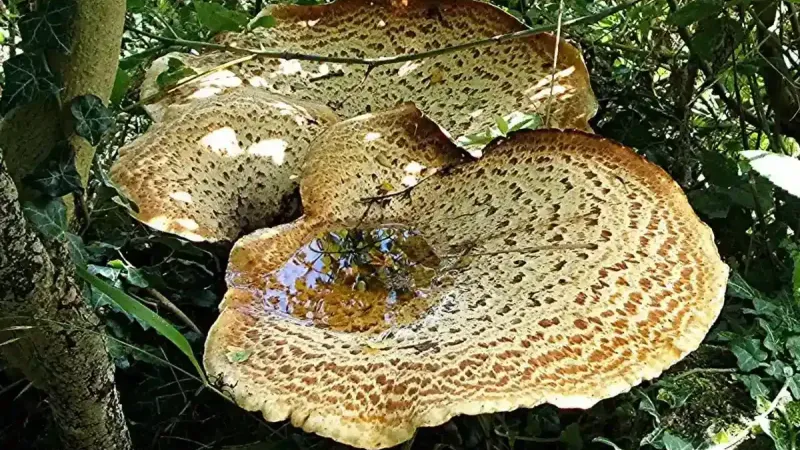
Polyporus squamosus fruiting bodies
Clasificación Científica
Reino:Fungi
División:Basidiomycota
Clase:Agaricomycetes
Orden:Polyporales
Familia:Polyporaceae
Género:Polyporus
Preguntas Frecuentes
- ¿Qué es la especie Dryad's saddle?
- La especie Dryad's saddle (Polyporus squamosus) pertenece a la familia Polyporaceae. Se estudia por sus características biológicas y está documentada en la base de datos micológica de ShroomSpy.
- ¿Es comestible la especie Dryad's saddle?
- Comestible cuando es joven y tierno, con una fragancia caracteristica a sandia. Solo se comen los margenes externos blandos de los ejemplares jovenes; la carne se endurece y se vuelve incomible con la edad, por lo que los hongos viejos no merecen ser recolectados. No es un comestible por si solo, pero funciona en lonchas finas y salteado en sopas, frittatas y otros platos.
- ¿Cuál es la clasificación científica de Dryad's saddle?
- La especie Dryad's saddle pertenece al reino Fungi, división Basidiomycota, clase Agaricomycetes, orden Polyporales, familia Polyporaceae, género Polyporus. Su nombre científico es Polyporus squamosus.
Acerca de
Polyporus squamosus, conocido comunmente como sella de driade o espalda de faisan, es un hongo poliporo de repisa caracterizado por sus cuerpos fructiferos en forma de abanico y semicirculares, con una superficie de color ocre amarillento a pajizo marcada por zonas concentricas de escamas pardas y aplanadas. La parte inferior presenta poros blanquecinos grandes y angulares en lugar de laminas, y un ejemplar fresco al romperse libera una inconfundible fragancia a sandia. Crece sobre tocones y troncos de arboles de madera dura como el platano y el olmo, actuando como saprobio y parasito, y se distribuye ampliamente por Europa, Asia y el este de Norteamerica. El hongo es comestible cuando es joven y tierno y desempena un importante papel ecologico como descomponedor de la madera.
Historia
Polyporus squamosus fue nombrado por primera vez de forma valida por William Hudson y posteriormente sancionado por Elias Magnus Fries, lo que da la cita de autoridad (Huds.) Fr. El epiteto especifico deriva del latin squama, que significa "escama", en referencia a las llamativas escamas pardas distribuidas sobre el sombrero. Apreciado durante mucho tiempo por los recolectores como sustituto primaveral cuando escasean las colmenillas, tambien ha figurado en la Medicina Tradicional China como remedio calido para aliviar tendones y ligamentos doloridos. Su abundancia y facil identificacion lo han convertido en un elemento habitual de las comunidades de recoleccion del hemisferio norte templado.
Descripcion general
Desde el punto de vista ecologico, Polyporus squamosus es un importante descomponedor de pudricion blanca que degrada la lignina y la celulosa de la madera dura muerta y viva, contribuyendo al ciclo de nutrientes del bosque. Fructifica principalmente en primavera y verano, pero puede aparecer durante todo el ano, formando a menudo grupos escalonados sobre el mismo huesped en temporadas sucesivas. El analisis fitoquimico ha identificado la trehalosa como su principal azucar libre y el acido p-hidroxibenzoico como su principal compuesto fenolico, junto con niveles notables de beta-tocoferol y acidos grasos poliinsaturados; los extractos muestran actividad antioxidante, antifungica y antibacteriana. Su sombrero escamoso y su gran superficie poroza blanca lo distinguen facilmente de los poliporos mas duros con forma de pezuna.
Sabores
Mild
Young P. squamosus has a mild, mushroomy flavor that works best incorporated into cooked dishes; older specimens turn bitter and leathery.
Texturas
Firm
Young specimens have firm, tender flesh near the margins; the bracket toughens rapidly and becomes inedible as it ages and expands.
Fragancias
Floral
A torn fresh specimen releases a distinctive watermelon-like (cucumber-melon) fragrance that aids identification.
Características Físicas
Sombreros:
The cap is fan-shaped to saddle-shaped, measuring 5-30 cm across, with a wavy margin. It is typically brown to yellow-brown with a scaly texture.
Láminas:
None; the underside features a series of small pores instead of gills, which are white to cream-colored.
Farmacología
Ayuda Con
Supresión Bacteriana
Extracts of Polyporus squamosus show antibacterial activity against E. coli, Staphylococcus aureus, Bacillus subtilis, and Salmonella typhimurium in laboratory studies.
Inflamación
As a low-calorie, high-fiber food relatively rich in polyunsaturated fatty acids, P. squamosus has been studied as a potentially valuable food for combating inflammation and heart disease.
Posibles Efectos Secundarios
Náuseas
Older P. squamosus brackets become tough, fibrous, and indigestible; only young, tender outer margins should be eaten to avoid gastrointestinal upset.
Constituyentes Químicos
Química Medicinal
Información Nutricional
Tamaño de Porción100
Cantidad por Porción
Calorías280
% Valor Diario*
Grasa Total 2.5 g3%
Grasa Saturada 0 g0%
Grasa Trans 0 g
Colesterol 0 mg0%
Sodio 18 mg1%
Carbohidratos Totales 50 g18%
Fibra Dietética 19 g68%
Azúcares Totales 0 g
Proteína 20 g40%
Vitamina A 0 µg 0%•Tiamina B1 0 mg 0%
Riboflavina B2 0 mg 0%•Niacina B3 11 mg 69%
Vitamina B6 0 mg 0%•Folato B9 0 µg 0%
Vitamina B12 0 mg 0%•Vitamina C 0 mg 0%
Vitamina D 0 µg 0%•Vitamina E 0 mg 0%
Vitamina K 0 µg 0%•Calcio 0 mg 0%
Cobre 0 mg 0%•Hierro 0 mg 0%
Magnesio 0 mg 0%•Manganeso 0 mg 0%
Fósforo 310 mg 25%•Potasio 1800 mg 38%
Selenio 16 µg 29%•Zinc 0 mg 0%
Vit A 0 µg 0%•B1 0 mg 0%
B2 0 mg 0%•B3 11 mg 69%
B6 0 mg 0%•B9 0 µg 0%
B12 0 mg 0%•Vit C 0 mg 0%
Vit D 0 µg 0%•Vit E 0 mg 0%
Vit K 0 µg 0%•Calcio 0 mg 0%
Cobre 0 mg 0%•Hierro 0 mg 0%
Mg 0 mg 0%•Mn 0 mg 0%
Fósf. 310 mg 25%•Pot. 1800 mg 38%
Selenio 16 µg 29%•Zinc 0 mg 0%
* Los porcentajes de valores diarios están basados en una dieta de 2,000 calorías.
Calificaciones de Hongos
0.0
Basado en 0 Reseñas
5
★4
★3
★2
★1
★Comparte tus pensamientos
Si has consumido este hongo, comparte tus pensamientos con nuestra comunidad