Última actualización:
Scleroderma citrinum
"Common Earthball, Pigskin Poison Puffball, Yellow Earthball"
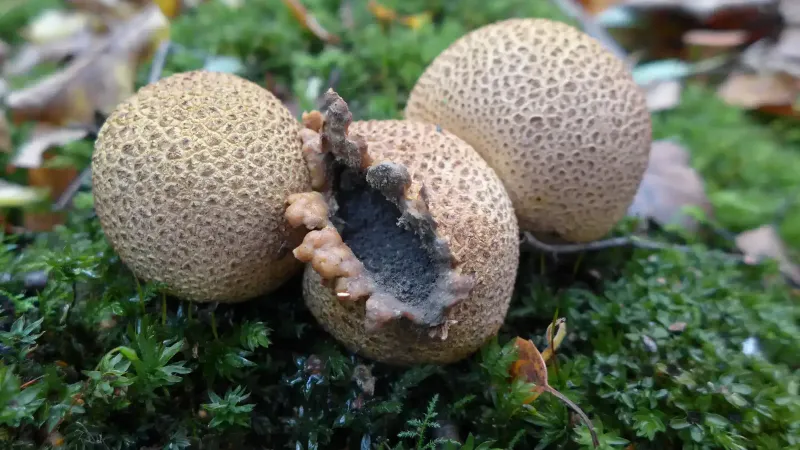
Scleroderma citrinum fruiting bodies
Clasificación Científica
Reino:Fungi
División:Basidiomycota
Clase:Agaricomycetes
Orden:Agaricales
Familia:Sclerodermataceae
Género:Scleroderma
Preguntas Frecuentes
- ¿Qué es la especie Common Earthball?
- La especie Common Earthball (Scleroderma citrinum) pertenece a la familia Sclerodermataceae. Se estudia por sus características biológicas y está documentada en la base de datos micológica de ShroomSpy.
- ¿Es comestible la especie Common Earthball?
- Venenoso - NO lo coma. Scleroderma citrinum (el bejin venenoso de piel de cerdo) es toxico y no es comestible. Su ingestion provoca intoxicacion gastrointestinal: nauseas, vomitos, calambres abdominales y diarrea que suelen aparecer en aproximadamente 1-4 horas. Las reacciones pueden ser graves: existe un caso documentado de un cerdo vietnamita que murio varias horas despues de comer un solo ejemplar, y algunas especies de Scleroderma han causado dano hepatico y la muerte en perros. El cuerpo fructifero, de piel gruesa y dura, se confunde facilmente con un bejin comestible, pero su interior se vuelve negro purpureo al madurar (los bejines comestibles permanecen totalmente blancos por dentro) y en su fase joven tambien puede parecerse al mortal angel destructor (Amanita virosa). Corte siempre por la mitad cualquier presunto bejin antes de considerarlo comestible; si no es uniformemente blanco por dentro, desechelo.
- ¿Cuál es la clasificación científica de Common Earthball?
- La especie Common Earthball pertenece al reino Fungi, división Basidiomycota, clase Agaricomycetes, orden Agaricales, familia Sclerodermataceae, género Scleroderma. Su nombre científico es Scleroderma citrinum.
Acerca de
Scleroderma citrinum, conocido como bola de tierra comun o bejin venenoso de piel de cerdo, es un hongo venenoso parecido a un bejin, reconocible por su corteza dura, escamosa y de color amarillo parduzco, y por su carne firme que se vuelve negro purpurea al madurar las esporas. El cuerpo fructifero esferico, normalmente de 2,5-7,5 cm de diametro, descansa directamente sobre el suelo sin pie y es ectomicorricico, formando asociaciones con las raices de robles, hayas, abedules y coniferas. Es comun en bosques y brezales de la zona templada del hemisferio norte. A pesar de su parecido superficial con los bejines comestibles, S. citrinum es toxico y no debe comerse.
Historia
La bola de tierra comun fue descrita por el micologo Christian Hendrik Persoon en 1801, en su obra Synopsis Methodica Fungorum. El nombre del genero Scleroderma proviene del griego skleros ("duro") y derma ("piel"), por su corteza resistente, mientras que el epiteto citrinum significa "amarillo limon". Durante gran parte del siglo XX se catalogo bajo el sinonimo S. aurantium. Nunca ha sido un alimento ni un remedio habitual debido a su toxicidad, aunque a veces se ha utilizado en Europa central -de forma indebida- para adulterar productos de trufa, practica desaconsejada por su naturaleza venenosa.
Vision general
Ecologicamente, Scleroderma citrinum es un importante simbionte micorricico que intercambia nutrientes del suelo con sus arboles hospedadores, y a su vez suele ser parasitado por el boleto Pseudoboletus (Boletus) parasiticus, que fructifica sobre su superficie. No se cultiva y carece de valor culinario. El dato practico mas importante de esta especie es su toxicidad: se confunde con frecuencia con los bejines comestibles y, en su forma joven, puede confundirse con especies mortales de Amanita. Sus rasgos distintivos son la corteza gruesa y verrugosa, la carne firme que madura a un negro purpureo veteado y la ausencia de un pie verdadero. Cortar por la mitad cualquier bejin para comprobar que su interior es uniformemente blanco es la salvaguarda mas fiable contra la intoxicacion.
Características Físicas
Sombreros:
The cap is roughly spherical to pear-shaped, measuring 5-10 cm in diameter, with a smooth, yellowish to brownish surface that may become darker with age.
Láminas:
None
Calificaciones de Hongos
0.0
Basado en 0 Reseñas
5
★4
★3
★2
★1
★Comparte tus pensamientos
Si has consumido este hongo, comparte tus pensamientos con nuestra comunidad