Última actualización:
Termitomyces robustus
"Termite Mushroom, Robust Termitomyces"
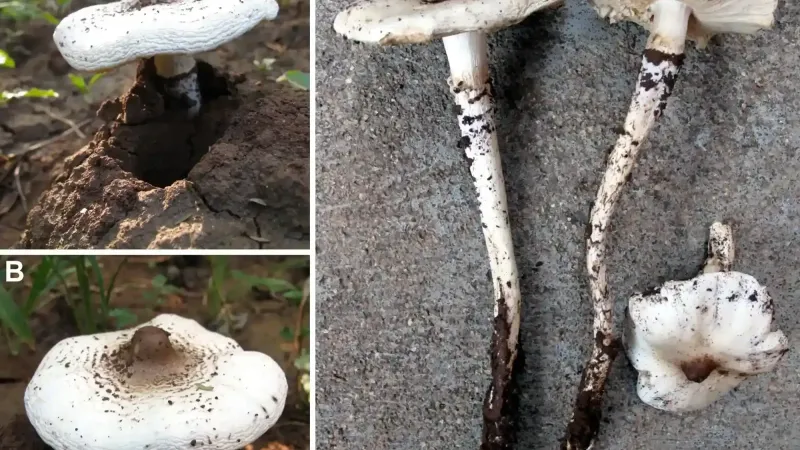
Termitomyces robustus fruiting bodies
Clasificación Científica
Reino:Fungi
División:Basidiomycota
Clase:Agaricomycetes
Orden:Agaricales
Familia:Termitomycetaceae
Género:Termitomyces
Preguntas Frecuentes
- ¿Qué es la especie Termite Mushroom?
- La especie Termite Mushroom (Termitomyces robustus) pertenece a la familia Termitomycetaceae. Se estudia por sus características biológicas y está documentada en la base de datos micológica de ShroomSpy.
- ¿Es comestible la especie Termite Mushroom?
- edible - considered a delicacy in some cultures, but should be properly identified before consumption.
- ¿Qué efectos produce la especie Termite Mushroom?
- La especie Termite Mushroom se asocia con los siguientes efectos: Energía. Las experiencias individuales varían según la dosis, el estado de ánimo y el entorno.
- ¿Cuál es la clasificación científica de Termite Mushroom?
- La especie Termite Mushroom pertenece al reino Fungi, división Basidiomycota, clase Agaricomycetes, orden Agaricales, familia Termitomycetaceae, género Termitomyces. Su nombre científico es Termitomyces robustus.
Acerca de
Termitomyces robustus is a fascinating species of fungus that forms a symbiotic relationship with termites, particularly those of the genus Macrotermes. Characterized by its large, umbrella-shaped fruiting bodies that can reach up to 30 cm in diameter, this mushroom features a smooth, pale to dark brown cap and a white to pale yellow stem. It typically grows in tropical and subtropical regions, primarily in Africa and parts of Asia, emerging from termite mounds where it plays a crucial ecological role in nutrient cycling. Not only is T. robustus significant for its ecological contributions, but it is also highly regarded as an edible mushroom, prized for its flavor and nutritional value in local cuisines.
History
Historically, Termitomyces robustus has been utilized in various traditional dishes across Africa, where it is often collected from the wild during the rainy season. Its unique flavor and texture have made it a sought-after ingredient in local culinary practices. The scientific discovery of this species dates back to the early 20th century, with formal classification and naming occurring in 1952 by the mycologist R. H. Petersen. The genus name, Termitomyces, derives from the Latin terms for "termite" (termes) and "fungus" (myces), highlighting its close association with these insects.
Over time, human understanding of T. robustus has evolved, particularly regarding its ecological importance and cultivation potential. Research has increasingly focused on its symbiotic relationship with termites, revealing how this fungus aids in the digestion of plant material, thereby enhancing nutrient availability in the ecosystem.
Overview
Termitomyces robustus plays a vital ecological role as a decomposer, breaking down organic matter and contributing to soil fertility through its association with termite colonies. While it is primarily harvested from the wild, there is growing interest in cultivating this species due to its culinary value and the ecological benefits it provides. Key distinguishing features include its large size, the distinctive shape of its cap, and its growth habit, which is closely tied to termite mounds, setting it apart from other edible mushrooms.
Commercially, T. robustus is gaining recognition in gourmet food markets, particularly in regions where it is traditionally consumed. Its unique flavor profile and the challenges associated with its wild harvesting underscore the importance of sustainable practices in its collection and potential cultivation, making it an intriguing species for both mycologists and culinary enthusiasts alike.
Características Físicas
Sombreros:
The cap is convex to broadly bell-shaped, measuring 5 to 15 cm in diameter, with a smooth, pale to dark brown surface that may become slightly sticky when moist.
Láminas:
Gills are free, closely spaced, and white to cream in color, turning yellowish with age.
Efectos Cognitivos
EnergíA
T. robustus se encuentra entre los hongos comestibles más ricos en proteínas por peso seco, proporcionando aminoácidos esenciales que apoyan la energía física y la recuperación muscular.
Farmacología
Ayuda Con
Sistema inmunológico
Las fracciones de polisacáridos de Termitomyces spp. muestran estructuras de beta-glucano que pueden activar las vías inmunitarias de macrófagos y complemento.
Digestión
T. robustus es un alimento básico en el África subsahariana y el África Occidental; su contenido de fibra apoya la motilidad intestinal y la salud digestiva.
Información Nutricional
Tamaño de Porción100
Cantidad por Porción
Calorías310
% Valor Diario*
Grasa Total 4 g5%
Grasa Saturada 0.6 g3%
Grasa Trans 0 g
Colesterol 0 mg0%
Sodio 20 mg1%
Carbohidratos Totales 46 g17%
Fibra Dietética 18 g64%
Azúcares Totales 0 g
Proteína 28 g56%
Vitamina A 0 µg 0%•Tiamina B1 0 mg 0%
Riboflavina B2 0 mg 0%•Niacina B3 14 mg 88%
Vitamina B6 0 mg 0%•Folato B9 0 µg 0%
Vitamina B12 0 mg 0%•Vitamina C 0 mg 0%
Vitamina D 5 µg 25%•Vitamina E 0 mg 0%
Vitamina K 0 µg 0%•Calcio 0 mg 0%
Cobre 1.4 mg 156%•Hierro 4.5 mg 25%
Magnesio 0 mg 0%•Manganeso 0 mg 0%
Fósforo 420 mg 34%•Potasio 2000 mg 43%
Selenio 22 µg 40%•Zinc 6 mg 55%
Vit A 0 µg 0%•B1 0 mg 0%
B2 0 mg 0%•B3 14 mg 88%
B6 0 mg 0%•B9 0 µg 0%
B12 0 mg 0%•Vit C 0 mg 0%
Vit D 5 µg 25%•Vit E 0 mg 0%
Vit K 0 µg 0%•Calcio 0 mg 0%
Cobre 1.4 mg 156%•Hierro 4.5 mg 25%
Mg 0 mg 0%•Mn 0 mg 0%
Fósf. 420 mg 34%•Pot. 2000 mg 43%
Selenio 22 µg 40%•Zinc 6 mg 55%
* Los porcentajes de valores diarios están basados en una dieta de 2,000 calorías.
Calificaciones de Hongos
0.0
Basado en 0 Reseñas
5
★4
★3
★2
★1
★Comparte tus pensamientos
Si has consumido este hongo, comparte tus pensamientos con nuestra comunidad