Scientists Found a New Antifungal Drug Class in a Campus Greenhouse Fungus
By Louis on 06/30/2026
McMaster University researchers discovered coniotins, a new antifungal drug class isolated from a plant-dwelling fungus that kills Candida auris without harming human cells.
Check out our Products!
Scientists Found a New Antifungal Drug Class in a Campus Greenhouse Fungus
The same lab that brought you butyrolactol A has done it again.
Professor Gerry Wright's research group at McMaster University, do qual falamos anteriormente nos Fungi Files for their discovery of a molecule that can revive defunct antifungal drugs, has now identified an entirely new class of antifungal compounds. The molecules, called coniotins, were isolated from a fungus growing in the McMaster campus greenhouse, published in Nature Communications in August 2025, and they work through a mechanism that no existing antifungal drug uses.
That last point is what makes this genuinely significant rather than just incrementally useful.
Why the Drug Pipeline Is So Empty
Before getting into what coniotins are and how they work, it helps to understand the problem they are trying to solve.
Wright puts it plainly: unlike antibiotics, where dozens of approved drug classes exist for clinical use, there are only three classes of antifungal drugs available to doctors treating serious infections. Three classes to cover a kingdom of organisms that is increasingly developing resistance to all of them.
The reason the pipeline has stayed this thin comes down to biology. Fungal cells and human cells are far more similar to each other than bacterial cells and human cells are. That similarity means a compound capable of killing a fungus is likely to cause collateral damage to the patient taking it. Finding a molecule that is lethal to the fungus and tolerable to the human is genuinely difficult chemistry, which is why the last seventy-five years have produced so few new antifungal drug classes.
There is also a historical market failure at work. Most fungi cannot survive at normal human body temperature, which means fungal infections have traditionally been surface-level problems: athlete's foot, nail infections, oral thrush. These conditions are unpleasant rather than life-threatening, and pharmaceutical companies had little financial incentive to invest heavily in drugs for them when the infections cleared up on their own or with mild topical treatment.
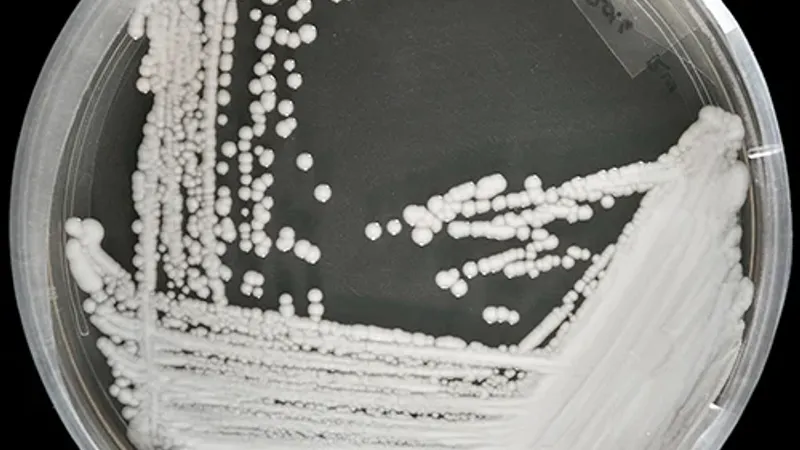
That calculation changed in 2009 when Candida auris appeared. Unlike most fungal pathogens, Candida auris thrives at body temperature, spreads readily in hospital settings, can invade the bloodstream, lungs, and nervous system, and arrived already resistant to many existing antifungal drugs. It now tops the WHO's priority fungal pathogen list, and it has forced the antifungal development pipeline to be taken seriously in a way it previously wasn't.
Where Coniotins Came From
The source of coniotins is Coniochaeta hoffmannii, a plant-dwelling fungus collected from the McMaster greenhouse on campus. That location is worth pausing on. This is not a remote deep-sea organism or an exotic jungle specimen. It is a fungus found in a university greenhouse, sitting largely unexamined until the Wright Lab's screening process flagged it.
Postdoctoral fellow Xufei Chen, who also played a central role in the butyrolactol A research, isolated the molecules using a technique called prefractionation. Standard drug discovery screening tends to rediscover known compounds repeatedly, because abundant molecules in a complex chemical mixture tend to overwhelm the signal from rarer, less dominant ones. Prefractionation separates the mixture into component fractions first, allowing rarer molecules to be identified individually rather than being masked by more common ones.
Chen combined this approach with mass spectrometry, metabolomics, and computational analysis to identify a previously overlooked molecule in the Coniochaeta hoffmannii sample. The result was coniotins: a new structural class with no close relatives among existing antifungal drugs.
Wright's reflection on this is worth sitting with. His lab has so far screened approximately five percent of the chemical library they have built at McMaster. They have found a new antibiotic class, butyrolactol A, coniotins, and several other drug candidates still under study. Ninety-five percent of the library remains unexplored.
How Coniotins Kill Fungi Differently
The mechanism is the headline here, and it is distinct from everything currently on the market.
Existing antifungal drugs broadly work in two ways: they target proteins essential to fungal function, or they attack the fungal cell membrane. Azoles, the most widely used class, disrupt membrane sterol production. Echinocandins inhibit a specific enzyme in the cell wall synthesis process. Polyenes like amphotericin B bind directly to membrane sterols and disrupt the membrane structurally.
Coniotins take a different approach. They bind to the fungal cell wall itself.
Wright describes the cell wall as functioning like the hard candy coating on an M&M: a protective outer shell that maintains the structural integrity of everything inside. When coniotins bind to the cell wall and disrupt that structure, the organism's ability to maintain itself fundamentally breaks down. The internal machinery of the fungal cell depends on the structural containment the wall provides. Remove it, and the organism cannot survive.
This matters for drug resistance for a specific reason. Resistance to a drug class typically develops through mutations that alter the target the drug binds to, or through the organism producing enzymes that neutralize the compound. When a new drug class uses a previously unused target, existing resistance mechanisms do not apply. The fungus has not had evolutionary exposure to selection pressure from this particular type of attack, and has not developed the countermeasures that have accumulated against existing classes over decades of clinical use.
The Results Against Candida Auris
In laboratory testing, coniotins demonstrated potent activity against Candida auris and several other fungal pathogens. Critically, the compounds did not harm human cells at the concentrations required to kill the fungi. That selectivity is the fundamental challenge in antifungal development, and clearing that bar at this stage is the core requirement for a molecule to proceed further along the development pathway.
The specificity for fungal cell walls over human cell membranes is likely the reason for this selectivity. Human cells do not have cell walls in the same structural sense that fungal cells do, which gives coniotins a target that exists in the pathogen but not in the patient.
That said, laboratory activity against a pathogen in a controlled setting is a long way from a clinical treatment. Coniotins need to progress through preclinical safety and efficacy studies, formulation work, and eventual clinical trials before they could be used therapeutically. Wright's stated next steps are producing the compound at scale through fermentation and formulating it for potential intravenous delivery, which is the route required for treating systemic infections in hospitalized patients.
[Suggested external link: McMaster Brighter World research – brighterworld.mcmaster.ca]
A Lab That Keeps Finding Things
Wright's lab is now responsible for multiple significant antimicrobial discoveries within a short timeframe: a new antibiotic class, butyrolactol A as an antifungal adjuvant, and now coniotins as a direct antifungal drug class. The common thread is prefractionation screening applied to a large, systematically built chemical library, combined with a research culture willing to follow leads that initially look unpromising.
Butyrolactol A spent three decades unexamined in the scientific literature before the Wright Lab identified its mechanism. Coniotins were sitting in a greenhouse on campus. The pattern is consistent: significant chemistry is being missed not because it doesn't exist, but because the standard tools and incentive structures of pharmaceutical discovery are not well designed to find it.
For anyone following antifungal resistance as a public health issue, the Wright Lab's output over the past year is the most substantive pipeline news the field has seen in a long time. Whether coniotins make it to clinical use depends on years of further development and substantial funding. But identifying a new drug class with a novel mechanism and selective activity against priority pathogens is the necessary first step, and it is a step the field has been waiting a long time for.
Ready to take your mycology journey to the next level? Browse nuestra gama completa de productos de hongos and find everything you need to grow, forage, and thrive.
Frequently Asked Questions
Coniotins are a new class of antifungal compounds identified by Professor Gerry Wright's research group at McMaster University and published in Nature Communications in August 2025. They were isolated from Coniochaeta hoffmannii, a plant-dwelling fungus collected from the McMaster campus greenhouse. According to the article, they represent an entirely new structural class with no close relatives among existing antifungal drugs.