Scientists Find Marine Fungus That Kills Toxic Algae Blooms
By Louis on 04/27/2026
A newly discovered ocean fungus called Algophthora mediterranea can infect and kill toxic algae responsible for harmful toxic algae blooms.
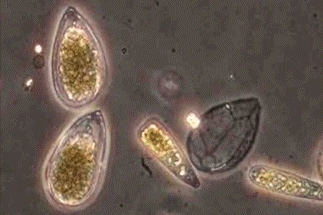
The Ocean Has Its Own Algae Killer, and It's a Fungus Nobody Knew About
Harmful algal blooms are getting worse. Warmer water temperatures and excess nutrients have made toxic outbreaks more frequent and more widespread, and the toolkit for managing them is still frustratingly limited. Researchers at Yokohama National University may have just found an unexpected piece of the puzzle: a previously unknown marine fungus that actively hunts and kills the algae responsible.
The organism, formally named Algophthora mediterranea, is a microscopic chytrid fungus capable of infecting and killing multiple algae species within days. The study was published in the journal Mycologia and describes not just a new species but an entirely new genus, one that appears to behave differently from anything marine scientists have isolated before.
What Harmful Algal Blooms Actually Do
To understand why this discovery matters, it helps to know what toxic blooms are doing to coastlines and the people living near them.
Algal blooms occur when aquatic algae multiply rapidly and in large quantities, typically driven by elevated nutrient levels and rising water temperatures. The resulting overgrowth depletes oxygen, degrades water quality, and in many cases releases toxins that threaten marine life and human health alike.
The specific algae targeted by the newly discovered fungus, Ostreopsis cf. ovata, is a particularly problematic species that has been appearing with increasing frequency along Mediterranean coastlines over recent decades. It produces a toxin called ovatoxin, which can cause a range of unpleasant symptoms in people who are exposed during coastal blooms, including respiratory irritation, eye inflammation, skin reactions, and coughing. These symptoms don't require direct contact with the water. Aerosols from breaking waves near bloom sites can carry the toxin onto beaches.
The frequency of Ostreopsis blooms has been climbing in tandem with sea surface temperatures, which makes the timing of this discovery particularly relevant.
WHO resources on harmful algal blooms
Algophthora Mediterranea: A New Genus, Not Just a New Species
Algophthora mediterranea was first detected in Spanish seawater in 2021 by scientists at the Institut de Ciències del Mar in Barcelona. The formal species description came from Professor Maiko Kagami and PhD student Núria Pou-Solà at Yokohama National University, following genetic analysis that confirmed the organism was distinct enough to warrant an entirely new genus classification.
The genus name was constructed from the Latin word for algae and the Greek word "phthora," meaning destruction. The name is accurate. In laboratory conditions, the fungus parasitises Ostreopsis cells and can kill them within a matter of days.
What makes it unusual beyond its lethality is the range of organisms it can infect. Most parasitic marine fungi are highly host-specific, evolving to target one species or a narrow group. Algophthora mediterranea demonstrated the ability to infect multiple different algae species and could even survive by feeding on pollen grains, a level of dietary flexibility that is genuinely unusual for a marine parasite.
How the Research Team Studied It
Isolating and characterising a newly discovered microscopic marine organism is technically demanding work. The Yokohama team used time-lapse imaging, capturing frames every ten minutes across a four-day observation period to document how the fungus interacts with its hosts in real time. They also analysed the organism using scanning electron microscopy, a technique that uses a focused electron beam to generate high-resolution surface images at scales impossible to achieve with conventional light microscopy.
Genetic sequencing confirmed the phylogenetic position of the organism within the chytrid group and its separation from all previously described genera. The combination of imaging and molecular analysis gave the team a detailed picture of both the fungus's physical structure and its place in the broader fungal family tree.
Pou-Solà noted that while environmental DNA surveys have revealed substantial diversity among marine fungi, the actual isolation and ecological study of parasitic marine species has lagged far behind. The majority of what lives in the ocean's fungal layer remains formally undescribed.
What This Means for Algal Bloom Management
The research team is cautious about overstating the near-term applications, and that caution is appropriate. Algophthora mediterranea is a newly described organism, and the leap from laboratory isolation to practical bloom control involves substantial scientific and regulatory complexity.
That said, the implications of finding a naturally occurring fungal predator for toxic algae are worth taking seriously. Harmful bloom management currently relies on a combination of nutrient reduction strategies, physical removal methods, and in some cases chemical treatments, none of which are ideal. A biological control agent that evolved in marine environments and already operates at scale in some capacity would represent a genuinely different kind of tool.
Kagami's stated research goals reflect this longer-term thinking. The aim is to build understanding of how parasitic fungi operate inside complex marine food webs and how they contribute to the ocean's biogeochemical cycles, the processes that move carbon, nitrogen, and other elements through seawater ecosystems. If chytrid fungi are acting as regulators of algal populations at a meaningful scale, that has implications well beyond bloom management.
The Broader Pattern: Fungi Keep Surprising Us
This discovery fits a pattern that mycologists have been tracking for years. Marine fungal ecology was, until relatively recently, a severely understudied field. The assumption that fungi were primarily terrestrial organisms meant the ocean's fungal diversity received far less scientific attention than it deserved. Environmental DNA work over the past decade has begun to correct that picture, revealing a vast and largely undescribed fungal layer operating throughout the world's oceans.
Algophthora mediterranea is a concrete example of what that diversity looks like in practice. A previously unknown organism, performing a previously uncharacterised ecological function, with a behavioural flexibility that distinguishes it from most known marine parasites. The fungal kingdom, as anyone in the mycology community already knows, has a habit of doing things nobody expected.
Whether the eventual application is bloom management, ecological modelling, or something not yet anticipated, the discovery adds to a growing body of evidence that marine fungi are doing meaningful ecological work that science is only just beginning to map.
Ready to take your mycology journey to the next level? Browse our full range of mushroom products at ShroomSpy.com/mushrooms/products and find everything you need to grow, forage, and thrive.
FAQ
What is Algophthora mediterranea?
Algophthora mediterranea is a newly identified species of marine chytrid fungus discovered by researchers at Yokohama National University. It represents an entirely new genus and is capable of infecting and killing multiple species of toxic algae, including Ostreopsis cf. ovata, which causes harmful coastal blooms in the Mediterranean.
How does the marine fungus kill toxic algae?
The fungus acts as a parasitic organism, attaching to algae cells and consuming them. In laboratory conditions, it was observed killing host algae within a few days of infection. It can infect a broader range of host species than most known marine parasites and can even survive on pollen.
What health risks do Ostreopsis blooms cause?
Ostreopsis cf. ovata produces a toxin called ovatoxin. People exposed to coastal blooms, including through aerosols from waves, can experience respiratory symptoms including coughing and shortness of breath, as well as eye inflammation, skin irritation, and dermatitis.
Could this fungus be used to control harmful algal blooms?
Potentially, but not yet. The research represents a foundational discovery and the team's stated goal is to build the scientific understanding necessary to eventually support bloom management applications. Significant further research is required before any practical application could be developed.
What are chytrid fungi?
Chytrids are a group of predominantly aquatic fungi that reproduce via spores. They are found in both freshwater and marine environments and can live as decomposers or parasites. While some chytrid species are well known for causing disease in amphibians, their broader ecological roles in marine systems are still being investigated.
Check out our Products!
Frequently Asked Questions
Algophthora mediterranea is a newly described marine chytrid fungus that represents an entirely new genus, not just a new species. It is a microscopic organism capable of infecting and killing multiple algae species within days, including the toxic alga Ostreopsis cf. ovata. The species was formally described by researchers at Yokohama National University following genetic analysis.