5-Level Food Grade Dehydrator
Sold by Colorado Cultures
Loading feedback...
$54.99
Estimated US shipping $148.75
30-day returns
Secure checkout — Stripe & PayPal
Final shipping is calculated at checkout.
30-day money-back guarantee

The harvest-to-storage step every cultivator gets wrong
You've nailed cultivation. The substrate is colonized, the chamber is dialed in, the flush comes in beautifully. You harvest a pound of fresh mushrooms.
Now what?
Fresh mushrooms are perishable. At room temperature, they begin breaking down within 24-48 hours. Refrigerated, they last 5-10 days. For any meaningful storage — weeks, months, or years — you have to dry them. This is where most home cultivators stumble.
The DIY drying approaches:
- Air drying — slow, uneven, can promote bacterial growth in humid climates
- Silica gel — works for small batches, slow for large harvests, requires gel maintenance
- Oven drying — too hot, destroys volatile compounds, uneven
- Hair dryer — clearly not the right tool
- Sun drying — UV degrades active compounds, weather-dependent
The right tool is a dedicated food-grade dehydrator designed for mushrooms and other organic materials.
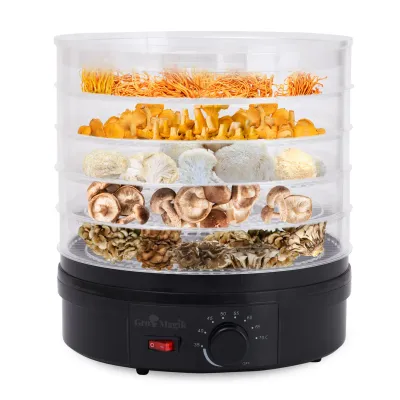
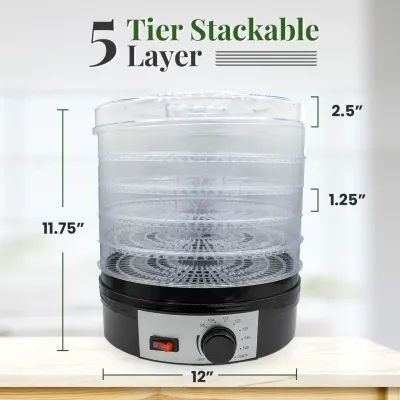
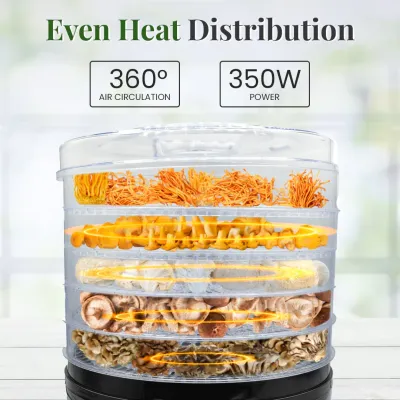
The Colorado Cultures 5-Level Food Grade Dehydrator is exactly that — a 5-tray stackable system with a 2.5" extra-tall top tray specifically designed for mushrooms of all shapes and sizes.
What "food grade" means
The term "food grade" distinguishes this product from:
- Industrial dehydrators designed for jerky or fish processing — different temperatures, different airflow
- Cheap appliance dehydrators with food-safety issues — may use plastic that leaches at heat
- Lab-grade dehydrators designed for scientific samples — over-engineered for home use
Food grade means:
- Materials certified safe for direct food contact
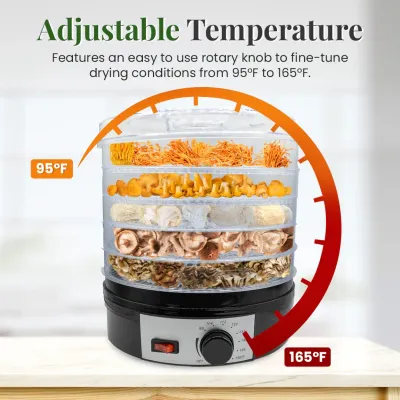
- Temperature ranges appropriate for food preservation (95-165°F typical)
- No off-gassing from plastic components during use
- Cleanable for repeated food contact
- Designed for whole, dried foods including mushrooms
The Colorado Cultures dehydrator meets these standards. You're using a food-grade appliance for drying mushrooms you intend to consume or store.
What "5 levels" actually delivers
The 5-tray stackable configuration:
- 5 separate drying trays stacked vertically
- Even airflow between trays (each tray gets ventilation)
- High volume capacity for big harvests
- Easy access to each tray independently
The capacity matters because mushroom drying scales differently than other foods:
- Single flushes from monotubs: Typically 4-8 oz fresh per flush → 0.5-1.5 oz dried
- Multi-tub Martha tent harvests: 12-32 oz fresh per harvest → 2-6 oz dried
- Bulk harvest from larger setups: 1-3 lbs fresh per harvest → 0.5-1 lb dried
The 5-tray capacity supports even the largest home harvests in a single drying session. No batching across multiple drying cycles required.
Why the "2.5-inch top tray" matters
Standard dehydrator trays are typically 1.5-2 inches tall. This works fine for sliced mushrooms but doesn't accommodate whole specimens of larger species.
The 2.5" top tray specifically allows:
- Whole lion's mane fruit bodies — these can be larger than standard trays accommodate
- Whole king oyster mushrooms — long stems may exceed standard tray height
- Larger cubensis specimens — particularly with stems intact
- Whole reishi conks — naturally larger than standard mushrooms
- Other oversized specimens from various species
The 2.5" headspace means you don't have to chop everything to fit standard tray dimensions. Whole specimen drying preserves the visual aesthetic and is often easier than chopping fresh mushrooms.
For mushrooms of standard size, the lower trays work fine; the oversized top tray is the unique feature for species variety.
Why mushroom-specific drying matters
Drying isn't drying isn't drying. Different foods need different drying conditions:
- Beef jerky: 165°F, high airflow, 8-12 hours
- Fruit (apples, etc.): 130-140°F, moderate airflow, 6-12 hours
- Herbs: 95-110°F, gentle airflow, 2-4 hours
- Mushrooms: 95-115°F, moderate airflow, 6-12 hours
Mushrooms specifically need:
- Low temperature (95-115°F) — preserves volatile compounds, prevents browning
- Even airflow — prevents wet spots that could mold
- Time-managed drying — too fast and they crack; too slow and they spoil
- Final moisture content of approximately 5-8% — "cracker dry" texture
The Colorado Cultures dehydrator is designed for this specific application — temperature ranges, airflow, and operation tuned for mushroom drying.
What you can dry with this
Beyond psilocybin and gourmet mushrooms specifically, the dehydrator supports:
- All edible mushroom species — oysters, lion's mane, king oyster, reishi, shiitake, maitake, etc.
- Wild foraged mushrooms (after confirmed identification)
- Mushroom extracts in liquid form (for dehydrating to powder)
- Other food items — meat jerky, fruit, vegetables, herbs (different temperatures required)
- Functional foods — incubated kefir cultures, certain fermented foods
- Sample preservation for cultivation research
The 5-tray capacity supports diverse simultaneous drying if you keep similar items per tray.
Standard mushroom drying workflow
After harvest:
- Sort the mushrooms by size and type — keep similar specimens together
- Slice large specimens in half lengthwise if needed for tray fit
- Whole-dry smaller specimens for visual aesthetic
- Spread evenly on the trays without overlap
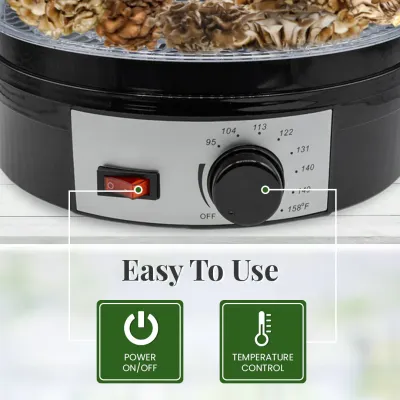
- Set the dehydrator to mushroom temperature (95-115°F)
- Run for 6-12 hours depending on specimen size
- Check periodically — done when "cracker dry" (snaps cleanly, no flexibility)
- Cool to room temperature before storage
- Store in airtight containers with desiccant for long-term preservation
The dehydrator handles steps 4-7 automatically; you handle the prep and storage.
Who buys this dehydrator
- Cultivators producing enough harvest to require systematic drying
- Multi-species cultivators with diverse drying needs
- Wild foragers drying foraged specimens for long-term storage
- Functional mushroom users drying for extract preparation
- Anyone storing mushrooms beyond a week of refrigerated freshness
- Bulk harvesters with regular harvests
- Educators and workshops demonstrating the harvest-to-storage workflow
What this is NOT
- Not a freeze dryer. Freeze dryers are a different category — slower, more expensive, but preserve more compounds. For most cultivators, dehydration is sufficient and significantly cheaper.
- Not a substitute for proper drying technique. Even the best dehydrator can't fix bad input — moldy mushrooms, contaminated harvest, or improperly stored fresh specimens.
- Not silent. The dehydrator's fan and airflow produce audible operation — comfortable in a workshop but noticeable in a quiet living space.
- Not portable. This is a benchtop appliance, not a travel item.
- Not pressure cooker safe for any reason. Don't pressure-cook or autoclave the dehydrator.
What you save by dehydrating your own
Compared to buying commercial dried mushrooms:
- Commercial dried mushrooms: $20-$60+ per ounce for premium gourmets
- Your own dried mushrooms: Cost is the original cultivation cost (substrate + spawn) spread across the dried weight
- Per-ounce cost of home-dried: $1-$5 typically
- Savings: 75-90% reduction in per-ounce cost vs. commercial
For active cultivators consuming or sharing meaningful amounts of mushrooms, the dehydrator pays for itself in 6-12 months of regular use.
Pairing with cultivation supplies
The dehydrator works with:
- Any cultivation chamber — Full Flush Bin, H2Shroom, Martha Tent, DIY
- Various species — cubensis, oysters, lion's mane, reishi, others
- Storage containers — sold separately for the dried product
- Desiccant — for long-term dried mushroom storage
- Vacuum sealers — optional for maximum preservation
Together, these tools comprise a complete harvest-to-storage workflow for serious cultivators.
The harvest-to-storage workflow gap
Most cultivation guides focus on the cultivation phase — how to grow the mushrooms. The drying and storage phase is often skipped or treated as an afterthought.
But for cultivators producing meaningful harvests:
- The drying step determines whether mushrooms preserve cleanly or degrade
- The storage step determines whether dried mushrooms last months or years
- The harvest-to-storage workflow is what enables continuous mushroom availability between cultivation cycles
A proper dehydrator is the linchpin of this workflow. With it, you produce a consistent supply of high-quality dried mushrooms. Without it, you're limited to what you can consume fresh in the days after harvest.
For cultivators serious about long-term mushroom use, the dehydrator transforms cultivation from a hobby into a sustainable practice.