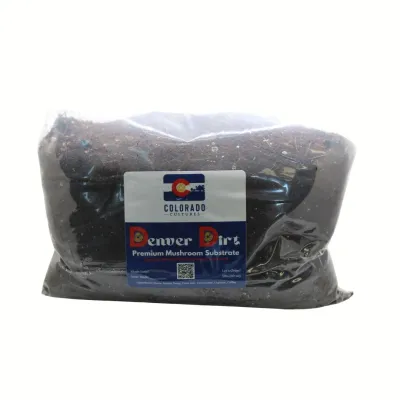

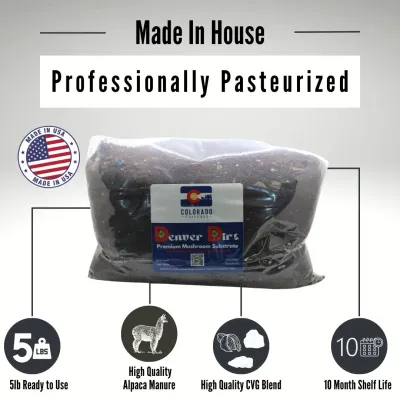
5lb Denver Dirt Premium Mushroom Substrate
Sold by Colorado Cultures
Loading feedback...
$29.99
Estimated US shipping $49.50
30-day returns
Secure checkout — Stripe & PayPal
Final shipping is calculated at checkout.
30-day money-back guarantee

The bulk substrate that produces more flushes
Bulk substrate is the single largest variable in mushroom cultivation yield. The same spawn, same chamber, same genetics — with two different substrates — can produce dramatically different results. A poorly-formulated substrate produces a single underwhelming flush; a properly-formulated substrate produces 3-5 productive flushes with each one delivering meaningful weight.
Denver Dirt is Colorado Cultures' premium substrate recipe — an expertly refined formula designed for dung-loving mushroom varieties, engineered to deliver more flushes, higher-quality fruits, and faster colonization than the standard CVG (coco coir + vermiculite + gypsum) recipe found everywhere else.
The 5-pound bag is the home-cultivator size — enough for one substantial monotub grow (24-30 quart fruiting chamber with appropriate spawn ratio).
What makes Denver Dirt different
Generic CVG substrate is good — it's been the modern mycology standard since the 2010s, and it works for nearly every cubensis grow. But "good" and "best" aren't the same thing.
Denver Dirt is Colorado Cultures' in-house refinement of the CVG concept, developed through years of production-grow iteration in their Denver facility. The improvements typically include:
- Higher-quality coco coir sourcing — finer particle size, lower salt content, higher water-holding capacity
- Optimized vermiculite grade for mushroom-specific aeration and moisture management
- Premium gypsum for cleaner pH buffering
- Possibly additional amendments — yeast extract, additional minerals, or proprietary additions that Colorado Cultures has found to improve performance
The result, per Colorado Cultures' own production testing:
- More flushes per grow cycle — 3-5 productive flushes is typical, compared to 2-4 with standard CVG
- Higher-quality fruits — larger caps, denser flesh, more uniform pinning
- Faster colonization — mycelium spreads through Denver Dirt more aggressively than through generic CVG
For cultivators who care about yield optimization, the substrate is a meaningful lever, and Denver Dirt is Colorado Cultures' answer to that lever.
What "dung-loving" means
The term "dung-loving" is the cultivation community's shorthand for the species that evolved on cow and horse dung in pasture environments — primarily Psilocybe cubensis and closely related species.
These species share a specific nutrient profile preference:
- High available carbohydrates — for fast mycelial growth and abundant fruiting
- Moderate nitrogen — enough for growth without encouraging bacterial competition
- Alkaline-buffered pH — typically 6.5-7.5, dung's natural range
- Aerated porous structure — dung's natural texture supports oxygen flow through the substrate
- Stable moisture retention — dung holds water without compacting
Denver Dirt is engineered to match this profile using mineral and plant-based ingredients (no actual dung) — providing all the benefits of natural dung substrate without the contamination risks, odor, or sourcing challenges of working with raw manure.
Compatible cultivars include all common cubensis varieties — Golden Teacher, B+, Albino A+, Penis Envy, Mazatapec, Treasure Coast, Cambodian, and others.
Why pre-mixed beats DIY for most cultivators
You can mix your own CVG-style substrate from raw components (Colorado Cultures sells vermiculite, coco coir bricks, and gypsum separately). The DIY approach has advantages:
- Lower per-pound cost when you've optimized your buying
- Full control over ratios for experimental work
- Better for high-volume operations running many grows
But for most home cultivators, pre-mixed substrate (this product) is the better value:
- Time savings — no measuring, no mixing, no testing field capacity
- Consistency — every grow uses the same ratios and ingredients
- Quality control — Colorado Cultures' substrate prep is tighter than most home mixing
- No partial bags accumulating — you buy one bag per grow rather than three partial bags of components
For 1-3 grows a year, pre-mixed is the right purchase. For 10+ grows a year, DIY mixing becomes more cost-effective.
What 5 pounds gets you
The 5-pound bag is sized for a typical home grow:
- One medium monotub grow (24-30 quart fruiting chamber)
- 3-4 inches of substrate depth across the chamber bottom
- Properly proportioned to typical spawn loads (1:2 to 1:5 spawn-to-substrate ratio)
For larger operations:
- 15-30 quart small monotub: 1 bag (5 lbs) is sufficient
- 30-50 quart medium-large monotub: 1-2 bags (5-10 lbs)
- 50+ quart commercial-scale tub: 2-3 bags (10-15 lbs)
- Multi-tub setups: 1 bag per tub plus margin
Plan to order slightly more substrate than you think you'll need — better to have 0.5 pounds of margin than to run short mid-mix.
When to use Denver Dirt vs. CVG vs. Masters Mix
Colorado Cultures stocks several substrate options for different applications:
| Substrate | Best for | Why |
|-----------|----------|-----|
| Denver Dirt (this product) | Cubensis bulk monotub fruiting | Premium dung-loving species formula |
| Generic CVG [if stocked] | Budget cultivation, learning the basics | Standard recipe, lower cost |
| Masters Mix | Wood-loving species (oysters, lion's mane, reishi) | Hardwood-based, different nutrient profile |
| Individual components (vermiculite, coco coir, gypsum) | DIY mixing for high-volume cultivators | Lowest per-pound cost |
For cubensis cultivation specifically, Denver Dirt is the premium choice. For other species, source the appropriate specialized substrate.
Who buys Denver Dirt
- Cubensis cultivators running monotub or fruiting chamber grows
- Cultivators upgrading from entry-level kits (Gro Magik, generic Amazon kits) to better substrate quality
- Yield-focused growers who want the optimal substrate for maximum harvest
- Cultivators rebuilding after contamination — start the next grow with premium substrate
- Genetics testers running controlled experiments where substrate consistency matters
- Anyone running back-to-back grows who values pre-mixed convenience over DIY mixing time
What this is NOT
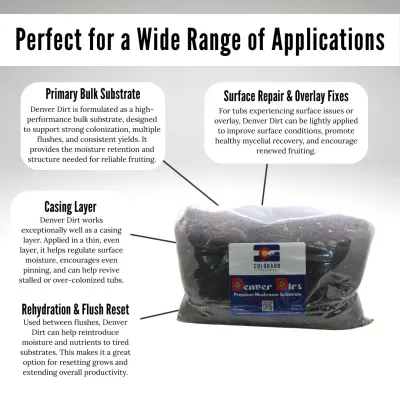
- Not pre-inoculated. This is bulk substrate — you mix it with your own colonized grain spawn for fruiting. Spawn sold separately.
- Not a fruiting chamber. This is substrate that goes inside a fruiting chamber (Full Flush Bin, H2Shroom Chamber, or DIY monotub) along with spawn.
- Not optimized for wood-loving species. Oysters, lion's mane, reishi prefer hardwood-based substrates (Masters Mix).
- Not fertilized for vegetable growing. This is mushroom substrate, not garden soil. It's designed for mycelial nutrition, not plant nutrition.
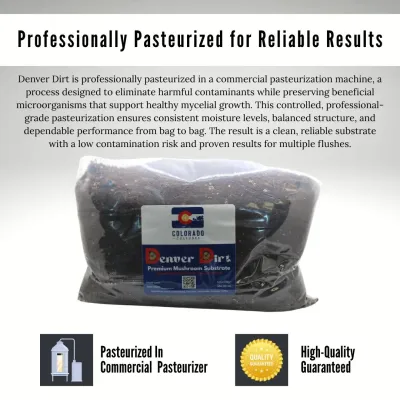
- Not pressurized or autoclaved on receipt. The substrate has been pasteurized at the manufacturing facility for direct use; if you want full sterilization, you can autoclave the bag yourself, but pasteurization is sufficient for most cubensis grows.
For cubensis cultivators wanting maximum yield with minimum prep work, Denver Dirt is the substrate of choice in the Colorado Cultures lineup. One bag, one grow, more flushes, better fruits.
What you actually save with Denver Dirt vs. DIY
For a single grow:
DIY substrate (3 components, mixed manually):
- Vermiculite: ~$3-5
- Coco coir brick: ~$3-5
- Gypsum: ~$2-3
- Mixing time: 30-60 minutes
- Cleanup: 15-30 minutes
- Total: ~$8-13 + 1-1.5 hours of labor
Pre-mixed Denver Dirt:
- Mixing time: 0 (drop into chamber)
- Cleanup: 0
For active cultivators running 4-6 grows per year, the time savings of pre-mixed substrate is meaningful — easily 6-9 hours of cultivation labor avoided per year. For occasional cultivators, the per-grow time savings still translates to less friction starting each new grow.
The yield improvement from premium-formula substrate (more flushes, better fruits) is the additional value beyond pure time savings.