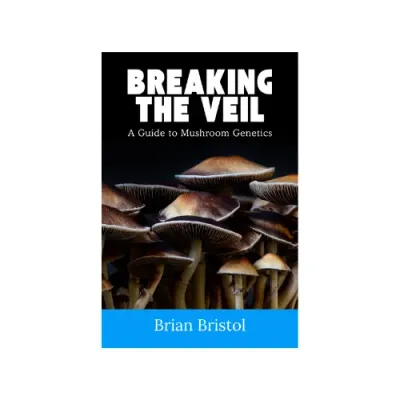
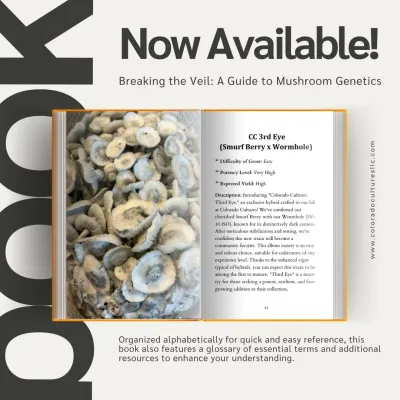

Breaking the Veil: A Guide to Mushroom Genetics
Sold by Colorado Cultures
Loading feedback...
$24.99
Estimated US shipping $7.70
30-day returns
Secure checkout — Stripe & PayPal
Final shipping is calculated at checkout.
30-day money-back guarantee

The genetics book the cultivation community has been waiting for
Most mycology books cover cultivation technique — how to sterilize grain, how to inoculate spawn, how to manage humidity in a monotub. The Mushroom Bible by Dr. K. Mandrake is the gold standard reference. The Magic Mushroom Growers Guide is the focused workflow guide. Mycelium Running by Paul Stamets is the ecosystem-scale manifesto.
But what about genetics? What about the deeper question of why one cultivar produces dense, photogenic, golden-capped specimens while another produces tall, pale, leggy mushrooms — even on identical substrate, in identical conditions, from the same supplier's spore stock? What about understanding why isolating a "perfect" cultivar from a multispore syringe takes years of work, and why even experienced cultivators sometimes lose strains they thought they had stabilized?
Breaking the Veil: A Guide to Mushroom Genetics is the book that addresses these questions. Curated by the experts at Colorado Cultures, this is the cultivation community's accessible-but-rigorous reference on the underlying genetics of mushroom cultivation — what's happening inside the mycelium that determines yield, potency, fruit body morphology, and strain stability.
This is not a beginner's first book. It's the book you graduate to once you've successfully completed several grows and you're ready to understand cultivation at a deeper level.
What this book actually covers
Fungal genetics fundamentals
- Spore biology — what's actually inside a spore, how spores combine to form mycelium
- Heterokaryosis — the genetic state where mushroom mycelium carries multiple nuclei with different genetic backgrounds (the most important concept in mushroom genetics that most beginners never learn)
- Hyphal fusion — how mycelial cells exchange and combine genetic material
- Mating types — why two compatible mycelia can combine to form fertile cultivars
Cultivar genetics
- What makes a cultivar a cultivar — defined characteristics, genetic stability, isolation work
- Why "Golden Teacher" and "B+" produce different results — the genetic basis for cultivar variation
- Strain drift — how genetics change over generations of propagation
- Strain stability — how to maintain a cultivar without losing its defining characteristics
Isolation techniques
- Single-spore isolation — the foundational technique for genetics work
- Multi-spore isolation — when and why it differs from single-spore work
- Re-isolation from existing strains — refreshing genetics that have drifted
- Backup culture maintenance — preserving the genetic line you've developed
Breeding and selection
- Selection criteria — what to look for when developing a new strain
- Cross-breeding — combining two parent strains to create new cultivars
- Hybrid vigor and stability — the trade-offs in cross-breeding
- Maintaining selected cultivars — keeping a successful selection viable across generations
Genetic preservation
- Long-term storage of cultures — agar slants, lyophilization, and other preservation methods
- Strain library management — organizing and maintaining a personal genetic collection
- Documentation — recording strain characteristics, lineage, and performance
- Genetic banks — the broader community resources for cultivar preservation
Advanced topics
- Aneuploidy and polyploidy — chromosome variations in mushroom cultivars
- Genetic causes of contamination resistance — why some cultivars survive bad conditions
- Genetic basis of potency variation — the heritability of psilocybin production
- Mutation and variation — natural sources of genetic novelty
Who buys this book
This is a graduate-level book in the cultivation reading curriculum. The audience:
- Cultivators with 3+ successful grows under their belt — ready for deeper understanding
- Genetics testers and breeders developing or stabilizing their own cultivars
- Single-spore isolation workers doing real strain development
- Strain hunters — cultivators searching for novel genetics in multispore syringes
- Researchers and grad students in mycology or related fields
- Cultivation educators teaching advanced techniques
- Anyone who has wondered why their cultivar performs differently from someone else's — even with identical genetics on paper
Who this is NOT for
- First-time growers — start with The Mushroom Bible or the Magic Mushroom Growers Guide
- Casual hobbyists — content depth exceeds casual interest
- Readers wanting only practical cultivation steps — this is genetics theory more than substrate recipes
- Anyone uncomfortable with biology fundamentals — assumes some prior knowledge of cell biology and inheritance
Why this book exists
Cultivation genetics has been the missing chapter in most mycology cultivation literature. The standard cultivation books mention genetics briefly — "different cultivars produce different results, choose the right one for your goals" — but stop there.
The actual depth of fungal genetics is dramatically more interesting:
- Why does a single multispore syringe produce multiple distinct strains when you isolate from it? Because each spore carries unique genetics, and the resulting mycelial cells combine in different ways.
- Why can the same cultivar perform differently in different cultivators' setups even with identical substrate? Because environmental factors interact with genetic predispositions in complex ways.
- Why do strains "drift" over generations of propagation? Because random mutation, selection pressure, and heterokaryotic exchange constantly shift the genetic profile.
- Why does single-spore isolation produce more stable cultivars than multi-spore work? Because you're starting with a single genetic origin rather than a population.
Understanding these dynamics changes how you cultivate. You go from "I bought a Golden Teacher spore syringe and hoped for the best" to "I selected for the fastest-fruiting, most consistent specimens across multiple isolation rounds and now have a personally-developed strain that consistently outperforms generic Golden Teacher."
That's the level this book operates at. Genetics is the cultivation depth that separates serious cultivators from casual ones.
How this book compares to other Colorado Cultures books
The Colorado Cultures book lineup:
| Book | Best for | Reading order |
|------|----------|---------------|
| Magic Mushroom Growers Guide Book | First grows, workflow | 1st |
| The Mushroom Bible (Dr. K. Mandrake) | Comprehensive cultivation reference | 2nd |
| Mycelium Running (Paul Stamets) | Ecosystem-scale fungal applications | 3rd |
| Breaking the Veil (this product) | Advanced genetics work | 4th |
| The Mushroom Chef Cookbook | Culinary applications | Specialty |
Breaking the Veil is the advanced/specialty volume in the lineup. It's not the book to start with, but it's the book that makes the others actionable at a deeper level.
Most serious cultivators eventually own this book even if they only consult it for specific projects (isolation work, strain development, troubleshooting unstable cultivars).
The Colorado Cultures expertise
The book is curated by the experts at Colorado Cultures — drawing on the brand's in-house cultivation work, strain development, and the broader cultivation literature.
This is meaningful because the cultivation genetics literature is fragmented. Academic papers exist in journals most cultivators don't access. Forum threads and YouTube videos cover bits and pieces. A consolidated, accessible, cultivation-focused reference book on mushroom genetics is genuinely rare in the market.
Colorado Cultures' production team works with cultivar genetics daily — propagating dozens of strains, developing new ones, troubleshooting strain drift, maintaining the company's culture library. The book represents that accumulated practical knowledge organized into a teaching reference.
What you'll be able to do after reading this book
After completing Breaking the Veil:
- Understand why your cultivars perform the way they do at a genetic level
- Plan effective isolation work to develop your own preferred strains
- Maintain strain stability across many generations of propagation
- Recognize signs of strain drift before it produces poor grows
- Engage with the cultivation community at a higher technical level
- Document and preserve your own strains for long-term cultivation
- Make informed cultivar selection decisions based on understanding the underlying genetics
This is real cultivation expertise — the kind that distinguishes a serious grower from a casual one.
What this book is NOT
- Not a substitute for hands-on practice. Reading about isolation doesn't replace doing isolation. The book provides the framework; you provide the experience.
- Not a wild specimen identification reference. This is cultivation genetics, not species identification.
- Not the only book you need. Pair with The Mushroom Bible for cultivation technique depth, the Magic Mushroom Growers Guide for workflow, and Mycelium Running for ecological context.
- Not a beginner's first book. Genuinely, start with simpler books first. Reading this without prior cultivation experience will be frustrating.
For experienced cultivators ready to deepen their understanding, Breaking the Veil is the right next book in the cultivation reading curriculum.