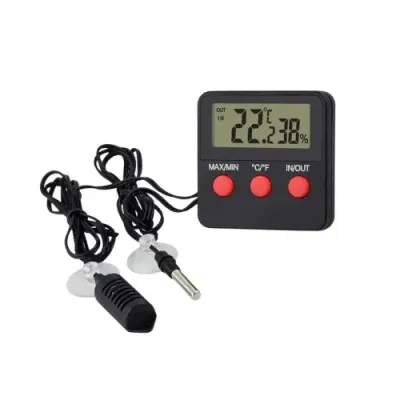
Digital Hygrometer & Thermometer for Mushroom Cultivation
Sold by Colorado Cultures
Loading feedback...
$14.99
Estimated US shipping $6.60
30-day returns
Secure checkout — Stripe & PayPal
Final shipping is calculated at checkout.
30-day money-back guarantee

The measurement you can't skip
Almost every cultivation guide says some version of: "Maintain humidity at 85-95% during fruiting; keep temperature between 70-78°F." What none of them tell you is how you actually verify those numbers in your chamber.
You can't tell humidity by feel — 80% RH feels almost identical to 92% RH inside a closed monotub. You can't tell temperature accurately by feel either — chamber air can be 10°F different from the room air just a few feet away. If you're not measuring, you're guessing.
And guessing produces results like:
- Stalled spawn runs because your "warm enough" basement is actually 65°F (mycelium colonization slows dramatically below 68°F)
- Aborted pin sets because your humidifier-on-room-shelf actually delivers 65% RH at the substrate, not the 90% you assumed
- Side-pin rot because chamber temperature drifted to 82°F overnight without you noticing
- Inconsistent grows where the same genetic and same substrate produce wildly different results because the environment was different in ways you couldn't see
The Colorado Cultures Digital Hygrometer & Thermometer is the instrument that closes this gap. A compact, dual-function meter measuring both humidity and temperature, designed specifically for mushroom cultivation environments. Set it inside your chamber; read it at a glance; adjust your conditions based on real numbers instead of hope.
What it measures
Humidity (relative humidity, RH)
The percentage of water vapor in the air relative to the maximum amount the air could hold at that temperature.
Why it matters for mushrooms:
- Below 80% RH: Fruit bodies dry out, stop developing, abort
- 80-85% RH: Marginal — some species pin but development is slow
- 85-92% RH: Optimal fruiting range for most cultivated species
- 92-95% RH: Optimal pinning range; aggressive fruiting; ideal for cubensis
- 95-100% RH: Wet zone — risk of side-pin rot, bacterial bloom, mold; rarely needed and often harmful
The Hygrometer's RH reading tells you exactly which zone your chamber is in.
Temperature
The temperature of the air in your chamber, in Fahrenheit or Celsius (typically switchable).
Why it matters for mushrooms:
- Below 65°F: Most cubensis strains grow very slowly; can stall completely
- 65-75°F: Acceptable for fruiting; ideal for some species (oysters, lion's mane prefer cooler)
- 70-78°F: Sweet spot for cubensis fruiting
- 78-82°F: Acceptable; mycelium grows fast but contamination risk increases
- Above 82°F: Risk zone — bacteria and contaminants thrive; mushrooms abort
The Hygrometer's temperature reading is just as critical as the humidity reading. Together, they tell you whether your chamber is in the operating window.
What you get
A small, battery-powered, digital LCD display showing both humidity (RH%) and temperature (in °F or °C). The unit is compact, lightweight, and designed to sit anywhere in your grow space:
- Inside a monotub (sits on the substrate corner or attached to the lid)
- Inside a Martha tent (mounted on a shelf or hung from the frame)
- Inside a fruiting chamber of any design
- Inside an incubation space (room corner, closet, basement)
- In an indoor greenhouse
- Inside a sealed grain spawn bag (during spawn run, for monitoring)
The display is easy to read at a glance — you don't need to fiddle with the unit to know your conditions.
Why this specific unit (vs. a kitchen thermometer or a $10 humidor hygrometer)
The mushroom cultivation market is full of cheap "humidity monitors" that are not actually accurate enough for serious cultivation work:
Cheap dial hygrometers (analog)
- Accuracy: ±10-15% RH typical
- Stability: Drift over time without calibration
- Response time: 30-60 minutes to equilibrate
- Verdict for cultivation: Not adequate. A reading of 85% might actually be 75% — the difference between "good fruiting humidity" and "marginal humidity that aborts pins."
Cheap digital hygrometers (no calibration)
- Accuracy: ±5-8% RH
- Stability: Variable; can drift significantly within months
- Response time: 5-15 minutes to equilibrate
- Verdict for cultivation: Borderline acceptable for casual grows; insufficient for serious cultivation.
Quality digital hygrometers (this product)
- Stability: Stable for 1-3 years without recalibration
- Response time: 1-5 minutes to equilibrate
- Verdict for cultivation: The right tool. Accurate enough to tell you whether you're at 85% or 92%, which is the difference between marginal and ideal fruiting.
Lab-grade hygrometers ($100+ category)
- Accuracy: ±0.5-1% RH
- Stability: Years without drift
- Response time: Near-instant
- Verdict for cultivation: Overkill for home use, but appropriate for commercial or research operations.
For most home and serious-hobbyist cultivators, a quality digital hygrometer is the right balance of accuracy and cost.
Use cases throughout the grow cycle
Spawn run (incubation phase)
Target conditions: 70-78°F, 50-70% RH (substrate moisture provides higher humidity locally)
The Hygrometer placed in your incubation space tells you:
- Is the room actually 73°F like you think? Often basements and garages are 5-10°F cooler than you expect
- Is the air dry enough to slow colonization? Very dry air (below 30% RH) can actually pull moisture from sealed grain bags through the filter patches, slowing or stalling colonization
If spawn run is unusually slow, check the Hygrometer first.
Pinning initiation
Target conditions: 70-75°F, 90-95% RH
The Hygrometer placed inside the fruiting chamber, at substrate level, tells you:
- Has the chamber actually reached pinning humidity? It can take 60-120 minutes after starting the humidifier to fully saturate a Martha tent
- Is the chamber too warm? Above 80°F, cubensis pinning gets stress-induced and lower-quality
Active fruiting
Target conditions: 70-78°F, 85-92% RH (slightly lower than pinning to encourage fruit body development)
The Hygrometer tells you when to:
- Adjust humidifier intensity if drift occurs
- Increase FAE if humidity climbs too high (above 95%)
- Move chamber if room temperature is causing problems
Harvest and between flushes
Target conditions: 65-75°F, 75-85% RH during the substrate rest period
The Hygrometer tells you whether the substrate is being kept moist enough during rest without being saturated.
Multiple unit setup (advanced)
For serious cultivators, multiple hygrometers placed in different locations give you a full environmental picture:
Placement | What it tells you |
|---|---|
Inside the tub, at substrate level | The microclimate the mycelium actually experiences |
Inside the tub, near the lid | Whether humid air is stratifying instead of circulating |
Martha tent, top shelf | Your warmest and driest point |
Martha tent, bottom shelf | Your coolest and wettest point |
Room ambient | The baseline your chamber is working against |
For Martha tent operations with 4-6 tubs, 5-6 hygrometers is not excessive — you'll catch tub-to-tub variability that single-hygrometer monitoring misses entirely.
Who buys this
- Anyone running their first grow — you genuinely need to know what's happening in your chamber
- Cultivators experiencing inconsistent results — guesswork environments produce inconsistent outcomes; measurement closes the loop
- Cultivators upgrading from single-tub to multi-tub — variability becomes obvious only with measurement
- Anyone using an ultrasonic humidifier (like the Colorado Cultures Gro Magik Ultrasonic Humidifier) — measure the actual delivered humidity, not just the dial setting
- Cultivators with humidity-sensitive species — oysters, lion's mane, shiitake, reishi all benefit from precise environmental control
- Cultivators with temperature-variable environments — basements, garages, climate-uncontrolled spaces where ambient conditions drift
- Year-round cultivators in regions with seasonal weather variability — winter heating and summer cooling change indoor humidity dramatically
- Anyone troubleshooting a problem grow — "what's actually happening in there?" is always the first question, and a hygrometer answers it
- Beginners wanting to learn proper cultivation — measurement is the foundation of skill
What this is NOT
- Not a controller. This is a measurement instrument. To adjust humidity, you need a separate humidifier; to adjust temperature, you need a heater, cooler, or thermostat. The Hygrometer reports; it doesn't act.
- Not a substitute for environmental control. Knowing your chamber is at 75% RH doesn't fix it; you need to add humidification or seal leaks to actually correct the issue.
- Not waterproof at submersion depth. The unit can tolerate the splashes and condensation of normal cultivation use, but don't drop it in a bucket of water.
- Not autoclavable. Don't include it in a pressure cooker. Use only in finished, post-sterilization environments.
- Not a substitute for visual inspection. Some problems (contamination, side-pin rot, abnormal mycelial growth) are visible-only. The Hygrometer tells you about environment, not biology.
- Not designed for outdoor use. Indoor cultivation only; outdoor use will damage the electronics and the calibration.
Pairing with the Colorado Cultures lineup
The Hygrometer is the sensor in your chamber environment alongside:
- Gro Magik Ultrasonic Humidifier — measure what the humidifier actually delivers, not what the dial promises
- Waterproof Myco Fans 2-pack — confirm FAE cycles are reducing humidity briefly without overcooling the chamber
- Mushroom Grow Light — confirm light's incidental heat is appropriate for your chamber size
- Martha Tent 4-Tier — multi-tub monitoring requires multiple hygrometers
- Full Flush Bin / H2Shroom Fruiting Chamber — chamber-specific monitoring
- Premium Disposable Face Masks + Nitrile Gloves — when adjusting the chamber, you'll want proper PPE for any contact
A complete chamber instrumentation kit costs about the same as 1-2 weeks of failed grows. The math justifies itself within months.
A note on calibration
Even the best digital hygrometers can drift over time. Calibrate yours at 3-6 month intervals using one of these methods:
Salt-water calibration test
The classic method: a saturated salt-water solution at room temperature has a stable 75% RH. To test:
- Add 2 tablespoons of table salt to a small dish
- Add 1 teaspoon of water — just enough to make the salt a wet slurry, not standing water
- Seal the dish and hygrometer together in a 1-quart plastic bag
- Wait 6-12 hours
- Read the hygrometer: it should read 75% RH ± 3%
- If off by more than 3%, your hygrometer needs replacement or recalibration
Comparison test
If you have two hygrometers, place them in the same location for 1+ hour and compare readings. They should agree within 3% RH. Disagreement suggests one or both is drifting.
Field reference test
Compare to a known-good source — a calibrated commercial hygrometer (a brewery, climate lab, or HVAC company can lend you one).
If calibration shows significant drift, replace the unit. A drifting hygrometer is worse than no hygrometer because it gives confident-but-wrong readings.
Long-term reliability
A quality digital hygrometer should last 3-5+ years in continuous cultivation use. Failure modes include:
- Battery exhaustion — replaceable (typical: AAA or button cell)
- Sensor drift — accumulating error over months to years
- Display failure — LCD elements can fade or die
- Moisture damage — extreme humidity environments can damage internal electronics
For most users, 3 years is a reasonable replacement interval, with intermediate sensor calibration tests.
Pricing and ROI
Consider: a single failed grow from humidity-related abortion costs $40-120 in spawn, substrate, and time. The Hygrometer is one of the highest-ROI tools in cultivation — small upfront cost, immediate value, long lifespan.