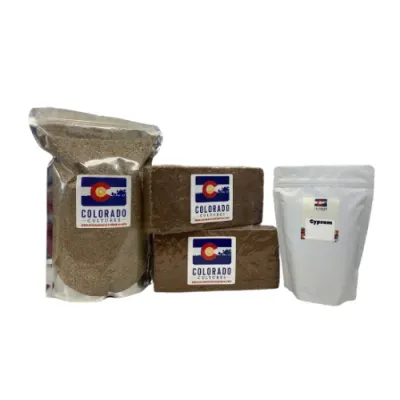
DIY CVG Kit (Coco Coir, Vermiculite, Gypsum) - Pre-Measured and Ready to Use
Sold by Colorado Cultures
Loading feedback...
$24.99
Estimated US shipping $27.50
30-day returns
Secure checkout — Stripe & PayPal
Final shipping is calculated at checkout.
30-day money-back guarantee

The CVG recipe, pre-measured
CVG — Coco Coir + Vermiculite + Gypsum — is the canonical substrate for cubensis cultivation. Three ingredients, mixed at specific ratios, pasteurized, mixed with grain spawn, and you have the foundation of every successful monotub grow.
The problem: getting the ratios right is fussy. A typical CVG recipe runs something like:
- 1 part hydrated coco coir
- 1 part vermiculite (by volume)
- 1 tablespoon gypsum per quart of mix
You can measure these out yourself. Most cultivators do. But it requires:
- Buying three separate products — Colorado Cultures sells each individually (Coco Coir Brick, Vermiculite 1lb, Premium Gypsum 1lb)
- Measuring carefully every time — by volume, not by weight, with tools you may not have
- Standardizing across batches — when you change brick brand or vermiculite batch, your ratios shift
- Storing three sets of supplies — taking up shelf space
The Colorado Cultures DIY CVG Kit eliminates all of that. A single pre-measured package containing the perfect ratio of high-quality coco coir, vermiculite, and gypsum — measured by experienced cultivators to the proven CVG ratio.
Open the bag. Mix. Sterilize. Spawn. Grow. No measuring spoons, no math, no second-guessing the ratios.
What's in the kit
The kit contains a pre-portioned blend of:
- Coco coir — primary substrate volume; provides moisture retention and structure
- Vermiculite — adds aeration and supplemental moisture retention
- Gypsum — pH stabilization, calcium and sulfur mineral supplementation
All three components are the same quality grade as the standalone Colorado Cultures products. You're not paying extra for "pre-measured" — you're paying the same per-volume cost as buying the components separately, and saving the time and effort of measuring.
Why CVG specifically (and not other substrate types)
Different mushroom species evolved to eat different things. CVG is optimized for dung-loving species — primarily Psilocybe cubensis and similar manure-loving mushrooms.
What CVG offers cubensis:
- Excellent moisture retention — coco coir holds water at field capacity without becoming waterlogged
- Aeration — vermiculite creates air pockets where mycelium can expand
- pH stability — gypsum buffers the substrate at 6.0-7.0 pH (cubensis' preferred range)
- Nutrient availability — gypsum's calcium and sulfur support healthy mycelium growth
- Contamination resistance — pasteurized CVG has dramatically lower contamination rates than soil-based or unrefined substrates
For wood-loving species (oysters, lion's mane, shiitake), you'd use a different substrate (Colorado Cultures Masters Mix). For functional mushrooms in specialized environments, the substrate may vary. For cubensis and most dung-loving species, CVG is the standard.
What "Easy to Use" actually means
The kit advertises ease-of-use. Here's what that looks like in practice:
Step 1: Open the kit (5 seconds)
Cut the bag open. The components are mixed or layered — depending on packaging — and ready to combine.
Step 2: Hydrate (5 minutes)
Add the recommended water volume. The coir absorbs water rapidly; vermiculite mixes in cleanly. No need to measure water carefully — the kit specifies a recommended volume that's close to field capacity.
Step 3: Mix (2 minutes)
Combine the hydrated components in your monotub or mixing container. All ingredients are already pre-measured to the correct ratio — you don't need to math out the gypsum dose per quart, you don't need to verify the coir-to-vermiculite ratio.
Step 4: Test field capacity (30 seconds)
Squeeze a handful. If water drips freely, it's too wet — add more dry vermiculite. If it crumbles without holding shape, it's too dry — add more water. Most cultivators hit field capacity on the first try.
Step 5: Pasteurize (1-2 hours)
Use bucket tek (boiling water poured over the CVG) or oven pasteurization (160-180°F for 1 hour). The kit content tolerates standard pasteurization protocols.
Step 6: Cool and spawn (1-2 hours cooling + 5 minutes mixing)
Once cooled to room temperature, mix with your colonized grain spawn (Sorghum AIO, Binky Bags, or DIY) and load into your monotub.
Total active time: about 15 minutes of work (plus pasteurization time). Compare to measuring out three separate ingredients, which adds 10+ minutes to the workflow for someone not experienced with substrate prep.
Who buys this
- First-time cultivators — eliminates the "did I get the ratios right?" anxiety
- Cultivators who want consistent results — pre-measured = same substrate every batch
- Multi-tub cultivators — buy multiple kits for parallel monotubs without measuring multiple times
- Cultivators with limited shelf space — one kit replaces three separate component packages
- Beginners learning CVG cultivation — guided substrate prep without the math
- Time-constrained cultivators — quick substrate prep on weekends or evenings
- Cultivators upgrading from PF Tek BRF cakes — the easiest entry into bulk substrate cultivation
- Cultivators recovering from a substrate failure — clean restart with proven ratios
- Anyone with grain spawn ready to fruit but no substrate prep ready
What this is NOT
- Not pre-sterilized. You'll pasteurize the kit before spawning. The kit is dry/raw; you hydrate and pasteurize.
- Not pre-hydrated. The components are dry; you add water during preparation.
- Not spawn. This is the substrate; you provide your own grain spawn (Sorghum AIO, Binky Bags, or DIY).
- Not an inoculation kit. No spores, liquid culture, or fruiting accessories included.
- Not for wood-loving species. Use Colorado Cultures Masters Mix for oysters, lion's mane, shiitake, etc.
- Not for all home cultivators. Experienced cultivators with their own ratio preferences and bulk ingredient suppliers may find more economic value in buying components separately.
- Not pre-measured for non-standard tub sizes. The kit is sized for typical 32-68 quart monotubs. Larger or smaller chambers may need adjustments.
Pairing across the Colorado Cultures lineup
The DIY CVG Kit is the substrate foundation of a cubensis cultivation setup:
- Sorghum AIO grain bags / Binky Bags / Unicorn Bags — grain spawn to mix with the CVG
- Liquid culture or spore syringe — inoculant
- Gro Magik Monotub / Full Flush Bin / H2Shroom Fruiting Chamber — chamber to fruit in
- Ultrasonic Humidifier + Hygrometer — environmental controls
- Waterproof Myco Fans 2-pack — FAE
- Mushroom Grow Light — photoperiod
- Myco Peeper — chamber monitoring
- Fungi Fuel — substrate enhancer (add at hydration)
- Gnat B Gone — pest control
- Premium Disposable Face Masks + Nitrile Gloves — PPE
A complete monotub cultivation setup using the DIY CVG Kit as the substrate base supports 3-5 flushes per grow cycle.
Compared to standalone components
| Approach | Pros | Cons |
|---|---|---|
| DIY CVG Kit (this) | Pre-measured, no math; consistent results; faster prep | Slightly higher per-volume cost than bulk; single SKU |
| Buying components separately | Bulk cost savings; flexibility for non-standard ratios; multi-purpose ingredients | More measuring; more storage; more SKUs to track |
| Pre-pasteurized substrate (Denver Dirt 5lb) | Zero prep work; pasteurized; ready to spawn | Higher per-volume cost; not customizable; single use |
For most home cultivators, the DIY CVG Kit is the sweet spot between convenience and cost. For high-volume cultivators, transitioning to standalone components becomes economical at 5+ grows per year.
Quality of the components
The components in the DIY CVG Kit are the same grade as the standalone Colorado Cultures products:
- Coco coir — same quality as the Colorado Cultures Coco Coir Brick (high-quality, screened, salt-washed)
- Vermiculite — same horticultural-grade vermiculite as the Colorado Cultures Vermiculite 1lb
- Gypsum — same agricultural-grade calcium sulfate as the Colorado Cultures Premium Gypsum 1lb
No quality compromise for the convenience. You're getting the same ingredients, just pre-portioned.
Substrate science: why these specific ingredients
Coco coir
- Source: Coconut husk fiber, processed and screened
- Function: Bulk substrate volume; moisture retention without compaction
- Why it works: Cubensis mycelium loves the fiber structure; the coir doesn't compact under spawn weight
- Alternative: Peat moss (less sustainable; harvested from depleting peatlands)
Vermiculite
- Source: Heated mineral mica that expands when heated
- Function: Aeration; moisture buffering; helps prevent the substrate from becoming a single dense mass
- Why it works: The expanded structure creates air pockets that mycelium can colonize through
- Alternative: Perlite (more aggressive aeration; less moisture retention)
Gypsum (calcium sulfate)
- Source: Natural mineral or industrial byproduct
- Function: pH stabilization; calcium and sulfur supplementation
- Why it works: Buffers the substrate at 6.5-7.0 pH (cubensis' optimal range); provides minerals mycelium uses to build cell walls
- Alternative: Agricultural lime (different pH effect; not interchangeable)
These three ingredients work together in CVG. The kit's pre-measured ratio represents years of refinement by cultivators who tested different proportions to find what produces the best yields.
Storage and shelf life
The kit's dry components have excellent shelf life when properly stored:
- Storage temperature: Room temperature (50-77°F / 10-25°C)
- Storage location: Dry, cool, away from direct sunlight
- Once opened: Use within 30 days for best quality; older opened kits may have absorbed humidity that affects consistency
- Sign of degradation: Mold or moisture damage; off odor; insect activity
For most cultivators, the kit is used immediately upon purchase, but the extended shelf life means you can stockpile multiple kits if you find a discount or want to lock in your supply.
The convenience-vs-cost calculation
For a single grow cycle:
For typical home cultivators running 2-4 grows per year, the DIY CVG Kit's slightly higher cost-per-volume is offset by the time savings and consistency. For commercial cultivators or those running 10+ grows per year, standalone components scale more economically once you've mastered the measuring.
Choose based on your cultivation scale and time priorities.