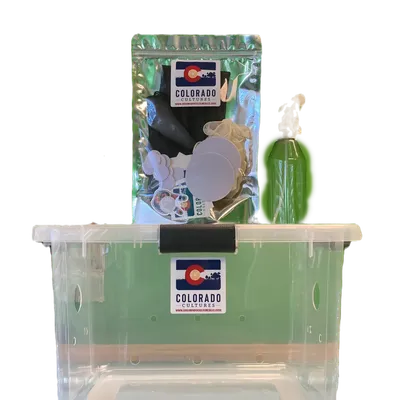
Full Flush Bin Only
Sold by Colorado Cultures
Loading feedback...
$49.99
Estimated US shipping $11.95
30-day returns
Secure checkout — Stripe & PayPal
Final shipping is calculated at checkout.
30-day money-back guarantee

The monotub problem nobody talks about
Most monotubs are a compromise. The cheap DIY route — a Sterilite tote, a Sharpie, a drill, and a roll of micropore tape — works, but it leaks at the seams, fogs over the lid, and gives you uneven fruiting where the airflow is good and contamination everywhere else. The expensive route — port filters, threaded inserts, silicone sealant — performs better but costs $40-$80 in fittings before you've added a single gram of spawn. And every cobbled-together tub has the same hidden weakness: the air movement is concentrated wherever you happened to drill, leaving dead zones where humidity pools, side-pins abort, and Trichoderma finds a foothold.
The Full Flush Bin solves this. It is the result of over a decade of iteration on the basic question — what does a monotub actually need to be? — and the answer turns out to be more specific than most growers realize.
What "full flush" actually means
Fruiting mushrooms exhale CO₂ and demand a constant influx of fresh oxygen. A 30-quart tub at peak flush, packed with cubensis or pearl oyster mycelium, can saturate its air column with CO₂ in under 30 minutes. The result you see is the result every new grower complains about: long stems, tiny caps, premature opening, and mushrooms that abort before they ever pin.
The fix is airflow. Not just a few holes near the lid, but distributed, balanced airflow that touches every cubic inch of the chamber — the corners, the substrate surface, the cake's far edge, the space directly above the pinning sites. That's what the 12-hole layout on the Full Flush Bin is engineered to deliver. Each hole is positioned and sized to create cross-currents rather than dead spots. Air enters from one side, sweeps over the substrate, and exits the opposite side — passively, without a fan, without you opening the lid to manually fan it.
What you get in one box
- A hinged lid — and this matters more than it sounds. A hinged lid means inspection, misting, and harvest happen without removing and replacing the lid each time (which is the #1 vector for airborne contamination during fruiting). It also means the lid never gets misaligned, never sits askew, and never slips off a stacked shelf.
- A spray bottle — for misting the chamber walls during fruiting and the casing layer between flushes.
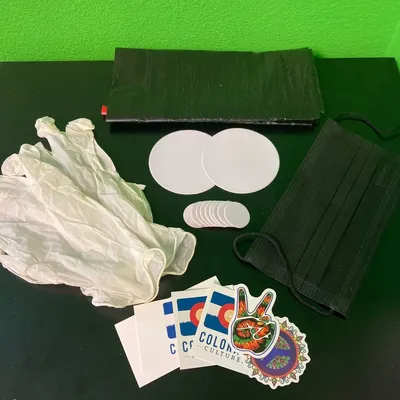
- A bin liner — sized to the tub interior for substrate loading and post-harvest cleanup. Drop the liner in, load substrate, fruit, harvest, lift the liner out, dispose of the spent block, drop in a new liner. Eliminates the worst part of monotub cultivation: scrubbing the inside of the bin between grows.
Who this is for
- First-time growers who want one purchase to cover the entire vessel-and-airflow side of cultivation. Drop in your colonized spawn and substrate, you're fruiting.
- Experienced cultivators rebuilding after a contamination wipeout, who want a known-good chamber design instead of re-engineering from scratch.
- Multi-chamber setups where you want every tub in your stack identical — same airflow, same dimensions, same humidity profile — for predictable, repeatable results across genetics.
- Anyone who's sick of taping micropore strips over hand-drilled holes and watching them sag, peel, and contaminate by week three.
Who this isn't for
- Industrial-scale or commercial cultivators running 50+ tubs. At that scale, you want HEPA-filtered flow rooms with active CFM management — not passive bin-based FAE.
- Wood-loving species in bulk fruiting blocks that need higher humidity walls than a smooth-sided polyethylene tub can hold. Reishi, lion's mane, and king trumpet do better in dedicated humidity tents.
- Anyone fruiting in volumes under a pound — a 30-quart bin is over-spec'd for a small jar grow and you'll just have empty headroom drying out your casing layer.
The Colorado Cultures pedigree
If you've already been growing in a hand-drilled tote, the upgrade pays for itself the first time you don't lose a flush to side-pin contamination. If you're just starting, it eliminates the single largest source of beginner failures — chamber-related contamination — before it can happen.