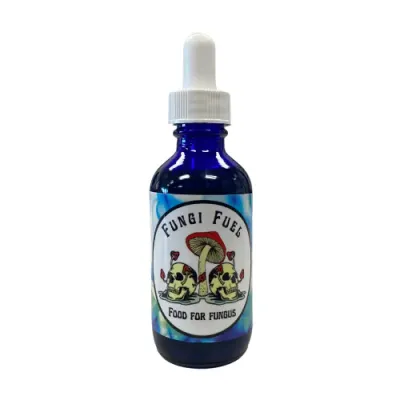

Fungi Fuel - 2oz Bottle with Dropper
Sold by Colorado Cultures
Loading feedback...
$29.99
Estimated US shipping $6.60
30-day returns
Secure checkout — Stripe & PayPal
Final shipping is calculated at checkout.
30-day money-back guarantee

The substrate problem nobody talks about
Every cultivation guide tells you the same things — "use a clean substrate," "mix at field capacity," "keep your CO₂ low and your humidity high." All true. All necessary. None of it is sufficient.
The variable nobody emphasizes is substrate biology. What's actually happening at the microscopic level inside your monotub between day 7 and day 21? A complicated mix of:
- Beneficial microbes breaking down complex carbohydrates into sugars your mycelium can metabolize
- Pioneer organisms out-competing the contaminants that snuck in despite your sterilization
- Enzymatic activity unlocking nitrogen, phosphorus, and trace minerals from the substrate matrix
- pH stabilization keeping the environment in the 6.0–7.0 sweet spot mycelium prefers
When all four of those happen on schedule, you get a fast colonization, a strong pin set, and 3–4 flushes from a single grow. When any one of them stalls, you get slow runs, stalled pinning, side-pin rot, or the dreaded "the grow that just wouldn't go."
Fungi Fuel is the additive that nudges all four in the right direction at once. A concentrated 2oz dropper bottle of substrate enhancer designed specifically for mushroom cultivation. A handful of drops at the right moment — pre-inoculation, post-spawning, between flushes — and the grow that was struggling starts moving.
What Fungi Fuel actually does
Marketed benefits are clear about the categories without overpromising:
- Boosts yields — more abundant and robust fruiting bodies per flush
- Enhances flushes — faster turnaround between fruiting cycles, more total flushes from each grow
- Fortifies against contamination — by encouraging beneficial microbe populations that out-compete Trichoderma, bacterial rot, and other common contaminants before they can establish
- Supports good bacteria — pre/probiotic-style support for the microbial community your mycelium lives alongside
- Optimizes substrate breakdown — enzymatic acceleration of the decomposition that unlocks nutrients
The mechanism isn't "feeding the mushroom" the way fertilizer feeds a plant. Mushrooms aren't plants. They don't photosynthesize. They don't have leaves to spray. What they need is a substrate that's already been partially broken down into bioavailable form — which is exactly what a well-balanced microbial community delivers.
Fungi Fuel accelerates that breakdown. The mycelium then has to do less work to extract nutrition, which means it can spend more of its energy on the things you actually care about: dense colonization, strong pinning, big fruit bodies, and second/third/fourth flushes that still produce.
When to use it
Three application windows:
- Pre-inoculation — added to bulk substrate during hydration, before pasteurization. This seeds the microbial community before mycelium arrives, setting up the environment for fastest colonization.
- Post-spawning — drops added to the surface of newly-spawned substrate to support the mycelium-substrate interface during the critical first 7 days when the spawn run is establishing.
- Between flushes — drops added after harvesting a flush, during the rest/re-hydration period. This is where the biggest yield gains hide. Most growers' second/third flushes are smaller than the first because the substrate is depleted. A re-application of Fungi Fuel re-energizes the microbial community and keeps the substrate productive for longer.
The 2oz dropper bottle is sized for a season's worth of grows at typical hobby scale — roughly 30–50 monotub-scale applications depending on dosing.
Why a dropper bottle
The dropper format matters because:
- Precision dosing — you can apply 3 drops, 5 drops, 10 drops, exactly as the application calls for, without measuring spoons or pipettes
- No waste — small applications mean no half-used bag sitting in a humid garage going rancid
The format is sized for the home cultivator who runs 1–5 grows per year, not for commercial operations. Commercial users would need the bulk-pack equivalent.
What's actually in it
Colorado Cultures' Fungi Fuel is a proprietary blend of:
These are the typical components of high-quality mycelium support products. The exact formula is proprietary to Colorado Cultures — request the SDS or label for the full breakdown.
Who buys Fungi Fuel
- Cultivators whose second/third flushes are notably smaller than the first — Fungi Fuel between flushes is the single biggest yield-recovery tool available
- Anyone running multiple monotubs in parallel where standardizing yields is the goal — consistent additive means consistent results
- Cultivators in challenging conditions — basements, garages, climates with humidity swings, or any environment where the substrate microbiome is more vulnerable to drift
- Wood-loving species growers (oysters, lion's mane, shiitake) whose substrates rely heavily on enzymatic breakdown and benefit from supplemental enzyme/microbial support
- Beginner cultivators who want to stack the deck in favor of a successful first grow — using Fungi Fuel removes one entire class of "I don't know why my mycelium stalled" failure modes
- Cultivators recovering from a contamination scare — re-establishing a healthy microbial baseline in a substrate that's been disrupted
- Anyone whose first flush is great but subsequent flushes disappoint — this is the canonical "depleted substrate" pattern, and a between-flush additive is the canonical fix
What Fungi Fuel is NOT
- Not a fertilizer. Mushrooms don't take up nutrients the way plants do. This is a microbiome and substrate-breakdown product, not a feed product.
- Not a contamination cure. If your substrate is already contaminated with green mold or bacterial bloom, no additive will save it — discard and restart. Fungi Fuel is preventive and supportive, not curative.
- Not a replacement for proper substrate prep. You still need to hydrate to field capacity, pasteurize or sterilize correctly, and maintain clean technique. Fungi Fuel optimizes a good grow into a great one; it doesn't rescue a bad one.
- Not psychoactive. Whatever you read into "Fuel your fungi," this is a substrate additive. Use as directed.
- Not species-specific. Works across cubensis, gourmets (oysters, lion's mane, shiitake), and any other species you'd grow on grain or bulk substrate.
What changes when you add it
The promise isn't magic. The promise is that the substrate is doing more of the work, so the mycelium does less, so it has more energy left over for fruiting. Practically, growers using Fungi Fuel report:
- Faster spawn runs — colonization complete in 12–16 days instead of 18–22
- Larger pins per flush — fewer scrawny side pins, more dense central clusters
- Tighter flush-to-flush timing — 7–10 days between flushes instead of 14–18
- More flushes per grow — 4 healthy flushes instead of 2 strong + 1 dribble + done
- Reduced contamination during long grows — fewer "green spot on day 30" disasters
These outcomes compound. A grow that produces 4 flushes at 80% of peak yield delivers far more total fruit than a grow that produces 2 flushes at 100% and then collapses. Across a season of cultivation, the difference is substantial.
Fitting it into your existing process
Fungi Fuel slots into the existing Colorado Cultures cultivation stack without disruption:
- With the Full Flush Bin or Full Flush Mushroom Grow Kit: Add at the bulk-substrate hydration step before sealing the lid.
- With Sorghum AIO bags or Binky Bags: Drops added at the bag-and-substrate-mix moment, not directly into the sealed grain bag.
- With Denver Dirt: Drops added during the field-capacity hydration of the Denver Dirt mix.
- With Martha tent multi-tub setups: Standardize the dose across all tubs to keep results consistent across the rack.
The 2oz size is intentional. It's enough for a serious hobby grower's annual cultivation, with shelf life to spare. If you're running 10+ monotubs in parallel, ask about bulk pricing — the per-application cost drops substantially at scale.