High Quality Coco Coir Brick - 600g
Sold by Colorado Cultures
Loading feedback...
$6.99
Estimated US shipping $11.95
30-day returns
Secure checkout — Stripe & PayPal
Final shipping is calculated at checkout.
30-day money-back guarantee

The substrate ingredient every cultivator builds with
Almost every bulk substrate recipe for mushroom cultivation contains coco coir — usually about a third of the substrate by volume. Mix it with vermiculite and gypsum, and you have CVG: the canonical, cubensis-friendly, contamination-resistant bulk substrate.
Why coco coir specifically (and not just plain soil)? Three reasons:
- Coir is a natural buffer. It holds moisture without becoming waterlogged. Mycelium can colonize it without drowning.
- Coir is contamination-resistant. Untreated soil is full of competing organisms — Trichoderma, Aspergillus, bacteria. Properly-processed coir is far cleaner from the start.
- Coir's structure is ideal for mycelium. Loose fibers create air pockets where mycelium can spread without compaction issues.
Coir is also versatile. Beyond mushrooms, it's used in:
- Hydroponic systems
- Container gardening
- Soil amendment for heavy clay
- Casing layers for cubensis fruiting
- Seed-starting mixes
- Orchid potting mix
The Colorado Cultures 600g Coco Coir Brick is the dry, compressed, ready-to-rehydrate form — shipped in a tight brick that expands to approximately 8-10 liters of usable coir when hydrated. Convenient, lightweight, shelf-stable, and ready to mix.
What a coco coir brick is
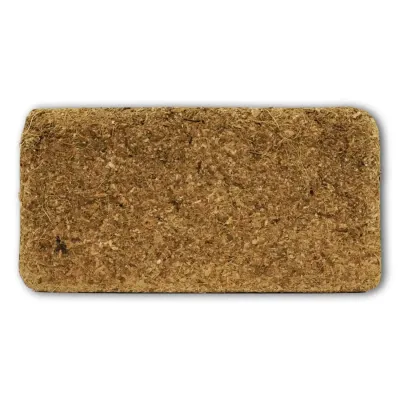
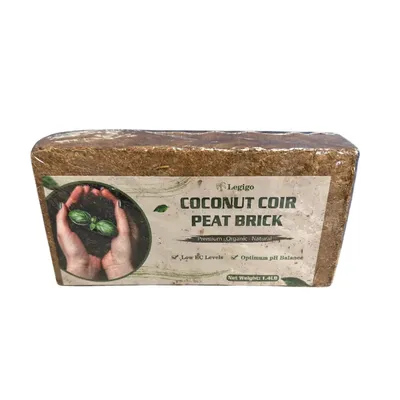
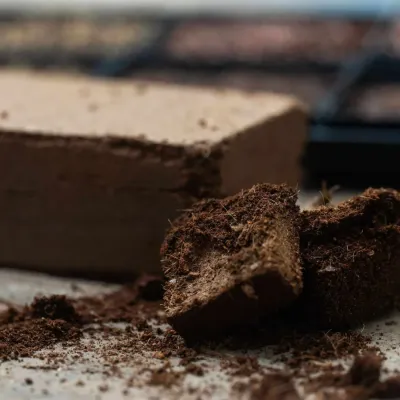
The brick is 600 grams of dry, compressed coconut coir fibers — pressed under significant force into a dense, hardened block roughly the size and weight of a typical paperback book.
When you add water (typically 4-5 liters), the brick expands and breaks apart into the loose, fluffy growing medium that mushroom cultivation requires. The expansion is dramatic — a 600g brick becomes about 8-10 liters of expanded coir, enough for multiple bulk substrate batches or a substantial amount of plant-medium.
The dry, compressed form has several practical advantages:
- Shelf-stable — Coir is unaffected by humidity or temperature; the brick can sit in a closet for years without degradation
- Lightweight to ship — 600g of dry coir vs. 10+ kg of pre-hydrated coir; massive shipping cost reduction
- Easy to store — A single brick is much smaller than the expanded volume
- Predictable hydration — You add water exactly when you need it; no pre-hydrated bag arriving wet, drying out unpredictably, or shifting consistency
What's in the brick (and what's not)
The 600g brick contains:
- 100% pure coconut coir fibers
- No fertilizers (raw coir is uniquely chemically nutrient-poor by design)
- No pesticides
- No fungicides
- No coloring or dye
- No bulking agents or fillers
This matters for mushroom cultivation:
- Pre-fertilized coir (often labeled "garden coir" with NPK supplementation) is NOT suitable for mushroom cultivation — the added nitrogen feeds bacteria and contaminants more than mycelium
- Pre-bleached or color-treated coir may contain residues that interfere with mycelium growth
- Raw, unmodified coir (like this brick) gives you full control over what gets added to the substrate
The CVG formula (Coco Coir + Vermiculite + Gypsum)
The canonical mushroom substrate formula:
Component | Proportion | What it does |
|---|---|---|
Coco coir | 1 brick (600 g dry) | Bulk and water retention — the body of the substrate |
Vermiculite | About 1 quart per brick | Aeration and a moisture reservoir; keeps the mix from compacting |
Gypsum | Roughly 2-5% by volume | Calcium and sulfur; reduces clumping and buffers pH |
Boiling water | About 4 quarts | Hydrates the brick and pasteurises it as it cools |
Target moisture | Field capacity | A firm squeeze yields a few drops, not a stream |
A typical monotub-sized batch:
- 1 part hydrated coir (from one brick — yields ~8-10L)
- 1 part vermiculite (1lb or about 4 quarts)
- ~2-3 tablespoons gypsum
- Water to bring the mix to field capacity (squeezable but not dripping)
This makes enough substrate for 1-2 large monotubs, depending on tub size and substrate depth.
How a brick expands
When you add water to a 600g coir brick:
- Dry brick: ~600 g, ~600 cm³ (size of a brick)
- Hydrated coir: ~5,000 g, ~8,000-10,000 cm³ (size of a tub)
Expansion ratio: roughly 8-10× volume and 8× weight.
The expansion happens in stages:
- Surface absorption (first 5-10 minutes) — the outermost layer absorbs water and softens
- Penetration (15-30 minutes) — water works its way deeper into the brick
- Complete breakdown (60-90 minutes with stirring) — the brick falls apart into loose fibers and clumps
- Final hydration (2-4 hours total) — coir reaches uniform field capacity
For best results, hydrate the brick in a large container — the expansion is dramatic and a 2-gallon bucket is comfortable for a 600g brick.
Use cases beyond mushroom substrate
Casing layer
A thin top layer applied to monotub substrate after colonization, before fruiting:
- Provides moisture and humidity microclimates that encourage pin formation
- 1/4" to 1/2" of moist coir spread over colonized substrate
- Misting can wet the casing without saturating the underlying substrate
Indoor plant medium
- Soilless potting mix for tropical plants, ferns, monsteras
- Holds water without waterlogging
- Lightweight; easier to manage than peat-based mixes
- Sustainable alternative to peat moss
Outdoor garden amendment
- Mix into heavy clay soils to improve drainage and aeration
- Adds organic matter without depleting nitrogen as it decomposes
- Lasts longer than peat in outdoor conditions
Hydroponic systems
- Common medium for hydroponic vegetables and herbs
- Holds water and dissolved nutrients without compacting
Seed-starting mix
- Sterile, contaminant-free medium for delicate seedlings
- Mix with vermiculite and peat for a complete seedling mix
Worm bedding (vermicomposting)
- Compostable bedding for vermicompost bins
- Worms thrive in moist coir conditions
Pet bedding
- Suitable bedding for reptile and amphibian enclosures
- Holds humidity required for many species
- Non-toxic and natural
Why this coir vs. cheap garden-center coir
Quality varies enormously across coco coir products. Premium coir like this product is:
- Naturally aged — fresh coir has high tannin and salt content that's harmful to mycelium and plants; aged coir has stabilized
- Salt-washed — coconut husks naturally absorb salt; quality coir is rinsed to remove
- Properly compressed — high-pressure compression keeps the brick stable in storage
- Single-source — typically sourced from a single producer for consistency; cheap coir blends low-quality and high-quality batches
- Properly screened — fines and large fibers are screened to a consistent particle size
Cheap garden-center coir often:
- Has high salt content that requires rinsing before use
- Has residual chemicals from processing
- Contains broken-down material that fragments rapidly
- Is mixed with peat or other fillers
For mushroom cultivation specifically, starting with quality coir is the foundation — bad coir is the source of much "I don't know why my grow failed" mystery contamination.
Who buys this
- CVG-using mushroom cultivators — the canonical use case
- Cultivators using casing layers for cubensis fruiting
- Multi-tub cultivators who need substantial substrate ingredients on hand
- Anyone running CC's Full Flush Bin or Mushroom Grow Kit — coir is the bulk substrate base
- Home gardeners integrating coir into soil-amendment routines
- Hydroponic gardeners using coir as the growing medium
- Houseplant collectors wanting a clean, sustainable potting medium
- Vermicomposting hobbyists
- Reptile and pet keepers using coir as bedding
- Cost-conscious cultivators who buy bricks for transport efficiency and rehydrate as needed
What this is NOT
- Not a complete substrate. Coir alone won't produce a good mushroom substrate — you need vermiculite for moisture retention and gypsum for pH stabilization.
- Not a fertilizer. Coir is intentionally nutrient-poor. Add your own substrate inputs (Fungi Fuel, etc.) for additional nutrient support.
- Not for direct grain spawn. Coir is a bulk substrate ingredient, not a grain spawn alternative. Use grain (rye, sorghum, popcorn) for spawn.
- Not pre-sterilized. You'll pasteurize or sterilize your substrate after combining coir with vermiculite and gypsum.
- Not pesticide-resistant. If your environment has gnats, mites, or other substrate pests, you'll need additional controls (the Colorado Cultures Gnat B Gone is one option for monotub gnats).
- Not interchangeable with peat moss. Coir and peat behave differently in substrate; recipes calling for peat may not perform identically with coir.
- Not lightweight after hydration. A 600g brick becomes ~5kg of hydrated coir. Plan for lifting and transport.
Pairing with Colorado Cultures products
Coir is the substrate foundation; it pairs with virtually every cultivation product:
- Vermiculite 1lb — the canonical CVG partner
- Premium Gypsum 1lb — pH and mineral stabilization for the substrate
- Magical Gypsum 3.0lbs — alternative gypsum for serious cultivation
- 5lb Denver Dirt Premium Substrate — alternative to making CVG yourself (pre-pasteurized)
- DIY CVG Kit — pre-measured ratio kit including coir, vermiculite, and gypsum
- Full Flush Bin / Full Flush Mushroom Grow Kit / H2Shroom Fruiting Chamber — chambers to fruit your coir-based substrate in
- Sorghum AIO grain bags / Binky Bags — grain spawn to mix with the coir substrate
- Fungi Fuel — substrate enhancer to add at the hydration stage
- Gnat B Gone — pest control for monotub gnats
- Ultrasonic Humidifier + Hygrometer — chamber environment controls for the fruiting stage
Storage and shelf life
The brick is exceptionally shelf-stable:
- Dry storage: Indefinite shelf life — store in a cool, dry location away from pests
- Hydrated coir storage: Once hydrated, use within 1-2 weeks for best results; refrigerate to extend life
- Long-term: A brick in a closet 3+ years old will hydrate and perform like a fresh brick
A note on sustainability
Coconut coir is a byproduct of coconut processing — the husks would otherwise be discarded. Coir is a sustainable alternative to peat moss, which is harvested from slowly-regenerating bogs. Switching from peat to coir is one of the easier sustainability choices in cultivation.