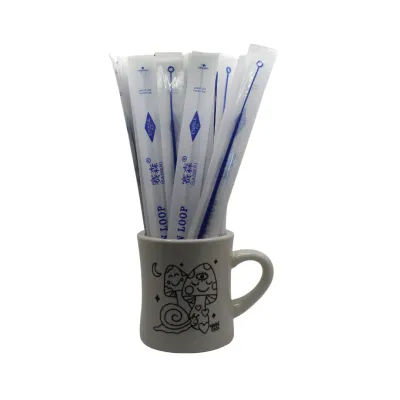
Inoculation Loop - Single
Sold by Colorado Cultures
Loading feedback...
$2.49
Estimated US shipping $6.60
30-day returns
Secure checkout — Stripe & PayPal
Final shipping is calculated at checkout.
30-day money-back guarantee

The agar tool every serious cultivator needs
Most home cultivators start with grain-spawn workflows — direct injection of liquid culture or spore syringe into a sterilized grain bag, then bulk substrate, then fruiting. It works. Generations of cultivators have produced thousands of pounds of mushrooms exactly this way.
But there's a higher tier of cultivation that grain-spawn-only workflows can't reach: agar work. Specifically:
- Isolating clean genetics from a multi-spore syringe
- Selecting and propagating the strongest mycelial sectors for breeding programs
- Recovering valuable cultures that have become contaminated or mutated
- Cloning a single specific mushroom fruit body by tissue transfer
- Storing genetics long-term as agar wedges in the refrigerator
- Spore-print culturing from harvested or wild-found specimens
Every one of these techniques depends on moving small amounts of mycelium, spore mass, or tissue between agar surfaces with sterile precision. That requires the right tool: an inoculation loop.
The Colorado Cultures Inoculation Loop - Single is exactly that tool. A pre-sterilized, ready-to-use inoculation loop, individually packaged, designed for agar plate work, mycelial transfer, and spore streaking. The "single" designation indicates this is the entry-level option — one loop per package, ideal for the cultivator running occasional agar work or buying ahead for replacement.
What an inoculation loop does
An inoculation loop is a small wire-tipped or plastic-tipped tool with a flat circular loop at the end. The loop is sized to hold a small volume of liquid, mycelium, or spore mass via surface tension and physical contact.
In cultivation practice, the loop is used to:
1. Streak agar plates
Drop a small volume of spore solution or LC onto an agar plate, then use the loop to streak it across the plate surface in a zig-zag pattern. This dilutes the spore mass as you streak, so isolated colonies grow in the dilute end of the streak. Those isolated colonies represent single-strain genetics — the foundation for clean genetic isolation.
2. Transfer mycelial sectors
Once isolated colonies grow on a streaked plate, use the loop to pick a single colony and transfer it to a fresh agar plate. This is "rescuing" or "isolating" a clean genetic from a multi-spore mix. Repeating this isolation across 2-3 generations produces a guaranteed-clean monoculture suitable for grain spawn inoculation.
3. Spore-print culturing
Drag the loop across a spore print to pick up a small mass of spores, then transfer to a freshly-poured agar plate. This is the standard method for starting a new culture from a harvested or foraged spore print.
4. Wedge cuts and slant cultures
For long-term genetics storage, use the loop (or a flame-sterilized scalpel) to cut and transfer agar wedges from a colonized plate to slant tubes for refrigerated storage.
5. Liquid culture preparation
When making your own LC from agar, the loop is used to transfer a small mass of mycelium from an agar plate to a sterilized broth solution. The transferred mycelium then colonizes the broth, producing usable LC.
Why the "single" version
This product is one loop per package, pre-sterilized and individually sealed.
The single format is right for:
- First-time agar workers who want to try out the tool before committing to bulk packaging
- Replacement loops when your existing supply runs low
- Specific genetics projects where you want a known-fresh loop for a particular important culture
- Travel or remote work where you need one tool for a specific application
- Casual home cultivators who do agar work occasionally but not constantly
If you're running production-scale agar work (10+ plates per week), look for multi-pack inoculation loops which offer better per-unit pricing.
What makes this sterile
The loop comes individually packaged in sealed sterile packaging. The packaging acts as the sterility guarantee — once you open the package, the loop is sterile until it contacts anything non-sterile.
The single-use designation matters: this is a "use once, dispose" tool, not a "use and re-sterilize" tool. If you have repeat-use loops (typically metal wire loops you re-flame between uses), those work differently and require flame sterilization between every use. The pre-sterilized single loops are easier to use and produce more reliable results for cultivators who don't have flame-sterilization workflows.
Workflow examples
From multi-spore syringe to clean monoculture (typical first-week agar protocol)
- Day 1: Pour fresh agar plates (4-6 plates) in a still air box. Allow to set.
- Day 1: Drop 0.1-0.2 mL of spore syringe onto one fresh plate.
- Day 1: Use inoculation loop to streak the drop across the plate in a "T" pattern (initial streak, then 3 perpendicular passes).
- Days 2-7: Watch for individual colonies to develop along the streak path.
- Day 7-10: Pick a strong, clean-looking colony with a fresh inoculation loop. Transfer to a fresh plate.
- Days 10-14: Watch the transferred colony grow.
- Day 14: If clean, this is your isolated monoculture. Use for grain spawn inoculation or further propagation.
The inoculation loop is used at step 3, step 5, and any further isolations. For a single complete isolation cycle, one loop is sufficient for the entire process — you'll use a fresh one for each transfer step.
Recovering valuable genetics from contamination
If a culture you've worked with starts showing contamination but the underlying genetic is valuable:
- Open the contaminated plate in a still air box.
- Identify a clearly-uncontaminated sector — typically the leading edge of the mycelium, far from the contamination source.
- Pick that sector with an inoculation loop and transfer to a fresh plate.
- Allow to grow for 5-7 days.
- Repeat isolation 1-2 more times to be confident the contamination is purged.
A valuable genetic can often be saved this way. The inoculation loop is the precision tool that makes this possible.
Cloning from a fruited mushroom
If you've grown a particularly impressive mushroom and want to clone the genetic:
- Open a fresh agar plate in a still air box.
- Cut the mushroom near the cap-stem junction with a sterile scalpel.
- Pick up a small piece of internal tissue with an inoculation loop (the interior of the mushroom is the cleanest, least-contaminated zone).
- Place the tissue piece on the agar plate, then gently press with the loop tip to ensure good contact.
- Incubate at 70-78°F.
- Within 2-7 days, mycelium will spread from the tissue across the plate. This is a clone of the parent mushroom.
Who buys this
- Agar workers of any scale — even occasional agar work requires fresh sterile loops
- Cultivators isolating genetics from multi-spore syringes — the canonical agar use case
- Cultivators cloning specific mushroom fruit bodies — tissue transfer with the loop
- Cultivators recovering contaminated cultures — sector isolation requires precision
- Spore-print collectors — starting cultures from prints needs a loop
- Genetics propagation enthusiasts — long-term storage and isolation workflows
- Mycology students and researchers — standard lab tool
- Anyone using the Colorado Cultures Pre-Poured Agar Plates 10-pack — these loops are the natural companion product
What this is NOT
- Not for grain spawn inoculation directly. Use a syringe and needle for grain bag injection, not a loop.
- Not a substitute for a sterile workspace. A loop is sterile until it contacts something non-sterile; you still need a still air box or laminar flow hood for clean agar work.
- Not re-usable. This is single-use. For repeat-use, consider a wire loop you flame-sterilize between uses.
- Not designed for non-mushroom cultivation. While the tool would technically work for bacterial or plant tissue culture, this product is positioned for mushroom cultivation specifically.
- Not a complete agar kit. You'll need agar plates, an inoculant source (spores, LC, or tissue), a sterile workspace, and other tools beyond just the loop.
Pairing with other Colorado Cultures products
- Pre-Poured Agar Plates 10-pack — the natural companion. Loops are useless without plates.
- Sterile Disposable Scalpels #11 — for the moments when a scalpel is the right tool (wedge cuts, tissue extraction)
- Sterilized Syringes (10mL Luer-Lock) — for inoculant delivery onto plates
- Portable Still Air Box — the sterile workspace where you'll use the loop
- 2'x2' Laminar Flow Hood — for higher-volume agar work
- 6" Sterile Cotton Wood Swabs — for cleaning surfaces during plate work
- 99% IPA Spray Bottle — for surface sterilization during the workflow
A typical first-time agar setup combines: Still Air Box + Pre-Poured Agar Plates + Inoculation Loop (single) + Sterile Scalpel + Cotton Swabs + IPA Spray. This is roughly the complete entry-level agar kit.
A note on quality
Inoculation loops vary widely in quality across suppliers. Quality markers to look for:
- Sealed sterile packaging (vs. loose packaging that may have been opened or contaminated)
- Consistent loop diameter (irregular loops produce irregular streak patterns)
- Smooth loop surface (rough or burred loops can damage the agar surface)
- Long-handle design (allows for steady control during streaking)
- Heat-resistant handle (allows for occasional flaming if you want belt-and-braces sterilization beyond the pre-sterilized state)
The Colorado Cultures inoculation loop meets these markers. For higher-volume work where you'll use 10+ loops per session, ask about multi-packs to reduce per-loop cost.