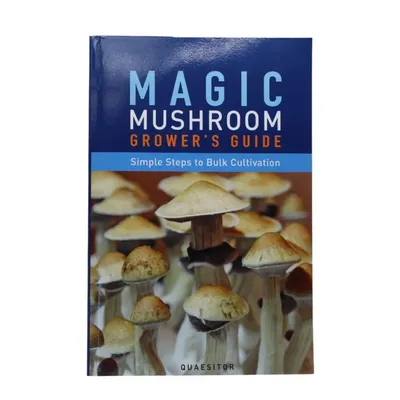
Magic Mushroom Growers Guide Book
Sold by Colorado Cultures
Loading feedback...
$26.99
Estimated US shipping $7.70
30-day returns
Secure checkout — Stripe & PayPal
Final shipping is calculated at checkout.
30-day money-back guarantee

The simple-steps cultivation guide for bulk grow operations
There is a particular kind of cultivation book the mycology community has been quietly recommending for decades. Not the encyclopedic deep-dives (those have their place — see The Mushroom Bible, also in the Colorado Cultures lineup). Not the ecosystem-scale manifestos (see Mycelium Running by Paul Stamets). But the practical, step-by-step, bulk-cultivation-focused book that takes a serious home grower from beginner to confident in measurable, replicable steps.
The Magic Mushroom Growers Guide Book is that book. It is a practical instruction manual with a deliberate focus on bulk cultivation methods — the substrate-and-spawn-mixed-in-monotub approach that produces real harvests at home, not just demo-scale results.
The book opens with the long view: psilocybin mushrooms have been shaping human perception from the earliest stages of recorded history. As humanity faces an uncertain future, this most ancient of tools can help us realize our fullest cognitive, spiritual, and physical potentials. That framing sets the tone — this isn't a "drug guide" or a "how to get high" manual. It's a serious cultivation reference grounded in respect for the lineage and the practice.
From that opening, the book delivers what most beginners actually need: clear, sequential, illustrated steps for bulk mushroom cultivation at home.
What "bulk cultivation" means
The phrase "bulk cultivation" distinguishes this approach from older home-grow methods:
- BRF cake cultivation — the classic 1990s home-grow method using brown rice flour cakes in jars. Works, but produces small flushes from each jar.
- Spore syringe direct-to-substrate — sometimes called "PF Tek" but used informally; works but inefficient.
- Bulk cultivation (the modern standard) — colonize grain spawn separately, then mix the colonized spawn into a much larger volume of bulk substrate (CVG, manure, etc.) for fruiting. Produces dramatically larger harvests than older methods.
Bulk cultivation is what every commercial cubensis grower uses. The Magic Mushroom Growers Guide Book teaches the home version of that workflow — same technique, smaller scale, complete with the workspace setup, sterilization, inoculation, colonization, and fruiting protocols.
What's inside
- Introduction and context — history of psilocybin cultivation, why bulk methods matter
- Workspace setup — what equipment matters, what doesn't, how to build a clean home cultivation space
- Sterilization fundamentals — pressure cooker basics, sterile technique principles
- Inoculation — spore syringe and liquid culture techniques
- Grain spawn — substrate selection, hydration, sterilization, inoculation, shake-and-break
- Bulk substrate preparation — CVG, manure-based, and alternative substrate recipes
- Spawn-to-substrate mixing — ratios, technique, timing
- Casing layer — when, why, how
- Fruiting chamber design — monotub building, ventilation, humidity, lighting
- Pin formation and fruiting — environmental targets, timing, what to expect
- Harvest — when to pick, how to pick, between-flush care
- Drying and storage — preservation methods, long-term storage protocols
- Troubleshooting — contamination identification, common failures and recovery
- Glossary and references
The book's strength is in the step-by-step structure — each major task is broken into sequential numbered steps that a first-time grower can follow without prior experience.
How this book compares to The Mushroom Bible
The Colorado Cultures lineup includes two major cultivation reference books:
The Mushroom Bible is the deeper reference; the Magic Mushroom Growers Guide is the leaner workflow guide. Many cultivators own both and use them complementarily — the Bible for understanding the why, the Growers Guide for the step-by-step how.
If you only buy one cultivation book before your first bulk grow, the Magic Mushroom Growers Guide is often the better choice — it's tighter, more action-oriented, and gets you to a successful first grow faster. The Bible is the book you graduate to after you've done a few grows and want deeper context.
Why this book exists
The cultivation literature has gone through several generations:
- 1970s-80s: Mostly underground guides, photocopied, technically accurate but legally dicey
- 1990s: First widely-published bulk cultivation books, mostly focused on jar-and-cake methods
- 2000s-2010s: The Mushroom Cultivator (Stamets) and similar academic-leaning works
- 2010s-2020s: Modern simple-steps guides focused on the monotub/CVG bulk method that has become dominant
- Present: Specialized works (this book and similar) that focus tightly on the bulk method workflow
The Magic Mushroom Growers Guide is in this present generation — recognizing that most home cultivators today use the bulk method, and providing a focused guide to that specific approach without the legacy material from older methods.
Who buys this book
- First-time bulk-method cultivators who want a focused workflow guide
- Cultivators who have done a few grows but want a more systematic approach
- People who own The Mushroom Bible but want a leaner, more action-oriented companion
- Gift recipients in the cultivation-curious community
- Cultivation educators and workshop instructors who want a recommended student text
- Anyone who has tried PF Tek or jar-based cultivation and wants to graduate to bulk methods
Why having the printed book matters
Free online cultivation guides exist, but printed cultivation books have specific advantages:
- Available during the actual grow — you don't want to be scrolling through forums while your gloves are sterile
- Edit history visible — major cultivation books have been peer-reviewed and refined; random online posts haven't
- Self-contained reference — a book covers the entire workflow in one trusted source
- No advertising or distraction — focus on the cultivation work, not on engagement metrics
- Long-term reference value — books on your shelf are accessible for years; webpages disappear
For a serious cultivation practice, a small library of trusted printed references is part of the standard kit. The Magic Mushroom Growers Guide is one of the foundational titles.
What this book is NOT
- Not a field guide for identification. This is a cultivation guide for known-species cultivation; not a wild mushroom identification reference.
- Not a deep mycological reference. For fungal biology depth, see Mycelium Running by Stamets.
- Not focused on wood-loving species. Oysters, lion's mane, reishi all use different substrate approaches; specialized books cover those better.
- Not a substitute for hands-on practice. Reading the book front-to-back doesn't replace the actual experience of running your first grow.
- Not legal advice. Cultivation legality varies by jurisdiction. The book describes the workflow; you're responsible for your local legal compliance.
- Not an ideological argument about psychedelics in society. The book mentions the broader context briefly in the introduction, then focuses on the technical cultivation work.
For everyone in the bulk-cultivation target audience, this is the right book at the right time — focused, accessible, and oriented toward actual successful grows rather than theory or history.
Pairing with other Colorado Cultures resources
The book sits within a complete cultivation curriculum:
Books:
- The Mushroom Bible (Dr. K. Mandrake) — comprehensive cultivation reference
- Magic Mushroom Growers Guide Book (this product) — bulk-method workflow
- Mycelium Running (Paul Stamets) — ecosystem and applied mycology
- The Mushroom Chef Cookbook — culinary applications
- Breaking the Veil — advanced genetics
- The Mushroom Bible: Step by Step — companion volume
Supplies for hands-on practice:
- Grow kits — Gro Magik, Full Flush, H2Shroom
- Standalone substrate — CVG, Denver Dirt, Masters Mix
- Spawn bags — Sorghum AIO, Binky Bags
- Sterilization and lab equipment — Still Air Box, Flow Hood, Pre-Poured Agar Plates
- Tools and consumables — Scalpels, Cotton Swabs, Sealing Film
The book provides the workflow; Colorado Cultures' supplies provide the means to execute it.