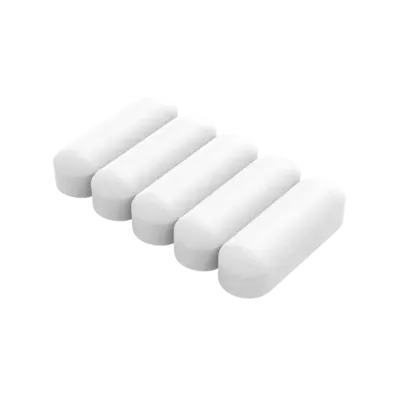
Magnetic Stir Bars
Sold by Colorado Cultures
Loading feedback...
$2.49
Estimated US shipping $6.60
30-day returns
Secure checkout — Stripe & PayPal
Final shipping is calculated at checkout.
30-day money-back guarantee

The small lab tool that doubles LC propagation speed
If you've used the Colorado Cultures Blank Liquid Culture Jar with Magnetic Stir Rod (sister product), you already know why magnetic stir bars matter — the stir rod inside that jar spins continuously when placed on a magnetic stirrer, agitating the LC medium to prevent mycelial clumping and dramatically speeding up culture propagation.
The Magnetic Stir Bars (this product) are the standalone version of that stir rod technology — sold separately for cultivators who want to add magnetic stirring to:
- Custom DIY LC jars they've built themselves
- Replacement for worn-out stir rods in existing Blank LC jars
- Multi-jar setups where stockpiling stir bars makes sense
- Lab applications beyond LC propagation — agar preparation, sterile water mixing, custom protocols
The stir bars are lab-grade magnetic stirring elements — engineered for consistent, hands-free agitation in laboratory, home, or DIY settings.
Why magnetic stirring matters in mycology
Liquid culture propagation has a hidden bottleneck: mycelium clumps in still liquid.
A drop of LC introduced into a sterile medium grows as a single mycelial mass. Only the outer surface of this mass accesses fresh nutrients; the interior is starved and stagnant. The result:
- Slow growth — only the surface area can absorb nutrients
- Uneven mycelium — clumpy, ropy growth rather than evenly distributed
- Variable inoculation outcomes — drawing from a clump may pull contaminated centers or empty surrounding fluid
Magnetic stirring solves this by continuously agitating the LC medium:
- Mycelial fragments separate across the entire medium
- Every cell accesses fresh nutrients continuously
- Growth rate doubles or triples vs. still-liquid LC
- Final mycelium distribution is uniform — inoculation samples are consistent
- Less manual intervention required — set it and forget it
For active cultivators, magnetic stirring is the most impactful single improvement you can make to LC propagation workflow.
What a magnetic stir bar actually is
A magnetic stir bar is a small magnet-encased rod that fits inside a vessel (LC jar, beaker, flask). When the vessel is placed on a magnetic stirrer plate (sold separately), the plate's rotating magnetic field causes the bar to spin inside the vessel.
The construction:
- Strong neodymium or ferrite magnet inside the bar
- PTFE or glass coating outside — chemically inert, doesn't react with cultivation fluids
- Cylindrical shape typically 1-2 inches long
- Smooth surface that doesn't catch mycelium or scratch the vessel interior
The result: a self-contained, sealed magnetic element that can be inserted into any vessel and spun externally by a magnetic stirrer.
What this 2-pack delivers
Typical magnetic stir bar packs include:
- 2 stir bars of the same size, OR
- Multiple sizes for different vessel sizes
- PTFE-coated or glass-encased depending on the model
- Standard 1-2 inch length for typical mycology applications
The 2-pack format supports:
- Multiple LC jars running simultaneously
- Backup stir bar in case one is lost or damaged
- Different sizes for different applications if the pack includes variety
- Cost-effective bulk pricing vs. individual purchase
Standard mycology applications
LC propagation (primary use)
Insert a stir bar into a Blank LC jar or DIY LC vessel. Place the jar on a magnetic stirrer. The stir bar spins continuously, agitating the LC medium and accelerating propagation.
Sterile water preparation
For preparing sterile water with dissolved nutrients (LME, salts, etc.):
- Add the dry components to water in a beaker or jar
- Insert a stir bar
- Stir on magnetic stirrer until dissolved
- Sterilize the solution per protocol
Agar preparation
For preparing agar plates from powder:
- Combine water and agar powder in a beaker
- Insert a stir bar
- Heat with stirring on a hot-plate magnetic stirrer (some stirrers combine heating + stirring)
- Stir continuously during heating to prevent burning
- Pour into plates when at appropriate temperature
Multispore syringe preparation
For combining spore prints with sterile water:
- Add water and spore print to a clean container
- Insert a stir bar
- Stir continuously on magnetic stirrer
- Helps dissolve and distribute spores uniformly
General lab mixing
Any application requiring continuous, hands-free agitation:
- Dye solutions
- Buffer solutions
- Sample preparation
- Custom protocols
Who buys magnetic stir bars
- LC propagation enthusiasts building custom or DIY LC setups
- Cultivators replacing worn stir rods in existing Blank LC Jars
- Multi-strain genetics workers running multiple LC jars simultaneously
- Researchers doing controlled cultivation experiments
- Educators and demo presenters showing the LC workflow
- Lab and small-batch chemistry workers outside of mycology
What this is NOT
- Not a complete LC vessel. Stir bars work inside vessels; they don't replace vessels. Pair with Blank LC Jars (sold separately) or custom DIY containers.
- Not a magnetic stirrer. The bars are the spinning component; you need a magnetic stirrer plate (also called magnetic mixer) to spin them. Stirrers sold separately.
- Not autoclavable without verification. Most PTFE-coated stir bars are autoclavable, but verify specifically with the supplier before pressure-cooking.
- Not for very small volumes under 10ml. Small volumes don't stir effectively due to surface tension; use a micro-stirrer for those applications.
- Not for very large volumes over 1L. Large volumes require larger or multiple stir bars.
Why this is the upgrade from manual agitation
Cultivators new to LC sometimes manually shake LC jars 2-3 times per day to agitate the medium. This works, but:
- Inconsistent agitation — depends on remembering and being available
- Less effective than continuous stirring — manual shakes are brief events vs. continuous flow
- Risk of opening the jar for some manual mixing techniques
- Time consuming for ongoing cultivation work
Magnetic stirring eliminates all of this — once set up, the system runs continuously without human intervention. The LC develops faster, more uniformly, and with less labor.
The magnetic stirrer requirement
Magnetic stir bars require a magnetic stirrer plate (Colorado Cultures' Magnetic Stir Plate is the companion product). The stirrer is:
- A small electric motor with a rotating magnet
- Plug-in operation (typical 110V AC)
- Variable speed control (50-1500 RPM typical)
- Compact form factor — sits on a benchtop
The stirrer is a one-time purchase that supports many years of stir bar use. A single magnetic stirrer handles one LC jar at a time; multi-position stirrers handle 4-6 jars simultaneously.
For active cultivators, the stir bar + stirrer combination is the most impactful equipment upgrade for serious LC work.
What "high-performance" means
The stir bars are marketed as high-performance, meaning:
- Strong magnetic field for consistent spinning
- Smooth coating that doesn't catch mycelium or substrate
- Durable construction for many use cycles
- Compatible with standard magnetic stirrers
- Reliable spinning at typical RPM ranges (50-1000 RPM)
The premium grade matters because cheap stir bars can:
- Lose magnetic strength over time
- Develop coating defects that snag mycelium
- Stop spinning at higher speeds (rotor cogging)
- Damage vessel surfaces with imperfect coating
Quality stir bars deliver years of reliable service; cheap ones may need replacement after months.
Pairing with Colorado Cultures supplies
The stir bars work with:
- Blank Liquid Culture Jars — for primary LC propagation
- Magnetic Stir Plate (sold separately) — the motor that spins the bars
- DIY LC vessels — for custom builds
- Lab beakers and flasks — for agar preparation, sterile water mixing
- Custom containers — for any lab application requiring continuous stirring
A complete LC propagation setup includes:
- Blank LC Jar (with stir bar included)
- Magnetic Stir Plate (sold separately)
- Replacement stir bars (this product) as needed
- Source LC or inoculant for the jars
Long-term value
The stir bars are a modest investment with multi-year service life:
- Per-bar cost: Less than a single LC jar
- Service life: Many years with proper care
- Reusable across many cultivation cycles
- Sterile-compatible with standard 70% IPA wipe-downs
For active cultivators, the stir bar 2-pack supports dozens of LC propagation cycles with minimal ongoing investment.
What "hands-free" means in practice
Manual mixing requires:
- Daily attention to shake jars
- Risk of forgetting during busy periods
- Brief, inconsistent agitation when you do shake
- Manual labor for ongoing cultivation work
Magnetic stirring delivers:
- 24/7 continuous agitation
- No forgetting — set the stirrer, it runs until you stop it
- Uniform, sustained agitation throughout the entire propagation
- Zero labor during the cultivation work itself
For cultivators running multiple LC jars or doing serious genetics work, the labor savings alone justifies the stir bar + stirrer investment.
Choosing the right stir bar size
Different vessel sizes work best with different stir bar sizes:
| Vessel size | Recommended stir bar |
|-------------|---------------------|
| Small (50-200 mL) | 1/2" - 1" stir bar |
| Medium (200-500 mL) | 1" - 1.5" stir bar |
| Large (500 mL - 1 L) | 1.5" - 2" stir bar |
| Very large (over 1 L) | 2"+ stir bar |
For standard pint Blank LC jars, 1-1.5" is typical. For quart jars, 1.5-2" works better.
Building your LC propagation system
The Colorado Cultures LC propagation lineup includes:
- Blank Liquid Culture Jar with Stir Rod — complete LC system
- Magnetic Stir Bars (this product) — replacement or DIY use
- Magnetic Stir Plate — the motor for stirring (sold separately)
- Various liquid cultures — for inoculation
- Sterile inoculation supplies — needles, syringes, IPA, gloves
A complete setup costs more upfront but pays back through doubled or tripled LC propagation speed vs. manual methods.
When stir bars wear out
Signs a stir bar should be replaced:
- Coating damage — visible cracks or chips in the PTFE/glass
- Spinning irregularly — possible internal magnet weakening
- Stopping mid-cycle — magnetic coupling has failed
- Discoloration or staining that won't clean off
- Mycelium catching consistently — coating may be roughened
With proper care, a stir bar should last 5-10 years of regular use. The 2-pack provides backup so one is always ready.