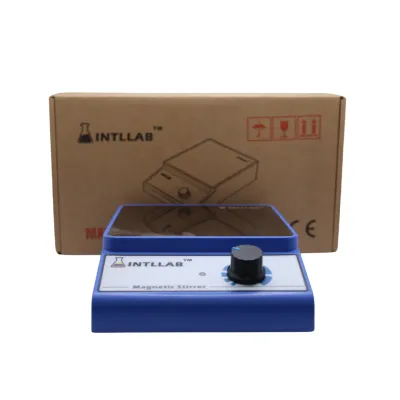
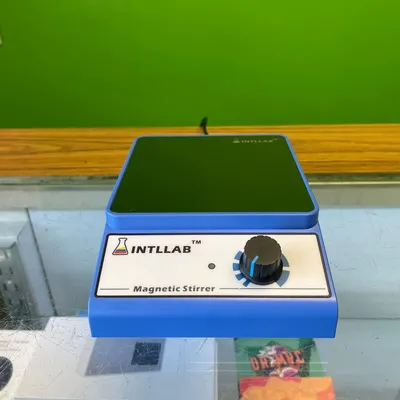
Magnetic Stir Plate
Sold by Colorado Cultures
Loading feedback...
$44.99
Estimated US shipping $11.95
30-day returns
Secure checkout — Stripe & PayPal
Final shipping is calculated at checkout.
30-day money-back guarantee

The lab tool that transforms liquid culture work
Liquid culture (LC) is the propagation tool that experienced cultivators graduate to. Instead of buying or producing spore syringes, you take a small piece of mycelium from agar (or grain spawn) and grow it in a sterile liquid medium. The result: a multiplied, vigorous, ready-to-inject inoculant that can spawn dozens of grain bags from a single source culture.
The bottleneck in LC production is stirring. Mycelium grown in a still container forms dense clumps that won't pass through a syringe needle. Hand-shaking the jar 10 times a day works marginally but causes shear damage to mycelium. Mechanical stirring is the right answer — but it has to be the right kind.
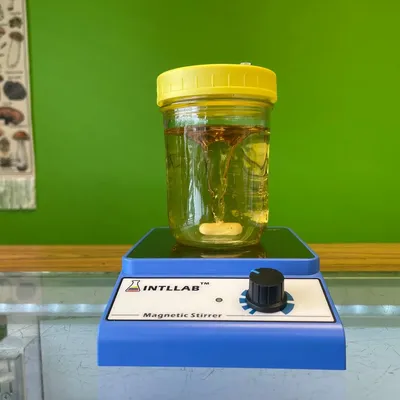
A magnetic stir plate solves this elegantly. A spinning magnetic field drives a coated stir bar inside your LC jar, gently and continuously circulating the broth to:
- Keep mycelium suspended as small fragments rather than clumps
- Distribute nutrients evenly through the culture
- Promote even oxygenation of the broth
- Prevent dense mycelial mass formation at the jar bottom
The Colorado Cultures Magnetic Stir Plate is a compact, powerful, multi-use stirrer designed for laboratory work and specifically useful in mushroom cultivation contexts like LC production, broth preparation, and agar making.
What you get
The product includes:
- 1× Magnetic Stirrer — the main unit with rotating magnetic field
- 1× Power Adapter — typical wall plug for US 110V power
- 1× Stir Bar (PTFE coated) — the magnetic bar that spins inside your liquid container
- 1× Instruction Manual — for setup and use
This is a complete starter kit — everything you need to begin stirring liquid cultures or any other compatible liquid.
Why magnetic stirring over hand-shaking or other methods
For liquid culture cultivation, several mixing approaches exist:
Hand-shaking the jar
Pros: Free; works for short periods Cons:
- Causes mechanical shear damage to mycelium
- Inconsistent agitation
- Tiring and impractical for daily 10-shake sessions
- Risks contamination from opening
- Can't continuously stir during incubation
Verdict: Acceptable for casual LC work but limits LC quality.
Aquarium air pump bubbling
Pros: Continuous agitation; oxygenation Cons:
- Risk of contamination from non-sterile air
- Difficult to integrate sterilely
- Can dry out the broth via evaporation
Verdict: Possible but contamination risk is high.
Magnetic stirring (this product)
Pros:
- Continuous gentle agitation
- No mechanical shear damage to mycelium (gentle vortex)
- Sealed jar — no contamination from external air
- Hands-free operation for days or weeks
- Easy to set up and use
- Multi-purpose for other lab work
Cons:
- Initial equipment cost
- Requires PTFE-coated stir bar (included)
- Glass container required (compatible jar)
Verdict: Best option for serious LC cultivation.
How magnetic stirring works
The science is elegant:
- The stir plate has a rotating magnet underneath its work surface
- You place a sealed jar with PTFE-coated stir bar on the plate
- The stir bar (also magnetic) inside the jar aligns with the plate's magnetic field
- As the plate's magnet rotates, the stir bar spins in the jar
- The spinning bar creates a gentle vortex in the liquid
The result: continuous, controlled stirring of sealed liquid contents without any physical contact between the stirrer and the broth. The seal stays intact, sterility is maintained, and mycelium stays evenly distributed.
The stir bar is PTFE coated (polytetrafluoroethylene — the same plastic used in non-stick cookware). PTFE is:
- Chemically inert — doesn't react with LC broth, sugars, or mycelium
- Heat tolerant — survives the sterilization required for LC vessels
- Smooth surface — slides cleanly through the broth without snagging mycelium
Use cases in mushroom cultivation
The stir plate has multiple applications:
Primary: Liquid culture production
The canonical use case:
- Prepare LC broth (water + sugar + nutrient) in a sterile jar with magnetic stir bar inside
- Place jar on stir plate
- Run continuously during incubation at low-medium speed
- Result: Mycelium grows as evenly-distributed small fragments rather than dense clumps
- Inoculate grain bags with high-quality LC
Secondary: Agar preparation
For pouring uniform agar plates:
- Hydrate agar mix in a sterile container
- Pasteurize/sterilize
- Use stir plate to mix during pouring — ensures even component distribution
- Pour into Petri dishes with consistent quality
Tertiary: Tincture preparation
For making mushroom tinctures:
- Combine ground mushroom + alcohol in a sealed jar
- Run on stir plate during maceration (continuous low-speed)
- Accelerates compound extraction
- Result: More potent tinctures in shorter time
Quaternary: Substrate enhancement
For applying liquid microbiome supplements (like Fungi Fuel):
- Mix Fungi Fuel with water in a measured container
- Stir on plate to ensure even mixing
- Distribute evenly to substrate
General lab use
Beyond mushroom cultivation:
- Chemistry experiments and reagent preparation
- Medicine and pharmacy applications
- Biotechnology research
- Brewing and fermentation experiments
- Soap-making and cosmetics formulation
The Colorado Cultures stir plate is not just a mushroom tool — it's a general-purpose lab tool.
Compact and powerful
The "compact and powerful" description in the marketing is accurate:
For LC bottles (typically 500mL-1L jars), the unit is appropriately sized.
Power and operation
- Operating noise: Quiet — typically 30-40 dB (quieter than a whisper)
- Heat generation: Minimal — no warming of contents
- Duty cycle: Continuous operation — can run for hours/days without overheating
What you DON'T need to buy
The Colorado Cultures stir plate includes everything to start:
- ✗ Separate power cord (included)
- ✗ Separate stir bar (one included)
- ✗ Separate manual (included)
You will need (sold separately):
- Glass jar with sterile mycology lid (Colorado Cultures Reusable Mycology Lids)
- Liquid culture broth ingredients (sugar, water, optional malt extract or other nutrients)
- Source mycelium (from agar plate, grain spawn, or LC syringe)
- Sterile workspace (Still Air Box or Laminar Flow Hood)
Who buys this
- Cultivators starting liquid culture work — the stir plate is the canonical LC accessory
- Agar workers who want to upgrade to advanced LC propagation
- Multi-genetics experimenters — LC is the easiest way to propagate isolated genetics
- Cultivators producing their own grain spawn — LC is the efficient inoculant source
- Commercial cultivators running production LC operations
- Cultivators producing tinctures — accelerates maceration
- Researchers and educators in mycology
- Cultivators with existing chemistry/lab interests — multi-purpose use beyond cultivation
- DIY enthusiasts building their own lab capabilities
What this is NOT
- Not a heater plate. Some stir plates have integrated heating (hot plate stirrers). This is a stirrer-only unit. For heating, use a separate hot plate or water bath.
- Not a vortexer. Different tool entirely. The stir plate creates gentle vortex motion; a vortexer creates aggressive shaking motion.
- Not for high-viscosity liquids. Very thick liquids (oil, honey, syrup) may not stir effectively. Aqueous broths (LC broth, water, alcohol-based mixes) work fine.
- Not for very large volumes. Each unit can stir 100mL-2L typical; commercial-scale operations may need larger industrial stirrers.
- Not autoclave safe. Don't autoclave the unit. Pre-sterilize your jar separately, then place on the plate.
- Not waterproof. Standard splash resistance only; don't submerge or drop in water.
- Not a substitute for proper LC technique. The plate is one tool in a larger LC workflow that includes sterile broth preparation, sterile inoculation, and sterile transfer to grain spawn.
Pairing across the Colorado Cultures lineup
The stir plate integrates with the cultivation stack:
- Pre-Poured Agar Plates 10-pack — grow source mycelium for LC inoculation
- Inoculation Loop - Single — transfer mycelium from agar to LC broth
- Reusable Mycology Lids — sterile lids for your LC jars (with injection port for sampling/transfer)
- Sterilized Syringes (10mL Luer-Lock) — withdraw LC from finished bottle for inoculating grain
- Sorghum AIO 3lb / Binky Bags / Unicorn Bags — grain spawn vessels to receive LC inoculation
- Portable Still Air Box / Laminar Flow Hood — sterile workspace for LC inoculation
- The Mushroom Chef Cookbook — tincture recipes that use stir plate for maceration
A complete LC workflow using Colorado Cultures products:
- Inoculate agar plate (Pre-Poured Agar Plates + Inoculation Loop)
- Grow clean genetics on agar (week 1-2)
- Transfer mycelium to LC broth (week 2-3)
- Stir continuously on stir plate (this product) for week 3-4
- Use LC to inoculate grain bags (Sorghum AIO, Binky, Unicorn)
- Spawn-run grain (week 4-7)
- Inoculate bulk substrate (Denver Dirt or DIY CVG)
- Fruit (week 7-10)
- Harvest
The stir plate is the catalyst that makes step 4 work — without it, you're either hand-shaking (poor results) or producing inferior LC.
Reliability and lifespan
A quality compact magnetic stir plate, well-maintained, lasts 5-10+ years in regular use. Failure modes:
- Motor wear — gradual degradation; typical after 5,000+ hours of use
- Bearing failure — replace bearings or replace unit
- Switch or dial failure — mechanical wear on adjustment controls
- PTFE bar wear — replace with fresh bar (sold separately at lab supply stores)
For most cultivators, the stir plate becomes a permanent fixture in the lab/cultivation workspace for many years.
A note on PTFE-coated stir bars
The included stir bar is PTFE coated — this matters because:
- PTFE is non-reactive with mycelium, sugars, alcohols, and most aqueous solutions
- Smooth surface prevents mycelium from snagging on imperfections
- Heat tolerant — autoclave-safe for sterilization with the LC vessel
- Long lifespan — proper care extends use for years
Don't use uncoated metal stir bars for mycology — the metal can react with some broth components and introduces contamination risk over time.
Practical setup considerations
Placement
- Flat, stable surface — vibration affects stirring
- Near a power outlet — minimizes cord stretch
- Away from direct sunlight — protects electronics
- In a sterile workspace when running active LC cultures (still air box adjacent)
- Easy access to your LC bottles — for daily inspection
Compatibility with chambers
- Inside still air box: Works fine — stir plate fits in typical sized SAB
- Inside laminar flow hood: Works fine — small footprint
- In open workspace: Acceptable; cover LC jars to maintain sterility
Multi-bottle setup
For cultivators running multiple LCs simultaneously:
- One stir plate per LC bottle (typical)
- Or alternate plates if you have only one stir plate (move bottles between plates)
- Track which culture is which by labeling
For 4-6 simultaneous LCs, expect to invest in 2-3 stir plates over time.