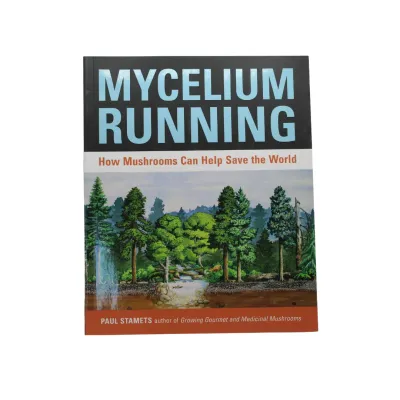
Mycelium Running by Paul Stamets
Sold by Colorado Cultures
Loading feedback...
$44.99
Estimated US shipping $12.60
30-day returns
Secure checkout — Stripe & PayPal
Final shipping is calculated at checkout.
30-day money-back guarantee
The book that changed how we see the forest
When Mycelium Running was published in 2005, it did something almost no popular science book had ever done before: it persuaded a generation of readers that fungi might be the most important — and the most underrated — organisms on Earth.
Paul Stamets, the author, is not a casual hobbyist. He is the founder of Fungi Perfecti, a longtime cultivator and field mycologist, a TED speaker whose talks have been viewed tens of millions of times, and one of the most influential voices in modern mycology. His credentials are scientific; his communication style is accessible. The combination has made Mycelium Running the single most-recommended mycology book of the 21st century — equally at home on a graduate-school reading list, a homesteader's bookshelf, and a permaculture practitioner's reference stack.
This book is not a step-by-step cultivation guide. For that, get The Mushroom Bible by Dr. K. Mandrake. Mycelium Running is something larger: a manifesto, a research summary, and a blueprint for using fungi to address some of the most urgent environmental challenges of our time.
The core argument
Stamets opens with a simple, almost provocative claim: growing more mushrooms may be the best thing we can do to save the environment.
The argument that follows is grounded in basic biology and decades of his own research:
- Mycelium — the microscopic, thread-like cells that make up the vast underground body of every mushroom — is the primary decomposer of organic matter on Earth. Every fallen leaf, every dead tree, every rotting fruit eventually gets broken down by fungi back into the constituent nutrients that feed new life.
- Mycelium also breaks down a remarkable list of human-made pollutants — petroleum, pesticides, plastics, heavy metals. Specific species under specific conditions can decompose hydrocarbons that no other organism can touch.
- Mycelium also filters water, controls insect populations, defends forests from disease, and produces compounds with measurable medicinal value that are now being researched for use against everything from antibiotic-resistant bacteria to cancer.
- And all of this is happening underneath our feet — largely invisible to most of us, in soils we walk past every day, with capabilities we are only beginning to understand.
The book is a call to take fungi seriously — not as a curiosity, not just as food, but as a tool for addressing systemic environmental problems at scale.
The four pillars of mycorestoration
The heart of Mycelium Running is Stamets' framework for mycorestoration — using fungi to actively repair damaged ecosystems. He divides this into four major application areas:
Mycoremediation
Using fungi to decompose toxic wastes and pollutants. Stamets details specific protocols for using oyster mushrooms to break down diesel-contaminated soil, Phanerochaete species to decompose industrial dyes, and various wood-decay fungi to address petroleum spills. The chapter includes real-world case studies, lab data, and replicable methods that have been used in actual remediation projects.
Mycofiltration
Using fungi to filter water, soil runoff, and waterways. Stamets describes the use of mycelium-inoculated wood chips and burlap installations to catch agricultural runoff, reduce pathogens in stream water, and trap silt before it reaches sensitive waterways. The chapter offers practical recipes and installation guides for small-scale water filtration projects.
Mycopesticides
Using fungi to control insect populations — naturally and selectively. Specific species of Metarhizium, Beauveria, and related entomopathogenic fungi can be deployed to control specific insect pests without the broad-spectrum environmental damage of chemical pesticides. The chapter explores both natural deployment and lab-cultured fungal pesticide products.
Mycoforestry and Mycogardening
Using fungi to enhance the health of forests, gardens, and food production. Stamets describes inoculating tree stumps with edible species (turning forestry waste into food production), seeding wood-chip beds with cultivated mycelium to improve soil structure and disease resistance, and integrating fungi into garden ecosystems as natural decomposers and nutrient recyclers.
Beyond the four pillars
The book covers significantly more than just mycorestoration:
- Medicinal properties of mushrooms — a dedicated section on the therapeutic compounds in Ganoderma, Trametes, Hericium, Cordyceps, and others. This was groundbreaking content in 2005 and remains some of the most accessible writing on the topic.
- Nutritional value of cultivated mushrooms — what makes mushrooms a uniquely complete food.
- Inoculation methods — log culture, stump culture, woodchip beds, and other field-scale cultivation approaches.
- Species selection for specific environmental purposes — which fungi for which jobs, with detailed species-by-species recommendations.
- Cultivation protocols at homestead and small-farm scale — not the home-grower scale of The Mushroom Bible, but the larger-scale outdoor cultivation that fits permaculture, forestry, and small-farm operations.
Why this book matters more than ever
Climate change. Soil erosion. Pesticide resistance. Microplastic pollution. Antibiotic-resistant bacteria. Industrial-agriculture topsoil loss. Every one of these problems has — somewhere in the global research literature — a mycological angle.
Stamets was writing about these connections in 2005, before most of these terms entered mainstream conversation. Twenty years later, the book reads less like a niche manifesto and more like a prescient research roadmap.
The TED talks based on this book have been viewed tens of millions of times. The species protocols Stamets describes are being deployed in actual remediation projects from oil-spill cleanup to wastewater treatment. The mycelium-based packaging materials he predicted are now commercially available. The future Stamets described is, in significant ways, already here.
Who buys this book
- Cultivators expanding from home-scale to outdoor, field-scale, and ecosystem-scale work — the book describes techniques far beyond what monotub cultivation covers
- Permaculturalists and homesteaders integrating fungi into their land management practices
- Foresters, gardeners, and land managers using mycelium for soil improvement, pest control, and waste management
- Environmental scientists and remediation professionals looking for practical mycoremediation protocols
- Anyone deeply interested in the bigger picture of fungi's role in ecosystems
- Readers who loved The Mushroom Bible and want the larger context of where home cultivation fits in the broader mycological landscape
- TED talk fans who want to dig deeper into the specific topics Stamets covers in his presentations
- Gift recipients in the mushroom, environmental, permaculture, or science-curious communities
What this book is NOT
- Not a step-by-step home cultivation guide. For "I want to grow Golden Teacher in my closet," get The Mushroom Bible by Dr. K. Mandrake. Mycelium Running is the bigger-picture, larger-scale companion volume.
- Not a field guide to mushroom identification. It's a guide to fungal ecology and applications, not a "what is this mushroom?" reference.
- Not light reading. The book is dense, heavily referenced, and covers significant scientific ground. Expect to read it slowly, take notes, and re-read chapters.
- Not strictly hands-on protocol. Some chapters are recipe-driven; others are advocacy and overview. Read both for the full picture.
Pairing with other Colorado Cultures books
The Colorado Cultures book lineup forms a complete reading curriculum for the serious cultivator:
- The Mushroom Bible (Dr. K. Mandrake) — home cultivation step-by-step
- Mycelium Running (Paul Stamets) — ecosystem-scale fungal applications (this product)
- The Mushroom Chef Cookbook — culinary applications of fresh and dried mushrooms
- Breaking the Veil: A Guide to Mushroom Genetics — advanced cultivation and genetics work
- Magic Mushroom Growers Guide Book — alternative cultivation references
Read together, these books cover the full arc from "I want to grow my first cubensis" through "I'm running ecosystem-scale remediation projects" — with cuisine, genetics, and traditional knowledge filling in the gaps.
Mycelium Running is the centerpiece of that arc. It is the book that contextualizes everything else — that turns mushroom growing from a hobby into an applied science with environmental, agricultural, and medicinal stakes.
A note on the author
Paul Stamets has, over the past three decades, become one of the most recognizable faces in mycology. His patents include mushroom-based pesticide alternatives. His TED talks have introduced millions of viewers to fungal biology. His Star Trek cameos (yes, really — a Star Trek: Discovery character is named after him) signal how thoroughly his work has entered popular culture.
Reading this book is, in a real sense, reading the source material for a significant portion of contemporary mycological conversation. Stamets' frames, terms, and protocols appear in countless secondary sources — but they are first articulated, in their most complete form, here.
If you want to understand why mushrooms matter to people who think about ecosystems, agriculture, medicine, and the planet — start with Mycelium Running.