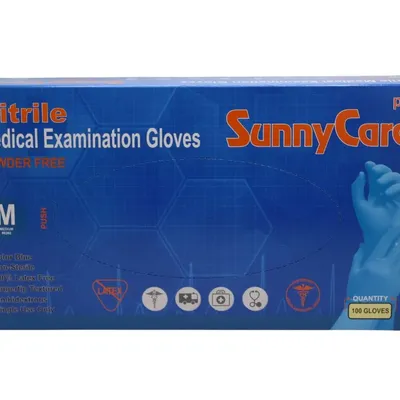
Nitrile Medical Grade Powder Free Gloves - Medium - 100 Pack
Sold by Colorado Cultures
Loading feedback...
$10.99
Estimated US shipping $7.70
30-day returns
Secure checkout — Stripe & PayPal
Final shipping is calculated at checkout.
30-day money-back guarantee

The unglamorous tool that prevents most contamination
Ask any cultivator who's lost a grow to Trichoderma (green mold) or bacterial slime what they would change. The answer is almost never "better substrate" or "better genetics" or "better humidity." It's almost always: "I'd take sterile technique more seriously."
And the foundation of sterile technique is what you put between your skin and your work surface.
Human skin is teeming with microorganisms. The average square centimeter of skin hosts thousands to millions of bacterial cells plus yeasts, fungi, and viruses. Some are harmless commensals. Some are Staphylococcus, Pseudomonas, Aspergillus, and other species that can devastate a mushroom grow if they make contact with your substrate, agar plate, or grain bag.
Gloves are not optional. Not "nice to have." Not "if you're being fancy." Gloves are the single most effective contamination-prevention tool available to home cultivators, and the difference between a 95% success rate and a 60% success rate often comes down to whether the cultivator wears gloves during sterile work.
Colorado Cultures stocks Nitrile Medical Grade Powder Free Gloves because the right glove for cultivation is specifically nitrile, specifically medical-grade, specifically powder-free, and specifically blue. Every one of those qualifiers matters.
Why nitrile (and not latex or vinyl)
Three main glove materials are sold for medical, lab, and food work:
Latex
- Pro: Cheap, stretchy, tight fit
- Con: Latex allergies are common (5-15% of healthcare workers eventually develop sensitivity); torn latex can release proteins that trigger reactions in the wearer or others nearby
- Cultivation rating: Avoid — latex allergies are a real problem, and the lower chemical resistance means alcohol and other lab chemicals can degrade the glove during use
Vinyl (PVC)
- Pro: Cheap, hypoallergenic
- Con: Looser fit, less tactile sensitivity, lower chemical resistance, higher permeability (allows more substances through the material)
- Cultivation rating: Acceptable for short-term low-stakes work, but not ideal for sterile technique where chemical resistance matters
Nitrile
- Pro: Hypoallergenic, highly chemical-resistant (resists IPA, bleach, peroxide), tactile sensitivity nearly equal to latex, durable
- Con: Slightly higher cost than vinyl
- Cultivation rating: The right choice for mushroom cultivation. Resistant to the IPA and bleach you'll use for surface sterilization. Durable enough to last through multi-hour sterile-technique sessions. Allergen-free.
Why medical grade
"Medical grade" is a meaningful technical designation for gloves. It indicates:
- FDA 510(k) clearance for use in medical procedures
- Tested for chemical resistance against common medical and laboratory substances
- Pinhole testing — random batches sampled and rejected if pinhole rate exceeds 1-2%
- Burst strength testing — gloves must tolerate stretching to specified percentages without failure
- Tactile sensitivity standards — must allow surgeons and clinicians to feel small objects clearly
Cheap industrial-grade gloves don't meet any of these standards. For mushroom cultivation, you want medical grade — your contamination prevention depends on the glove not having pinholes, not tearing under stress, and not allowing IPA to soak through during a 1-hour sterile-technique session.
Why powder-free
Older medical gloves used cornstarch powder inside the glove to make donning (putting on) easier. The problem: the cornstarch powder is itself a contaminant.
- It carries bacterial and fungal spores
- It can deposit on sterile work surfaces when you touch them
- It can drift onto agar plates during work
- It can be allergenic for some users
Modern cultivation work uses powder-free gloves universally. The slight loss of donning ease is worth the dramatic gain in contamination prevention. Colorado Cultures' gloves are powder-free.
Why blue (and not white or natural)
The color is functional, not aesthetic.
- Blue is visually distinct from natural mushroom mycelium — if you tear a glove during work and a small piece of glove material ends up on your substrate, you'll see it immediately
- Blue is visually distinct from spore prints and agar — easy to spot contamination from torn glove fragments
- Blue is the standard medical-and-laboratory color for nitrile gloves — instantly recognizable as "this is a glove for clean work"
White or natural-colored gloves can be mistaken for mycelium fragments or contaminate the visual inspection of a substrate. Blue gloves don't have this problem.
Why fingertip-textured
The gloves are designed with textured fingertips — a subtle pattern of bumps or grooves on the finger surface that improves grip on wet, slippery, or smooth surfaces.
This matters because mushroom cultivation involves:
- Wet substrate (just-hydrated CVG, dunking dripping mushroom blocks)
- Slippery surfaces (alcohol-wiped agar plates, sterile glass slides)
- Small items (syringe needles, scalpel blades, inoculation loops)
- Precision movements (positioning a needle through a bag's injection port, picking a single mycelial colony with a loop)
The fingertip texture gives you enough grip to do precision work without dropping or fumbling. Smooth-finger gloves can slip on wet surfaces, leading to dropped tools, missed targets, and frustrated workflow.
Why ambidextrous
The gloves are designed to fit either hand interchangeably — there's no "left glove" or "right glove" distinction.
Practical advantages:
- No fumbling for the right glove in a sterile workspace
- Even pair pricing — both gloves in a pair are equally usable
- Easier inventory — same SKU for both hands
The trade-off: ambidextrous gloves are slightly less ergonomically optimized than hand-specific gloves, but for cultivation work, the difference is negligible.
What you get in the box
- 100 individual nitrile gloves (50 pairs, but designed for ambidextrous use)
- Blue color
- Powder-free
- Fingertip-textured
- Medical-grade quality designation
- Latex-free (100% nitrile)
100 gloves equals 50 pairs of gloves, sized for the typical cultivator who runs 2-3 sterile-technique sessions per month. A single 100-pack lasts most home cultivators 6-12 months.
Sizing guidance
A good fitting glove feels snug but not tight, with enough room to flex your fingers fully and pick up small objects. A glove too tight tears more easily; a glove too loose loses tactile sensitivity and grip.
When to use them
The short answer: anytime your hands are about to touch something that needs to stay clean.
Specific cultivation contexts where gloves are non-negotiable:
- Sterile inoculation — injecting LC or spores into a grain bag, agar plate, or substrate
- Agar work — opening agar plates, transferring colonies, streaking
- Substrate mixing — combining bulk substrate with spawn (gloves prevent skin bacteria from inoculating the substrate)
- Harvest work — handling mushrooms before drying or processing
- Cleaning work — wiping surfaces with IPA, bleach, or peroxide between sessions
- Tincture and extraction work — handling sterile glass, alcohol, mushroom material
- Spore print collection — preventing skin contact from contaminating prints
When you don't need them
There's no need to glove up for:
- Reading or planning (no contact with sterile work)
- Setting up equipment in advance (cleaning happens, then sterile work)
- Casual handling of sealed bags or containers (the seal is doing the work)
- Disposing of waste (gloves can come off after disposal)
Cost-per-grow analysis
At typical sterile-technique use:
- 1 inoculation session: 1 pair of gloves
- 1 substrate-mixing session: 1 pair of gloves
- 1 between-flush maintenance session: 1 pair of gloves
- Total per typical 3-flush cubensis grow: 3-5 pairs = 6-10 gloves
A 100-pack supports 15-25 complete grow cycles.
Who buys these
- Active cultivators who run sterile-technique sessions monthly or more frequently
- Multi-grow operations that need a reliable glove supply
- Lab and agar workers doing precision sterile work
- Anyone doing tincture, extraction, or processing work with mushroom material
- Beginners building out their first sterile-technique setup — these are non-negotiable equipment
- Cultivators recovering from a contamination scare who are tightening their sterile protocols
- Cultivators who already wear gloves but want a reliable, in-stock supplier — running out mid-session is unacceptable
What these are NOT
- Not sterile-packaged for medical surgery. These are bulk-packaged 100-count boxes for general clean-work use. For sterile surgical applications, see specifically packaged sterile gloves.
- Not autoclavable. Discard after use; don't re-sterilize.
- Not biohazard-rated for advanced pathogens. Standard medical-grade nitrile is rated for general protection, not for highly pathogenic biological hazards.
- Not chemical-resistant to all substances. Resistant to IPA, bleach, peroxide. Not resistant to acetone, gasoline, or concentrated strong acids/bases. For specialized chemical handling, consult a chemical-resistance chart for your specific compound.
- Not heat-resistant. Don't use these for handling hot pressure-cooker bags or hot autoclave loads. Use silicone or leather oven mitts for heat handling.
Pairing with other Colorado Cultures products
Gloves are paired with everything in the sterile-technique stack:
- Premium Disposable Face Masks 50pk — gloves + mask + IPA + still air box = the complete sterile-technique workstation
- 99% IPA Spray Bottle — wipe gloves with IPA between contact with non-sterile surfaces
- Sterile Disposable Scalpels #11 — wear gloves while handling scalpels
- Sterilized Syringes (10mL Luer-Lock) — wear gloves during syringe handling
- Inoculation Loop - Single — agar work requires gloves
- Pre-Poured Agar Plates 10-pack — opening these plates without gloves is contamination-roulette
- Portable Still Air Box / Laminar Flow Hood — the sterile workspace where you'll wear the gloves
- 6" Sterile Cotton Wood Swabs — used for cleaning between sessions; gloves protect during cleanup
A complete sterile-technique setup costs $50-150 in consumables; gloves are typically the cheapest line item but the highest-impact in actual sterility maintenance.
A note on environmental impact
Single-use gloves generate waste. Some cultivators ask whether they can be re-used or recycled.
- Re-use is not recommended — even a wiped glove may have micro-tears or residual contamination from the prior use
- Recycling is generally not available in most jurisdictions for nitrile gloves (different polymer than typical recyclable plastics)
- Disposal: Standard household waste
For users prioritizing environmental impact, reduce by improving technique (fewer sessions, more efficient use of gloves per session) rather than re-using. The contamination risk of re-use is real and consequential.