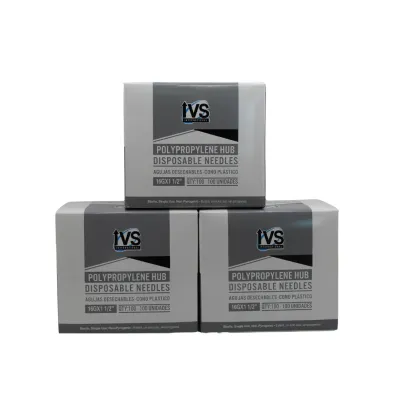
Polypropylene Hub Disposable Needles - 16 Gauge - 1 1/2"
Sold by Colorado Cultures
Loading feedback...
$0.50
Estimated US shipping $6.60
30-day returns
Secure checkout — Stripe & PayPal
Final shipping is calculated at checkout.
30-day money-back guarantee

The right gauge for the right job
Every cultivator who has done LC or spore syringe work has discovered the same hard truth: the gauge of your needle matters. Too thin, and your needle clogs with mycelium fragments mid-injection — wasting valuable LC and risking contamination. Too thick, and you damage the self-healing injection ports on your grain spawn bags, creating leaks that allow contamination later.
For mycology cultivation specifically, 16-gauge is the right needle. Wide enough to pass mycelial fragments without clogging. Narrow enough to make clean injections through standard 3M self-healing rubber ports without leaving permanent holes.
The Colorado Cultures Polypropylene Hub Disposable Needles - 16 Gauge - 1½" are surgical-grade, individually sterilized, pre-sealed disposable needles engineered specifically for mycology and lab applications.
Available in two pack sizes
- Individual — for occasional use or one-off needs
- Box of 100 — for active cultivators doing frequent injections and LC work
The individual format makes sense when you're running a casual grow or as a one-time replacement. The 100-pack is for cultivators doing serious LC work, where you may use 5-20 needles per session and value the bulk pricing.
What 16-gauge actually means
Needle gauge is inverse — larger numbers mean smaller needles. The scale runs from approximately 7g (very large) to 30g (very fine).
For mycology applications:
| Gauge | Inner diameter | Best for |
|-------|---------------|----------|
| 14g | ~1.6mm | Heavy-duty injection through thick membranes |
| 16g (this product) | ~1.2mm | Mycology standard — LC and spore syringes, grain spawn bags |
| 18g | ~0.84mm | Tissue culture work, fine LC injection |
| 20g | ~0.6mm | Microscopy injection (rarely needed in cultivation) |
| 22g | ~0.4mm | Lab injection of small volumes |
The 16g size is the mycology consensus standard for several practical reasons:
- Wide enough for mycelium passage — mycelial fragments in LC don't clog the needle
- Narrow enough for clean port injection — 3M self-healing rubber ports seal cleanly around 16g punctures
- Compatible with standard syringes — pre-attached on most spore syringes and LC syringes
- Wide enough for spore solution passage — spores in liquid pass through easily
- Familiar to medical/veterinary professionals — standard size in many other applications
Why 1.5" length specifically
The needle length matters for reaching the right depth when injecting into grain spawn bags or substrate:
- Shorter needles (1" or less) can't reach all the way through the bag's plastic and into the grain
- Longer needles (2"+) are awkward and may damage the bag wall on the opposite side during deep injection
- 1.5" (this product) is the goldilocks length — long enough to fully penetrate a standard bag, short enough to be precise
For multi-bag injection sessions, the 1.5" length is significantly more comfortable to use than alternatives.
Why "polypropylene hub" specifically
The needle hub is the plastic fitting where the needle attaches to a syringe. The hub material matters:
- Polypropylene (this product) — chemically inert, doesn't react with cultivation fluids, autoclavable, durable
- Metal hub — heavier, can corrode over time
- Plastic hub variants — some plastics can leach plasticizers; polypropylene doesn't
Polypropylene is the standard for laboratory and medical disposable needles because it's:
- Sterilizable — can be autoclaved if needed (though this product is single-use)
- Inert — doesn't contaminate sample fluids
- Stable — doesn't degrade over storage
- Translucent — lets you see fluid passing through during injection
Why "disposable" matters
Cultivators sometimes try to economize by reusing needles. This is a mistake for two reasons:
Cross-contamination risk
A needle used to inject one LC into one bag carries:
- Mycelium fragments from that LC
- Bag-port residue from the injection point
- Any airborne contaminants the needle picked up between sterilization and use
Re-using the same needle on a different culture guarantees cross-contamination between cultures. Even flame-sterilizing between uses doesn't fully clean a needle of biological residue.
Sharpness loss
Each injection cycle slightly dulls the needle tip. After 3-5 injections:
- The needle tears the injection port rather than punching cleanly
- The torn port doesn't self-seal properly
- Contamination through the damaged seal becomes likely
A fresh needle for each injection is cheap insurance against losing weeks of cultivation work to contamination.
What's included
- Individual unit: One needle in individual sterile peel-pouch
- Box of 100: 100 individually-sealed needles in a bulk box
Each needle ships:
- Pre-sterilized at the factory (gamma-irradiation or EtO treatment)
- Individually sealed in a peel-pouch
- Pre-attached needle and hub ready to attach to a syringe
- Protective cap covering the needle tip until use
Standard mycology applications
Grain spawn bag inoculation
The most common use. Inject 2-3mL of LC or spore syringe solution through the bag's self-healing 3M rubber port.
Liquid culture jar inoculation
Inject 3-5mL of source LC into a blank LC jar to propagate fresh culture stock.
Spore syringe filling
If preparing your own spore syringes, the 16g needle works for drawing sterile water into the syringe and for transferring spore prints into solution.
Tissue culture injection (advanced)
Inject sterile water through a culture's lid for sample collection, or transfer small volumes of LC between vessels.
Sterile water draw
For LC preparation and dilution work.
Who buys these
- Cultivators doing LC inoculation of grain spawn bags
- Genetics testers running multi-strain LC work
- Spore syringe preparers filling their own custom syringes
- Tissue culture workers doing genetic isolation
- Lab and research workers with general sterile injection needs
- Anyone replacing the needles that came with their spore syringes — many users prefer fresh needles for each session
What this is NOT
- Not a medical injection product. These are sold for laboratory and mycology applications. Not approved for medical use.
- Not autoclavable for reuse. Single-use design. Disposing after each use is the safe and sterile approach.
- Not appropriate for high-pressure injections. Standard mycology injection pressure is fine; industrial high-pressure applications need different needles.
- Not a substitute for proper sterile technique. A sterile needle is necessary but not sufficient. You still need clean gloves, mask, surface sanitation, and good technique.
- Not safe for casual handling. These are sharp surgical-grade needles. Use proper safety practices — re-cap after use, dispose in a sharps container.
For everyone doing mycology injection work, these needles are the right product for the price-to-quality ratio. Standard mycology gauge, standard length, factory-sterilized, ready to use.
Why fresh needles matter
Even though needles are inexpensive per unit, the economics of fresh needles strongly favor them:
- Individual needle cost: typically less than $0.20-$0.50
- Cost of contaminated grow: typically $20-$100+ in wasted spawn, substrate, time
- Cost saving from reusing one needle: $0.20-$0.50
- Break-even: if reusing causes contamination one out of every 100 times, you've broken even on the savings
- Realistic risk: reusing dramatically increases contamination risk well beyond 1%
Always use a fresh needle per injection. The cost is negligible; the protection against contamination is enormous.