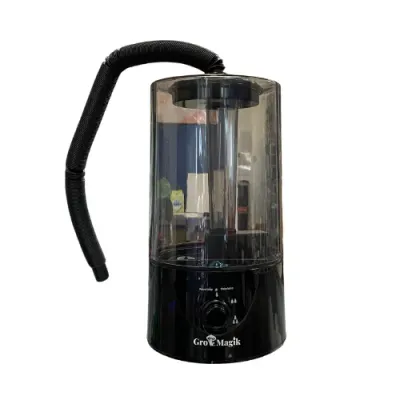
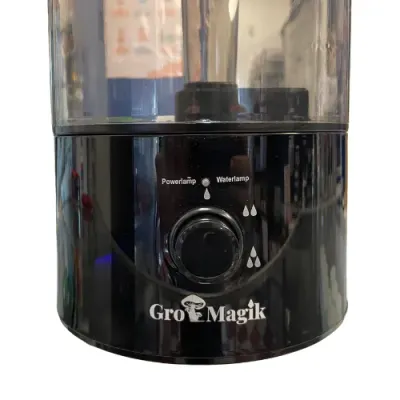
Ultrasonic Humidifier
Sold by Colorado Cultures
Loading feedback...
$54.99
Estimated US shipping $11.95
30-day returns
Secure checkout — Stripe & PayPal
Final shipping is calculated at checkout.
30-day money-back guarantee

Why humidity is the variable that decides the grow
Every experienced cultivator can point at a humidity number that ruined a grow. 65% and the pins abort. 78% and side-pin rot starts. 90% with no airflow and bacterial slime takes over. 95-100% with airflow and good substrate prep and you have a textbook flush.
The window between "successful fruiting" and "stalled or rotted grow" is narrow — typically 85-95% relative humidity during fruiting, with brief drops to 80% for FAE cycles. Hitting that window consistently across days and weeks is genuinely difficult without active humidification:
- Indoor air during heating season routinely sits at 30-40% RH — far below mushroom fruiting requirements
- Air conditioning in summer dehumidifies aggressively, dropping rooms below 50% RH
- Basement and garage grow spaces swing wildly between seasons, humid in spring and bone-dry in winter
- Passive monotub designs depend on substrate evaporation alone, which falls off as the grow cycle progresses
- Multi-tub setups and Martha tents have far more total volume than passive evaporation can saturate
The Gro Magik Ultrasonic Humidifier solves this. A purpose-built, 4-liter capacity, three-speed, hose-directed ultrasonic mist generator designed for mushroom cultivation environments. Set it once. Run for 8-16 hours unattended. Maintain fruiting-chamber humidity at the level your species and substrate require, without constant misting interventions, without bottle-shaped wrist cramps, without the variability that wrecks otherwise-good grows.
What ultrasonic humidification actually does
Three common ways to add humidity to a grow space:
- Passive evaporation — wet perlite trays, damp towels, water dishes. Free, but unreliable and weather-dependent.
- Steam humidifiers — boil water and release steam. Effective but power-hungry, hot, and risky in enclosed grow tents (steam temperature can stress mycelium).
- Ultrasonic humidification — a piezoelectric transducer vibrates at 1.7+ MHz to atomize water into a cool, fine mist that disperses through the air without significant temperature change. This is what mushroom cultivation needs.
Cool mist matters. Mushroom fruiting conditions ideally sit at 65-78°F. Steam humidifiers spike chamber temperature; ultrasonic humidifiers don't. The mist is room-temperature, the cultivator's temperature setpoint stays stable, and the humidity climbs without thermal stress on the mycelium.
The Gro Magik unit uses a standard ultrasonic transducer feeding a flexible delivery hose, with a 4-liter reservoir sized for overnight or full-workday autonomy. Three intensity settings let you dial humidity output to chamber volume.
What you get
- Three adjustable intensity levels — low for small monotub setups, medium for typical Martha tents, high for large grow rooms or initial chamber saturation
- Flexible delivery hose — direct the mist exactly where you need it, not just where the humidifier happens to sit
- Cool-mist output — no thermal stress on the grow environment
- Ultrasonic operation — silent, energy-efficient, no boiling element
- Designed for cultivation use — the hose-and-targeting design distinguishes this from generic bedroom humidifiers
The flexible hose is the feature most people miss
Generic bedroom humidifiers spray mist into the surrounding room. That's fine for a sleeping space, useless for a cultivation chamber. A bedroom humidifier sitting next to your Martha tent will raise the room humidity to 60-65%, and the tent interior will still hover at 50-55% because the tent walls block the mist.
The Gro Magik's flexible hose routes the mist stream directly into your chamber. You insert the hose through a vent hole, the tent fabric flap, or a dedicated humidification port — and the entire 4L of water is delivered into the chamber, not into the room around it.
The implications:
- Faster humidity saturation — going from 40% to 90% in a chamber takes 15-30 minutes with a directed hose vs. 2-3 hours with a passive room humidifier
- Less water waste — every liter of mist lands in the grow space, not on furniture or floor
- Compatible with sealed chambers — Martha tents, large monotubs with humidification ports, custom-built grow boxes
- Targets specific substrate areas — direct the hose at a stalled tub corner, or alternate between tubs in a multi-tub setup
- Reduced room-level humidity damage — your house drywall, electronics, and books stay dry while your grow chamber stays at 95% RH
What changes when you run consistent humidity
Cultivators who upgrade from passive humidification to a directed ultrasonic humidifier consistently report:
- More uniform pin sets — fewer dry-corner abortions, fewer wet-corner rot zones
- Faster fruit body development — properly humid pins develop into full fruits in 5-7 days instead of stalling at small primordia
- Bigger fruit bodies overall — adequate humidity during fruiting development is one of the strongest single predictors of fruit body size
- Reduced contamination during fruiting — counterintuitive but real: stable humidity reduces the local moisture variability that bacterial and mold contaminants exploit
- Multi-flush consistency — flushes 2, 3, and 4 are far more dependent on stable humidity than flush 1 (which has fresh substrate moisture to coast on)
- Less daily intervention required — set the humidifier once, walk away for the workday, return to consistent conditions
Who buys this
- Cultivators running Martha tents — 4-6 tubs in a single enclosed volume need active humidification to maintain consistent conditions across the rack
- Large monotub growers — 50+ qt tubs depend more on chamber-level humidification than small tubs whose substrate evaporation can saturate the local volume
- Cultivators in dry climates — Denver, Phoenix, Salt Lake City, anywhere ambient indoor humidity sits below 40% — passive humidification cannot keep up
- Heating-season cultivators — anyone whose winter grows under-perform because forced-air heat drops indoor humidity to 25-30%
- Air-conditioned summer cultivators — same problem, opposite season
- Oyster, lion's mane, king oyster, shiitake, and other wood-loving species growers — these species are more humidity-sensitive than cubensis and benefit substantially from active humidification
- Anyone running multiple genetics in parallel — standardizing humidity across tubs is the only way to get clean genetics comparison data
- DIY fruiting chamber builders — the hose-and-tank design integrates cleanly into custom designs
- Cultivators recovering from chamber humidity issues — if you've had repeat failures at the pinning stage, dialing in stable humidity is the most likely fix
What this is NOT
- Not a replacement for proper FAE. Humidity alone won't grow mushrooms — you still need fresh air exchange (FAE) to remove CO₂ buildup. Pair with passive filter patches, the Colorado Cultures Waterproof Myco Fans, or a Martha Tent's built-in airflow system.
- Not a substitute for substrate hydration. If your substrate is dry, the humidifier won't rescue it. Re-hydrate the substrate first via dunking or misting before relying on chamber humidification.
- Not a sterile/HEPA-filtered humidifier. The mist is whatever's in the water. Use clean (filtered or distilled) water to avoid introducing bacterial spore loads into your grow chamber.
- Not a temperature controller. This unit handles humidity. For temperature, you need a heater, cooler, or thermostat-controlled environment. The Mushroom Grow Light produces incidental heat that can help in cool basements; the Gro Magik humidifier does not.
- Not designed for outdoor use. This is an indoor cultivation tool. Outdoor exposure will damage the electronics.
Pairing across the Colorado Cultures lineup
The humidifier slots into a complete chamber environment alongside:
- Martha Tent 4-Tier — the canonical multi-tub fruiting setup. Humidifier hose runs into the tent through the access flap.
- Waterproof Myco Fans 2-pack — handles the FAE that the humidifier doesn't. Run a fan during a 15-minute FAE cycle, then return to humidified rest.
- Mushroom Grow Light — incidental heat plus the photoperiod cubensis prefers for fruiting initiation.
- Digital Hygrometer & Thermometer — monitor the humidifier's actual effect on chamber RH. Without measurement, you can't tune the intensity setting.
- H2Shroom Fruiting Chamber — alternative to a Martha tent for single-chamber growers. Humidifier hose works the same way.
A typical chamber configuration: Martha Tent → humidifier hose through access flap, Myco Fan on a timer for FAE cycles, Grow Light on a 16/8 photoperiod, Hygrometer mounted at substrate level. Total energy cost: roughly the same as a small desktop computer running 24/7.
A note on running this for plants
The product is marketed for plants and mushrooms both. The mushroom-cultivation case is what most Colorado Cultures customers buy it for, but it works for any humidity-dependent grow:
- Tropical plants — orchids, ferns, calatheas, and other 60-80% RH species
- Seedling propagation — cool-mist humidification reduces transpiration stress on young seedlings
- Cannabis cultivation — flowering-stage RH targets sit at 40-50%, so this unit is overkill for most cannabis applications, but works fine on the low setting
- Indoor greenhouses — small-volume greenhouses benefit from directed humidification
Across all uses, the directed-hose feature is what separates this from generic humidifiers. If you're paying for an ultrasonic humidifier, you might as well get one that delivers the mist where you want it.
The investment math
The Gro Magik humidifier is a significant up-front cost compared to a $20 bedroom humidifier. The math that justifies it:
- A failed grow from humidity-related abortion or stalling costs $40-120 in spawn, substrate, and time (4-8 weeks of cycle wasted)
- A weak second/third flush from poor humidity halves your effective yield per grow
- A successful grow with consistent humidity returns multiples of the humidifier cost in produced fruit
- Multi-year reliability — a quality ultrasonic humidifier runs 3-5 years with basic maintenance. A bedroom humidifier in cultivation use often dies in 6-12 months from mineral buildup.
The humidifier pays for itself in 2-3 successful grows that wouldn't have happened with passive humidification, and then keeps paying every cycle after.