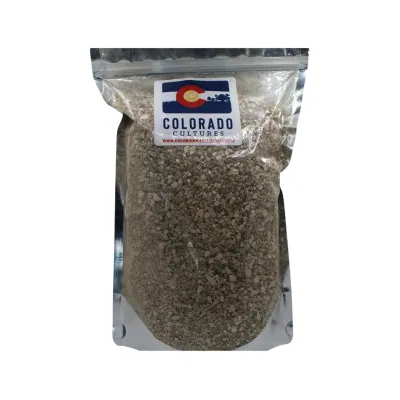
Vermiculite - 1lb
Sold by Colorado Cultures
Loading feedback...
$9.99
Estimated US shipping $11.95
30-day returns
Secure checkout — Stripe & PayPal
Final shipping is calculated at checkout.
30-day money-back guarantee

The substrate amendment that makes everything else work
Walk into any commercial mushroom growing operation in North America and you will find the same three ingredients on the shelf, in nearly the same proportions: coco coir, vermiculite, and gypsum. This combination — the "CVG" recipe — is the modern foundation of bulk mushroom substrate, and it has displaced older substrate formulas (BRF cakes, manure-based mixes, straw blends) at virtually every scale of cultivation.
Vermiculite is the workhorse of that combination. It is the amendment that makes the substrate hold moisture, breathe, resist compaction, and provide the porous matrix that mycelium needs to spread in three dimensions through the substrate volume.
The Colorado Cultures 1-pound vermiculite bag is a single-purchase ingredient for cultivators mixing their own bulk substrate — sized at the practical scale for a home grower running one to four monotubs at a time.
What vermiculite actually is
Vermiculite is a hydrated mineral — specifically, a magnesium-iron-aluminum silicate that's been mined, heated rapidly to expand the natural layered structure, and processed into the lightweight, golden-brown flakes most cultivators recognize.
The expansion process is the magic of vermiculite. Raw vermiculite ore is a dense layered silicate. When heated to 1,500-2,000°F, the water trapped between the mineral layers flash-boils and forces the layers apart — creating an "exfoliated" particle that is 20-40 times the volume of the original ore while remaining structurally intact. The result is a lightweight, porous material that:
- Absorbs and holds water at up to 4x its own weight, then releases it slowly to surrounding material
- Creates air pockets that prevent substrate compaction during heavy mycelial growth
- Provides structural integrity without compressing under its own weight or substrate moisture
- Resists rotting and decay — minerals don't decompose like organic substrates do
- Has a near-neutral pH that doesn't acidify or alkalize the substrate
For mushroom cultivation, this combination of properties is essentially perfect. No other amendment matches vermiculite's combination of water retention, structural integrity, and chemical neutrality.
What vermiculite does in mushroom substrate
In a CVG mix (or any vermiculite-based substrate), the mineral plays three critical roles:
1. Moisture management
Vermiculite acts as a moisture buffer — it absorbs excess water when substrate is over-hydrated, releases water when surrounding substrate dries, and stabilizes overall substrate moisture across the long colonization and fruiting cycle.
Without vermiculite, pure coco coir substrate cycles dramatically between wet and dry as mycelium consumes water. With vermiculite, the substrate stays at field capacity more consistently for the entire grow cycle.
2. Aeration and air pocket creation
Mycelium grows in three dimensions through substrate, and it needs interconnected air pockets to thrive. Vermiculite's flake structure naturally creates these pockets when mixed with denser substrate components like coco coir.
Without vermiculite, substrate compacts under its own weight and humidity, choking off oxygen to the deeper mycelium. With vermiculite, the substrate maintains an aerated matrix even after weeks of mycelial growth and heavy water content.
3. Casing layer foundation
In traditional cubensis cultivation, the casing layer — the thin layer of inert material spread over inoculated substrate to support pin formation — is typically pure vermiculite or a vermiculite/coco coir mix. Vermiculite's casing layer properties are exceptional:
- Provides a clean, sterile-resistant surface for pins to form on
- Holds moisture without forming a crust
- Lets pins push through without obstruction
- Inhibits surface contamination by being chemically neutral
A proper casing layer with vermiculite can double or triple the pin formation of an uncased substrate.
Why Colorado Cultures vermiculite
The vermiculite market is full of low-quality options. Garden-supply vermiculite is typically:
- Coarse-grade — large flakes designed for soil amendment, not the fine-grade structure mycelium prefers
- Possibly contaminated with trace minerals or coatings from horticultural use
- Inconsistent particle size — variable hydration and aeration properties
- Sometimes mixed with perlite or other amendments without clear labeling
The Colorado Cultures vermiculite is sourced and graded for mycology applications:
- Medium-fine particle size appropriate for substrate mixing and casing layers
- Clean, mycology-grade with no horticultural amendments
- Consistent quality batch-to-batch
- Appropriate hydration capacity for cubensis and gourmet mushroom cultivation
What you can use this for
Bulk substrate mixing (CVG)
The most common application. Mix vermiculite with coco coir and gypsum at standard ratios to create CVG bulk substrate. Typical recipe per 5 lbs of substrate:
- 2 lbs coco coir (rehydrated)
- 2 lbs vermiculite
- 1 lb gypsum
Colorado Cultures stocks all three components separately for cultivators who prefer to mix their own.
Casing layer
Sprinkle a thin (¼" - ½") layer of dry or lightly-moistened vermiculite over inoculated substrate before fruiting. The casing layer protects the substrate, supports pin formation, and produces a more even flush.
Vermiculite/coco coir 50/50 blend
A simpler substrate recipe than CVG, suitable for some species. 50/50 vermiculite to coco coir by volume, no gypsum required.
Spawn jar substrate
For BRF cake cultivation or jar-based grows, vermiculite is mixed with brown rice flour and water to create the classic BRF cake substrate.
Bulk substrate dilution
If your existing substrate is too wet or too dense, adding dry vermiculite can rehabilitate it by absorbing excess moisture and adding air pockets.
Who buys vermiculite
- Cultivators mixing their own bulk substrate rather than buying pre-mixed CVG
- Casing layer users who want a dedicated supply of vermiculite for layering
- BRF cake cultivators for traditional cake-style grows
- Experimenters and substrate optimizers running different mixtures across grows
- Bulk growers stocking ingredients for ongoing rotation
- Anyone replenishing their substrate-mixing supplies for the next round of grows
What this is NOT
- Not a complete substrate. Vermiculite is one ingredient. You'll typically mix it with coco coir and gypsum to make CVG, or with brown rice flour for BRF cakes.
- Not asbestos-containing. Modern commercial vermiculite is sourced from mines that have been certified asbestos-free. (Older vermiculite from certain mines, decades ago, had asbestos contamination issues; this is no longer relevant to modern supply.)
- Not a sterile product. Vermiculite is heated to extreme temperatures during processing and is naturally sterile of biological contaminants, but the bag itself is not autoclave-sealed. When mixing into substrate, plan to sterilize or pasteurize the final substrate, not the vermiculite alone.
- Not appropriate for all species. Wood-loving species (oysters, lion's mane, reishi) prefer hardwood-based substrates and don't benefit as much from CVG. Use Masters Mix or supplemented hardwood blocks for those.
For everyone mixing CVG, casing cubensis fruiting chambers, or stocking the mycology bench, vermiculite is the single most important amendment to keep on hand. The 1-pound bag is the right size for the home grower running 1-4 grows at a time.