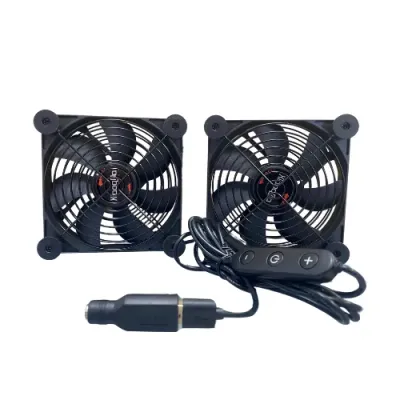
Waterproof FAE Myco Fans - 2 Pack
Sold by Colorado Cultures
Loading feedback...
$39.99
Estimated US shipping $11.95
30-day returns
Secure checkout — Stripe & PayPal
Final shipping is calculated at checkout.
30-day money-back guarantee

When passive FAE isn't enough
Filter patches and pre-drilled vents give your monotub passive ventilation — air moves in and out on its own as your mushrooms exhale CO₂ and the room air pressure shifts. For most home grows, passive FAE is enough. The Colorado Cultures filter patches and the Full Flush Bin both rely on it, and both work beautifully for typical cubensis cultivation.
But some grows need more airflow. Specifically:
- Larger fruiting volumes (50+ qt monotubs, multi-substrate setups) where passive air movement can't keep up with the CO₂ output of a peak flush
- Dense pin sets that produce hundreds of fruit bodies simultaneously and demand fresh air faster than passive vents can deliver
- Wood-loving species like oysters and lion's mane that have higher metabolic rates and demand greater FAE than cubensis
- High-humidity environments where stagnant air encourages condensation, side-pin rot, and bacterial bloom
- Multi-tub Martha tent setups where the entire enclosed volume needs active air circulation between tubs
- Long-running fruiting chambers where the difference between "OK yield" and "great yield" comes down to consistent airflow
The Waterproof Myco Fans are designed for exactly these cases. A two-pack of small, USB-powered, variable-speed fans rated for moist environments — meaning you can install them inside or near your fruiting chamber without worrying about the spray, condensation, or 90%+ humidity ruining the electronics.
What they do
Each fan creates a directed airflow stream that:
- Pushes fresh air across the substrate surface — sweeping CO₂ off the pinning zone and bringing in fresh O₂
- Distributes humidity evenly — preventing dry spots near vents and wet spots far from them
- Reduces condensation on chamber walls — air movement breaks the boundary layer where water would otherwise pool
- Accelerates pin formation in stalled grows — sometimes the only difference between "the grow that won't pin" and "the grow that just needed airflow" is a small fan running 12 hours a day
The 122mm × 122mm dimension is small enough to mount inside a monotub lid (or just outside a tub's air-exchange hole pointing inward) while still being large enough to move meaningful CFM. A few feet of directed airflow is dramatically more effective than a few cubic meters of room-level air circulation that never reaches your substrate.
Why "waterproof" matters
Most consumer USB fans aren't built for humid environments. The boards corrode. The motors short. The bearings rust. After two or three months in a 90%+ humidity monotub, a standard PC fan or USB desk fan has a 50/50 chance of failing.
The Waterproof Myco Fans are built for it. They tolerate moisture, condensation, and direct misting without failure — meaning you install them once and they run for the entire grow cycle, not the first two weeks.
This matters more than it sounds. A fan that dies on day 18 of a 45-day grow means you've got a stalled grow with no easy fix until you take everything apart, swap the fan, and risk re-contaminating the chamber. A waterproof fan that runs the full cycle is a fan you can trust.
10 adjustable speed settings
Most consumer fans are on-or-off, or have a single "high/medium/low" three-position switch. The Myco Fans have 10 distinct speed settings, giving you fine-grained control over airflow:
- Low settings (1-3) — barely-perceptible air movement for incubation phases or species that prefer minimal airflow
- Medium settings (4-6) — typical fruiting-phase airflow for cubensis and most gourmets
- High settings (7-10) — aggressive FAE for high-density pin sets, oysters, or multi-tub setups
The 10-step granularity matters because optimal FAE varies dramatically across grow stages. A pinning chamber needs different airflow than a fruiting chamber needs than a between-flush rest needs. Being able to dial it in for each phase, with the same hardware, is the kind of adjustment that pays off in yield.
USB connectivity
Each fan plugs into a standard USB-A port. The implications:
- No wall-wart power adapter required — powers from a USB hub, a phone charger, a computer, or a powered USB strip
- Easy to multi-fan setups — one USB hub can power 4-6 fans for a multi-tub installation
- Battery-bank compatible — a USB power bank will run the fan during power outages
- Programmable via USB timers — pairs cleanly with USB timer/controller products (sold separately) for scheduled on/off cycles
Power draw is minimal — typical USB fans pull 0.5W to 2W per fan, well within the capacity of any standard USB outlet.
Who buys these
- Large monotub growers (50+ qt tubs) where passive FAE can't keep up with peak flushes
- Oyster, lion's mane, and king oyster cultivators whose species need more active FAE than passive monotub designs deliver
- Martha tent operators running 4-6 tubs in a single enclosure where active air circulation between tubs improves consistency
- Cultivators in humid climates (Pacific Northwest, Florida, Gulf Coast) where ambient humidity makes condensation and stagnation a real problem
- Anyone whose previous grows stalled at the pinning stage — adding directed airflow at the right moment is often the missing variable
- DIY fruiting chamber builders integrating active airflow into custom designs
- Cultivators expanding from 1-2 tubs to a multi-tub operation where passive techniques no longer scale
What these are NOT
- Not a replacement for HEPA filtration. The fans move air; they don't filter it. Use in conjunction with proper filter patches, not as a substitute for them.
- Not industrial CFM rated. These are small fans (122mm) for home cultivation chambers, not commercial grow rooms.
- Not autoclave-safe. Do not pressure-cook the fans. Wipe with IPA between grows for sanitation.
- Not waterproof at submersion depth. "Waterproof" here means humidity, condensation, and direct misting — not "drop it in a bucket of water." Treat as splash-resistant, not dive-rated.
For everyone else, the Myco Fans 2-pack is the most cost-effective active-airflow upgrade available for home cultivation. Two fans give you enough flexibility to set up one inside the chamber and one outside (intake/exhaust), or distribute across multiple tubs in a multi-bin setup. The 2-pack format is sized exactly for the typical multi-position installation pattern.