Last updated:
Agaricus xanthodermus
"Yellow Stainer, Yellow-staining mushroom"
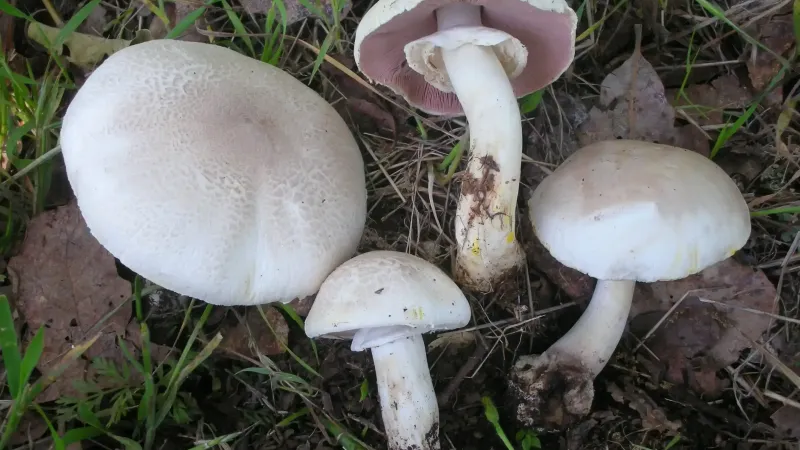
Agaricus xanthodermus fruiting bodies
Scientific Classification
Kingdom:Fungi
Division:Basidiomycota
Class:Agaricomycetes
Order:Agaricales
Family:Agaricaceae
Genus:Agaricus
Frequently Asked Questions
- What is Yellow Stainer?
- Yellow Stainer (Agaricus xanthodermus) is a mushroom species, belonging to the Agaricaceae family. It is studied for its biological characteristics and is documented in the ShroomSpy mycology database.
- Is Yellow Stainer edible?
- Poisonous — do not eat. Agaricus xanthodermus is the most commonly ingested poisonous mushroom in temperate regions because it closely resembles edible field, horse, and button mushrooms (Agaricus bisporus, A. arvensis). It causes gastrointestinal poisoning — nausea, vomiting, abdominal cramps, and diarrhea, sometimes with headache, sweating, and flushing — within 0.3 to 6 hours (typically about 2 hours) of consumption. Symptoms are caused by phenolic compounds and are usually self-limiting over about 24 hours, though children and sensitive individuals can be more severely affected. The two reliable warning signs: the flesh, especially the base of the stem, stains bright chrome-yellow within seconds when cut or bruised, and it gives off an unpleasant phenolic (carbolic/ink-like) odor that intensifies on cooking. The species also tends to accumulate heavy metals. If consumed, contact poison control.
- What is the scientific classification of Yellow Stainer?
- Yellow Stainer belongs to the kingdom Fungi, division Basidiomycota, class Agaricomycetes, order Agaricales, family Agaricaceae, genus Agaricus. Its scientific name is Agaricus xanthodermus.
About
Agaricus xanthodermus, the Yellow Stainer, is a toxic gilled mushroom of the family Agaricaceae that closely mimics several edible field mushrooms — making it one of the most frequently mistaken poisonous species. It has a smooth white-to-greyish cap 5–15 cm across, crowded free gills that pass from white through dingy pink to chocolate brown, and a ringed stem whose base flushes bright yellow within seconds when cut. The whole mushroom carries an unpleasant phenolic (carbolic) odor that strengthens on cooking. It grows in grass — lawns, pastures, parks, and roadsides — often in fairy rings from late spring to autumn across Europe and eastern and central North America.
History
Agaricus xanthodermus was formally described by the French pharmacist Léon Gaston Genevier in 1876. The epithet xanthodermus combines the Greek xanthos ("yellow") and derma ("skin"), referring to the diagnostic yellow staining of its surface and flesh. Because the genus Agaricus contains the world's most familiar edible mushrooms — the cultivated button mushroom and the wild field and horse mushrooms — the Yellow Stainer has long been a notorious cause of accidental poisonings among foragers who substitute it for safe lookalikes. It is grouped with related phenolic-smelling species in what mycologists call the "xanthodermus group."
Overview
The Yellow Stainer is a saprotrophic decomposer of grassland soils. It is not edible and is not cultivated. Identification rests on two consistent cues that separate it from edible Agaricus species: cut or bruise the flesh — particularly the base of the stem — and the toxic species turns chrome-yellow almost instantly, then often fades to brown; and check the smell, which is medicinal, metallic, or phenolic rather than the pleasant nutty or almond-like aroma of edible field and horse mushrooms. Its toxins are phenolic compounds that cause gastrointestinal illness; it also concentrates heavy metals. Dangerous confusions include the edible Agaricus bisporus, A. arvensis (Horse Mushroom), and A. campestris (Field Mushroom), so the yellow-stain and odor tests should always be applied before any wild Agaricus is considered for the table.
Physical Characteristics
Caps:
The cap is convex to flat, measuring 5-15 cm in diameter, with a smooth, yellowish to brownish surface that bruises yellow when handled.
Gills:
Gills are free, crowded, and initially white, turning pinkish as the spores mature.
Mushroom Ratings
0.0
Based on 0 Reviews
5
★4
★3
★2
★1
★Share your thoughts
If you've consumed this mushroom, share your thoughts with our community