Last updated:
Albatrellus confluens
"common earthfan, confluent earthfan"
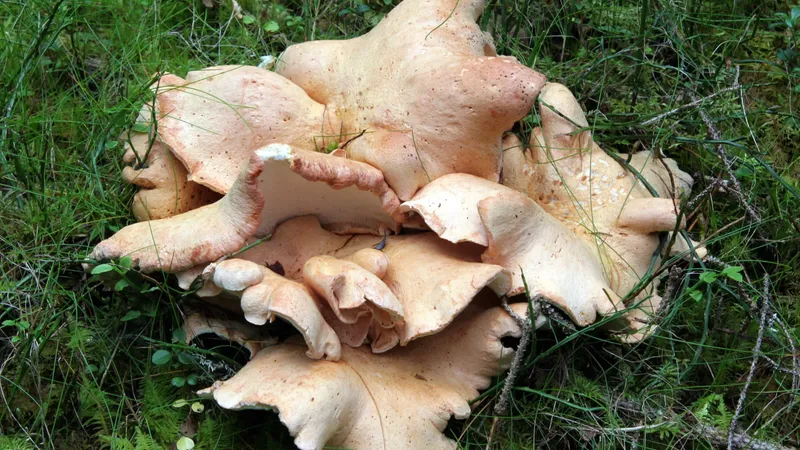
Albatrellus confluens fruiting bodies
Scientific Classification
Kingdom:Fungi
Division:Basidiomycota
Class:Agaricomycetes
Order:Russulales
Family:Albatrellaceae
Genus:Albatrellus
Frequently Asked Questions
- What is common earthfan?
- common earthfan (Albatrellus confluens) is a mushroom species, belonging to the Albatrellaceae family. It is studied for its biological characteristics and is documented in the ShroomSpy mycology database.
- Is common earthfan edible?
- Edibility uncertain - generally treated as inedible/not recommended. Reports of its food use are sparse and unverified, and there is no reliable consensus that it is safe to eat. Do not consume.
- What effects does common earthfan produce?
- common earthfan is associated with the following effects: Focus, Energy. Individual experiences vary based on dose, set, and setting.
- What is the scientific classification of common earthfan?
- common earthfan belongs to the kingdom Fungi, division Basidiomycota, class Agaricomycetes, order Russulales, family Albatrellaceae, genus Albatrellus. Its scientific name is Albatrellus confluens.
About
Albatrellus confluens is a terrestrial polypore in the family Albatrellaceae (order Russulales), commonly called the common earthfan or confluent earthfan. Rather than producing gills, it bears a white to cream pore surface beneath a fleshy, cream to ochre-brown cap. The caps of neighbouring fruitbodies frequently merge, a habit reflected in the epithet confluens. It fruits on the ground in coniferous forests of the Northern Hemisphere, where it is associated with conifers as an ectomycorrhizal partner. Its edibility is poorly documented and it is generally treated as inedible, but it has drawn scientific attention as a source of bioactive secondary metabolites.
History
The species was described by Albertini and Schweinitz and later transferred to the genus Albatrellus by Kotlaba and Pouzar, giving the accepted name Albatrellus confluens (Alb. & Schwein.) Kotl. & Pouzar. The genus name derives from Latin albus ("white"), referencing the pale pore surface and flesh typical of these polypores, while confluens refers to the way adjacent caps grow together. Interest in the species increased markedly in the early 2000s when researchers in China and Japan isolated and characterised its bioactive compounds.
Overview
Unlike bracket fungi that decay wood, A. confluens is a ground-dwelling, mycorrhizal polypore of conifer forests, and is not cultivated commercially. Its main significance is chemical: the phenolic meroterpenoid grifolin isolated from its fruitbodies has been shown in laboratory studies to inhibit the growth of several human cancer cell lines and to induce apoptosis (Ye et al., 2005; 2007), partly through suppression of the ERK1/2 signalling pathway. A related compound, albaconol, has also been studied for its biological activity. These findings concern isolated compounds in laboratory settings and are not evidence of culinary value or of any proven medical use; the mushroom itself is not recommended for eating.
Physical Characteristics
Caps:
Cap fleshy, 4-15 cm across, irregularly rounded to lobed; neighbouring caps often fuse (confluent), giving the species its name. Surface dry, smooth to finely cracked, cream, pinkish-buff to ochre-brown, bruising/ageing yellowish to reddish.
Gills:
No gills. The underside is a poroid (pore) surface; pores small, white to cream, decurrent down the stipe, bruising yellowish with age.
Cognitive Effects
Focus
Albatrellus confluens contains grifolin, a phenolic compound studied for its ability to inhibit NF-κB signaling — a pathway linked to cognitive inflammation that may impair focus.
Energy
Polysaccharide fractions in A. confluens fruiting bodies may support mitochondrial function, contributing to reduced physical fatigue in preliminary animal studies.
Pharmacology
Helps With
Immune System
The grifolin compound in A. confluens may modulate innate immune responses by downregulating pro-inflammatory cytokines in macrophage cell lines.
Cancer
Grifolin isolated from A. confluens has shown in vitro cytotoxic activity against several human cancer cell lines, including colon and lung carcinoma, though in vivo validation is limited.
Inflammation
Scutigeral and confluentin terpenoids in A. confluens may inhibit 5-lipoxygenase, an enzyme central to the arachidonic acid inflammatory cascade.
Possible Side Effects
Nausea
Some individuals report mild gastrointestinal upset after consuming A. confluens, possibly due to its sesquiterpene content when eaten raw or undercooked.
Chemical Constituents
Medicinal Chemistry
Nutrition Facts
Serving Size100
Amount Per Serving
Calories280
% Daily Value*
Total Fat 3.2 g4%
Saturated Fat 0.4 g2%
Trans Fat 0 g
Cholesterol 0 mg0%
Sodium 18 mg1%
Total Carbohydrate 52 g19%
Dietary Fiber 22 g79%
Total Sugars 0 g
Protein 18 g36%
Vitamin A 0 µg 0%•Thiamin B1 0 mg 0%
Riboflavin B2 0 mg 0%•Niacin B3 0 mg 0%
Vitamin B6 0 mg 0%•Folate B9 0 µg 0%
Vitamin B12 0 mg 0%•Vitamin C 0 mg 0%
Vitamin D 12 µg 60%•Vitamin E 0 mg 0%
Vitamin K 0 µg 0%•Calcium 0 mg 0%
Copper 4.2 mg 467%•Iron 0 mg 0%
Magnesium 0 mg 0%•Manganese 0 mg 0%
Phosphorus 380 mg 30%•Potassium 2100 mg 45%
Selenium 18 µg 33%•Zinc 4.1 mg 37%
Vit A 0 µg 0%•B1 0 mg 0%
B2 0 mg 0%•B3 0 mg 0%
B6 0 mg 0%•B9 0 µg 0%
B12 0 mg 0%•Vit C 0 mg 0%
Vit D 12 µg 60%•Vit E 0 mg 0%
Vit K 0 µg 0%•Calcium 0 mg 0%
Copper 4.2 mg 467%•Iron 0 mg 0%
Mg 0 mg 0%•Mn 0 mg 0%
Phosph. 380 mg 30%•Pot. 2100 mg 45%
Selenium 18 µg 33%•Zinc 4.1 mg 37%
* Percent Daily Values are based on a 2,000 calorie diet.
Mushroom Ratings
0.0
Based on 0 Reviews
5
★4
★3
★2
★1
★Share your thoughts
If you've consumed this mushroom, share your thoughts with our community