Last updated:
Amanita caesarea
"Caesar's mushroom, Amanita caesarea"
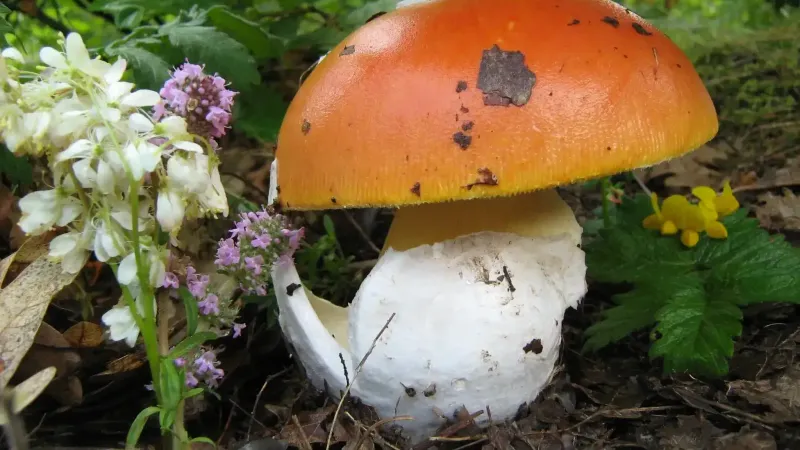
Amanita caesarea fruiting bodies
Scientific Classification
Kingdom:Fungi
Division:Basidiomycota
Class:Agaricomycetes
Order:Agaricales
Family:Amanitaceae
Genus:Amanita
Frequently Asked Questions
- What is Caesar's mushroom?
- Caesar's mushroom (Amanita caesarea) is a mushroom species, belonging to the Amanitaceae family. It is studied for its biological characteristics and is documented in the ShroomSpy mycology database.
- Is Caesar's mushroom edible?
- Edible and prized as a choice culinary mushroom, but DANGEROUS to forage: Amanita caesarea belongs to a genus that also contains the deadly Amanita phalloides (death cap) and Amanita virosa (destroying angel), and it is frequently confused with the highly poisonous Amanita muscaria (fly agaric) once rain washes the white cap warts away. Eat only specimens identified by an expert, and cook thoroughly. Fruiting bodies can also accumulate cadmium and lead from the soil.
- What effects does Caesar's mushroom produce?
- Caesar's mushroom is associated with the following effects: Energy. Individual experiences vary based on dose, set, and setting.
- What is the scientific classification of Caesar's mushroom?
- Caesar's mushroom belongs to the kingdom Fungi, division Basidiomycota, class Agaricomycetes, order Agaricales, family Amanitaceae, genus Amanita. Its scientific name is Amanita caesarea.
About
Amanita caesarea, commonly known as Caesar's mushroom, is an edible fungus prized as one of Europe's choicest wild mushrooms. It is recognized by its bright red to orange cap with a grooved (striate) margin, chrome-yellow free gills, a yellow stem bearing a skirt-like ring, and a thick white sac-like volva at the swollen base. It grows as an ectomycorrhizal partner in sandy, slightly acidic soils under oaks and other hardwoods, as well as pines, across the Mediterranean, temperate Europe, North Africa, and parts of North America (including Arizona, New Mexico, and Quebec). Despite its culinary reputation, it must be identified with extreme care, because the genus Amanita also contains some of the world's deadliest mushrooms.
History
Amanita caesarea has been esteemed since antiquity, famously associated with Roman emperors and noted by classical writers such as Pliny the Elder. Its species epithet derives from the Latin caesareus, "pertaining to Caesar," reflecting its imperial status at the Roman table. The mushroom also features in one of history's darker episodes: the Roman emperor Claudius is said to have been poisoned with a dish of his favourite Caesar's mushrooms adulterated with the juice of the deadly Amanita phalloides. The species was first described by Giovanni Antonio Scopoli in 1772 and later given its modern name by Persoon, hence the authority (Scop.) Pers.
Overview
Ecologically, Amanita caesarea is an ectomycorrhizal fungus that exchanges soil nutrients for tree sugars, supporting forest health. It is harvested from the wild rather than reliably cultivated, and is sold fresh in markets from Italy to Mexico. Identification hinges on its grooved cap margin, yellow gills and stem, prominent skirt-like ring, and large white volva. The most dangerous look-alike is Amanita muscaria (fly agaric), whose red cap normally bears white warts that can wash off in heavy rain, leaving it deceptively similar; misidentification is a documented cause of serious poisoning. Because Caesar's mushroom is congeneric with the deadly death cap and destroying angel, and because its fruiting bodies can accumulate heavy metals such as cadmium and lead, it should be eaten only when identified by an expert and always thoroughly cooked.
Physical Characteristics
Caps:
The cap is 7-25 cm broad, oval to convex then flat, bright red to orange (sometimes yellowish), slightly viscid when moist and smooth with a distinctly striate (grooved) margin.
Gills:
The gills are free to adnexed, close and broad, chrome yellow to pale yellow with slightly darker edges.
Cognitive Effects
Energy
A. caesarea is nutrient-dense with high protein, B vitamins, and ergothioneine content that supports physical energy and cellular health.
Pharmacology
Helps With
Oxidative Stress
A. caesarea contains significant ergothioneine and selenium, both potent antioxidants that may protect against oxidative damage in tissues.
Possible Side Effects
Nausea
Raw consumption can cause mild GI distress; thorough cooking is required as with most Amanita species due to heat-labile irritants.
Nutrition Facts
Serving Size100
Amount Per Serving
Calories285
% Daily Value*
Total Fat 3.5 g4%
Saturated Fat 0.5 g3%
Trans Fat 0 g
Cholesterol 0 mg0%
Sodium 16 mg1%
Total Carbohydrate 48 g17%
Dietary Fiber 17 g61%
Total Sugars 0 g
Protein 24 g48%
Vitamin A 0 µg 0%•Thiamin B1 0 mg 0%
Riboflavin B2 3 mg 231%•Niacin B3 16 mg 100%
Vitamin B6 0 mg 0%•Folate B9 0 µg 0%
Vitamin B12 0 mg 0%•Vitamin C 0 mg 0%
Vitamin D 14 µg 70%•Vitamin E 0 mg 0%
Vitamin K 0 µg 0%•Calcium 0 mg 0%
Copper 1.5 mg 167%•Iron 0 mg 0%
Magnesium 0 mg 0%•Manganese 0 mg 0%
Phosphorus 390 mg 31%•Potassium 2200 mg 47%
Selenium 30 µg 55%•Zinc 5.8 mg 53%
Vit A 0 µg 0%•B1 0 mg 0%
B2 3 mg 231%•B3 16 mg 100%
B6 0 mg 0%•B9 0 µg 0%
B12 0 mg 0%•Vit C 0 mg 0%
Vit D 14 µg 70%•Vit E 0 mg 0%
Vit K 0 µg 0%•Calcium 0 mg 0%
Copper 1.5 mg 167%•Iron 0 mg 0%
Mg 0 mg 0%•Mn 0 mg 0%
Phosph. 390 mg 31%•Pot. 2200 mg 47%
Selenium 30 µg 55%•Zinc 5.8 mg 53%
* Percent Daily Values are based on a 2,000 calorie diet.
Mushroom Ratings
0.0
Based on 0 Reviews
5
★4
★3
★2
★1
★Share your thoughts
If you've consumed this mushroom, share your thoughts with our community