Last updated:
Calvatia cyathiformis
"vase-shaped puffball, purple-spored puffball"
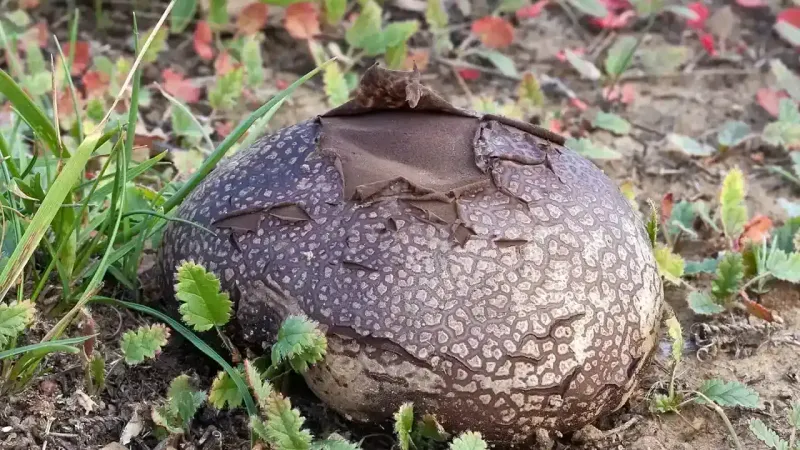
Calvatia cyathiformis fruiting bodies
Scientific Classification
Kingdom:Fungi
Division:Basidiomycota
Class:Agaricomycetes
Order:Agaricales
Family:Agaricaceae
Genus:Calvatia
Frequently Asked Questions
- What is vase-shaped puffball?
- vase-shaped puffball (Calvatia cyathiformis) is a mushroom species, belonging to the Agaricaceae family. It is studied for its biological characteristics and is documented in the ShroomSpy mycology database.
- Is vase-shaped puffball edible?
- Edible only when young and the interior is solid, pure white. The fruiting body must be cut in half before eating to confirm the flesh is uniformly white with no developing spore mass; once it matures to a dingy dark-violet, purplish-brown spore powder it is inedible. Caution: toxic false puffballs (Scleroderma species) can resemble young puffballs — a conspicuously thickened, firm outer skin is the hallmark of a poisonous false puffball, so discard any specimen with a tough rind or any internal discoloration.
- What is the scientific classification of vase-shaped puffball?
- vase-shaped puffball belongs to the kingdom Fungi, division Basidiomycota, class Agaricomycetes, order Agaricales, family Agaricaceae, genus Calvatia. Its scientific name is Calvatia cyathiformis.
About
Calvatia cyathiformis is a grassland puffball recognized by its softball-sized, roughly spherical to vase-shaped fruiting body. When young it is white and solid throughout, and as it matures the interior gleba develops into a distinctive dingy dark-violet to purplish-brown spore mass. It is found in meadows, pastures, lawns and open woods, often appearing in arcs or fairy rings. The species is edible only while young and pure white inside; once the spore mass begins to color it is no longer fit to eat, and it must be carefully distinguished from toxic false puffballs.
History
Calvatia cyathiformis has long been gathered as a grassland puffball, and like other members of the genus it carries a record of traditional medicinal use. Across several cultures puffballs have been valued as wound dressings and styptics. In Nigeria, the Yoruba have used ground Calvatia cyathiformis (with Daldinia concentrica) preparations, and in parts of India the fungus is recorded among species used for healing wounds. The genus name Calvatia derives from the Latin for "bald" or "smooth," while the epithet cyathiformis refers to its cup- or vase-like form.
Overview
Ecologically the fungus is a soil saprotroph that contributes to nutrient cycling in grassland habitats. Its key field features are the smooth white, softball-sized body lacking gills or pores, and the maturing gleba that turns a dingy dark-violet — a trait that helps separate it from the much larger Calvatia gigantea, whose mature spore mass is olive to greenish-yellow. The most important safety point is to confirm the interior is uniformly white and solid before eating and to rule out toxic Scleroderma false puffballs, which have a conspicuously thickened outer skin.
Flavors
Mild
Young C. cyathiformis has bland, tofu-like flavor that absorbs cooking flavors well.
Textures
Soft
Marshmallow-soft interior when young and pure white; becomes powdery and inedible at maturity.
Fragrances
Earthy
Subtle mushroom aroma when fresh; becomes more pronounced when sautéed in oil.
Physical Characteristics
Caps:
No distinct cap. The fruiting body is a gasteroid puffball, roughly spherical to top- or pestle-shaped, typically softball-sized (around 7-12 cm across, up to about 30 cm in circumference), with a smooth to slightly felted white surface that dulls and cracks at maturity.
Gills:
None. As a puffball it has no gills, pores, or other hymenophore; spores develop internally within the gleba.
Pharmacology
Helps With
Injury Recovery
Calvatia cyathiformis is recorded in traditional medicine for wound healing; like other puffballs its dried flesh and spore mass were applied as a dressing and styptic to staunch bleeding.
Bacterial Suppression
Calvatia species, including C. cyathiformis, are reported to show antibacterial activity in screening studies, consistent with the genus's broader documented antimicrobial properties.
Possible Side Effects
Allergies
Inhaling the spore cloud released by mature specimens can trigger respiratory irritation or allergic reactions (lycoperdonosis) in sensitive individuals; only firm, pure-white young specimens should ever be handled for food.
Chemical Constituents
Medicinal Chemistry
Nutrition Facts
Serving Size100
Amount Per Serving
Calories265
% Daily Value*
Total Fat 2 g3%
Saturated Fat 0 g0%
Trans Fat 0 g
Cholesterol 0 mg0%
Sodium 12 mg1%
Total Carbohydrate 48 g17%
Dietary Fiber 20 g71%
Total Sugars 0 g
Protein 21 g42%
Vitamin A 0 µg 0%•Thiamin B1 0 mg 0%
Riboflavin B2 0 mg 0%•Niacin B3 0 mg 0%
Vitamin B6 0 mg 0%•Folate B9 0 µg 0%
Vitamin B12 0 mg 0%•Vitamin C 0 mg 0%
Vitamin D 0 µg 0%•Vitamin E 0 mg 0%
Vitamin K 0 µg 0%•Calcium 0 mg 0%
Copper 0 mg 0%•Iron 0 mg 0%
Magnesium 0 mg 0%•Manganese 0 mg 0%
Phosphorus 300 mg 24%•Potassium 1600 mg 34%
Selenium 0 µg 0%•Zinc 0 mg 0%
Vit A 0 µg 0%•B1 0 mg 0%
B2 0 mg 0%•B3 0 mg 0%
B6 0 mg 0%•B9 0 µg 0%
B12 0 mg 0%•Vit C 0 mg 0%
Vit D 0 µg 0%•Vit E 0 mg 0%
Vit K 0 µg 0%•Calcium 0 mg 0%
Copper 0 mg 0%•Iron 0 mg 0%
Mg 0 mg 0%•Mn 0 mg 0%
Phosph. 300 mg 24%•Pot. 1600 mg 34%
Selenium 0 µg 0%•Zinc 0 mg 0%
* Percent Daily Values are based on a 2,000 calorie diet.
Mushroom Ratings
0.0
Based on 0 Reviews
5
★4
★3
★2
★1
★Share your thoughts
If you've consumed this mushroom, share your thoughts with our community