Last updated:
Cantharellus Minor
"Small Chanterelle, Yellow Legs"
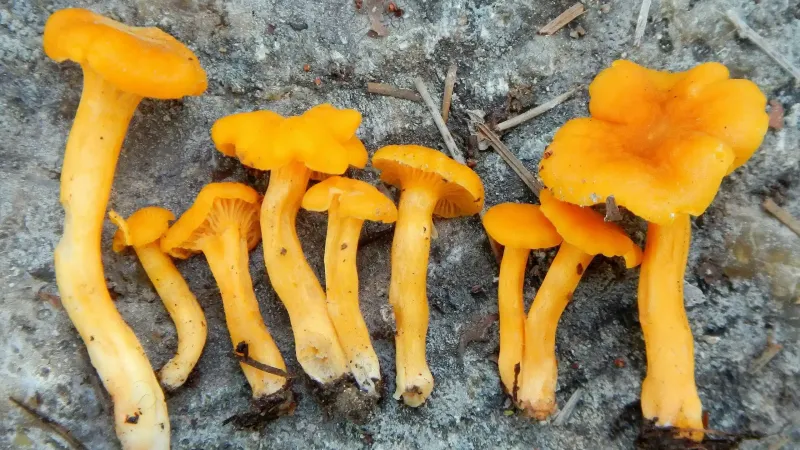
Cantharellus minor fruiting bodies
Scientific Classification
Kingdom:Fungi
Division:Basidiomycota
Class:Agaricomycetes
Order:Cantharellales
Family:Cantharellaceae
Genus:Cantharellus
Frequently Asked Questions
- What is Small Chanterelle?
- Small Chanterelle (Cantharellus Minor) is a mushroom species, belonging to the Cantharellaceae family. It is studied for its biological characteristics and is documented in the ShroomSpy mycology database.
- Is Small Chanterelle edible?
- Edible and good
- What effects does Small Chanterelle produce?
- Small Chanterelle is associated with the following effects: Focus. Individual experiences vary based on dose, set, and setting.
- What is the scientific classification of Small Chanterelle?
- Small Chanterelle belongs to the kingdom Fungi, division Basidiomycota, class Agaricomycetes, order Cantharellales, family Cantharellaceae, genus Cantharellus. Its scientific name is Cantharellus Minor.
About
Cantharellus minor, or the Small Chanterelle, is a delicately-sized, choice edible mushroom in the chanterelle family, valued for its subtle aroma, earthy-sweet flavor, and culinary versatility. Despite its smaller size compared to its larger cousins (Cantharellus cibarius or formosus), it remains a prized seasonal wild mushroom for foragers in the southeastern United States and parts of Asia.
History
Long appreciated by indigenous and rural communities, C. minor has been gathered for generations during summer and fall mushroom seasons, especially in deciduous forests rich in oak and beech trees. Though not commercially cultivated due to its mycorrhizal nature (it forms symbiotic relationships with trees), it is a staple in wild mushroom cuisine and is celebrated for its subtle peppery taste and fruity aroma—sometimes likened to apricots.
It is often used in soups, pastas, risottos, and light sautés, where its nuanced flavor can be highlighted.
Overview
This mushroom features a small, yellow to orange funnel-shaped cap, thin flesh, and false gills running down the stem. It's firm when fresh, and dries well, concentrating its flavor. Unlike many mushrooms, chanterelles are resistant to insect damage, making them great for wild harvest.
While C. minor is less showy than larger chanterelles, its aromatic profile, rarity, and culinary finesse make it a highly regarded gourmet mushroom.
Physical Characteristics
Caps:
Small, convex to flat, yellow to orange
Gills:
Forked, shallow, running down the stem, yellow to orange
Cognitive Effects
Focus
Reported to improve concentration when consumed in moderate amounts.
Pharmacology
Helps With
Inflammation
Contains anti-inflammatory compounds that may reduce swelling and pain.
Possible Side Effects
Sealers
Some individuals may experience allergic reactions such as itching or swelling.
Small Chanterelle Products
Explore Small Chanterelle products from independent vendors
Chemical Constituents
Medicinal Chemistry
Similar Species
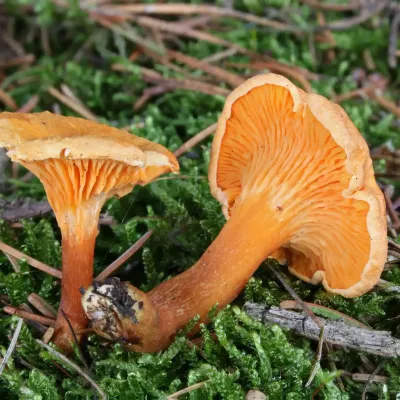
Species: Hygrophoropsis aurantiaca
(False Chanterelle)
Edibility: Not recommended for consumption. Hygrophoropsis aurantiaca is widely treated as occasionally or doubtfully poisonous: it commonly causes gastrointestinal upset (nausea, vomiting, diarrhea), and some authors report alarming hallucinatory or neurological reactions after eating it. It is not deadly, but it should NOT be eaten. The greatest danger is its close resemblance to the edible true chanterelle (Cantharellus cibarius) and to the toxic jack-o'-lantern (Omphalotus spp.); always rule those out by their thick, blunt forking folds (chanterelle) versus this species' thin, repeatedly forked true gills.
Key Differences: More orange and has a more fibrous texture
Species: Hygrophoropsis aurantiaca
(False Chanterelle)
Edibility: Not recommended for consumption. Hygrophoropsis aurantiaca is widely treated as occasionally or doubtfully poisonous: it commonly causes gastrointestinal upset (nausea, vomiting, diarrhea), and some authors report alarming hallucinatory or neurological reactions after eating it. It is not deadly, but it should NOT be eaten. The greatest danger is its close resemblance to the edible true chanterelle (Cantharellus cibarius) and to the toxic jack-o'-lantern (Omphalotus spp.); always rule those out by their thick, blunt forking folds (chanterelle) versus this species' thin, repeatedly forked true gills.
Key Differences: More orange and has a more fibrous texture
Nutrition Facts
Serving Size100
Amount Per Serving
Calories38
% Daily Value*
Total Fat 0.5 g1%
Saturated Fat 0 g0%
Trans Fat 0 g
Cholesterol 0 mg0%
Sodium 9 mg0%
Total Carbohydrate 7 g3%
Dietary Fiber 3.8 g14%
Total Sugars 0 g
Protein 1.9 g4%
Vitamin A 0 µg 0%•Thiamin B1 0 mg 0%
Riboflavin B2 0 mg 0%•Niacin B3 0 mg 0%
Vitamin B6 0.1 mg 6%•Folate B9 17 µg 4%
Vitamin B12 0 mg 0%•Vitamin C 0 mg 0%
Vitamin D 2 µg 10%•Vitamin E 0 mg 0%
Vitamin K 0 µg 0%•Calcium 15 mg 1%
Copper 0.4 mg 44%•Iron 1.2 mg 7%
Magnesium 20 mg 5%•Manganese 0.3 mg 13%
Phosphorus 57 mg 5%•Potassium 506 mg 11%
Selenium 9.3 µg 17%•Zinc 0.5 mg 5%
Vit A 0 µg 0%•B1 0 mg 0%
B2 0 mg 0%•B3 0 mg 0%
B6 0.1 mg 6%•B9 17 µg 4%
B12 0 mg 0%•Vit C 0 mg 0%
Vit D 2 µg 10%•Vit E 0 mg 0%
Vit K 0 µg 0%•Calcium 15 mg 1%
Copper 0.4 mg 44%•Iron 1.2 mg 7%
Mg 20 mg 5%•Mn 0.3 mg 13%
Phosph. 57 mg 5%•Pot. 506 mg 11%
Selenium 9.3 µg 17%•Zinc 0.5 mg 5%
* Percent Daily Values are based on a 2,000 calorie diet.
Mushroom Ratings
4.0
(1)
Based on 1 Review
5
★4
★3
★2
★1
★Share your thoughts
If you've consumed this mushroom, share your thoughts with our community
01/29/2025
Javier Villarreal
CalmContentRelaxedInsightful
Recently tried Small Chanterelles and these are underrated. Earthy flavor with a slight fruity note - really good in soups and risotto. I like them fresh best since they keep their texture.
What surprised me was the calming effect. Felt more relaxed and content after eating them, good for unwinding. Also seemed to help my digestion and I deal with some gut stuff so that was nice.
Apparently good for inflammation too which makes sense given how I felt.
No side effects for me but start small if you're new to these. Solid mushroom for cooking and feeling better 👍
2 people found this helpful