Last updated:
Clavariadelphus pistillaris
"tapered club, giant club"
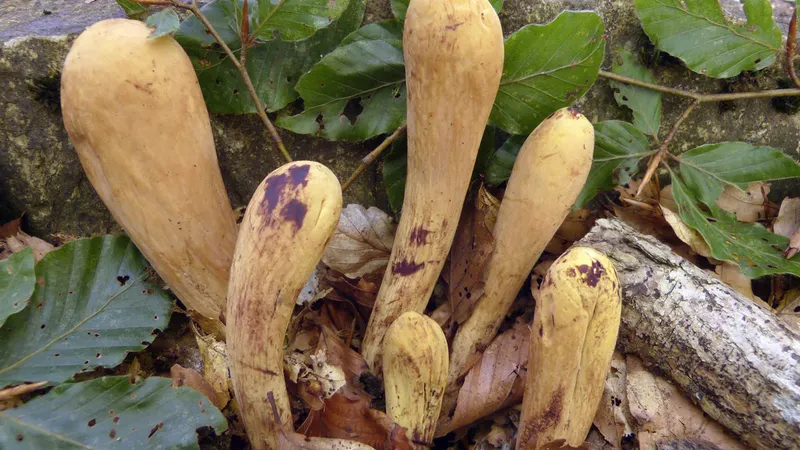
Clavariadelphus pistillaris fruiting bodies
Scientific Classification
Kingdom:Fungi
Division:Basidiomycota
Class:Agaricomycetes
Order:Cantharellales
Family:Clavariaceae
Genus:Clavariadelphus
Frequently Asked Questions
- What is tapered club?
- tapered club (Clavariadelphus pistillaris) is a mushroom species, belonging to the Clavariaceae family. It is studied for its biological characteristics and is documented in the ShroomSpy mycology database.
- Is tapered club edible?
- Edible but generally considered poor due to its pronounced bitterness. The flesh is soft and tinged with bitter compounds; soaking or repeated boiling is needed to make it palatable, and most foragers regard it as inferior. C. pistillaris is also uncommon and listed as rare or threatened in parts of its range, so collecting is discouraged. As with any wild fungus, positive identification is essential before any consumption.
- What is the scientific classification of tapered club?
- tapered club belongs to the kingdom Fungi, division Basidiomycota, class Agaricomycetes, order Cantharellales, family Clavariaceae, genus Clavariadelphus. Its scientific name is Clavariadelphus pistillaris.
About
Clavariadelphus pistillaris is the largest of the simple, unbranched club fungi, producing a striking pestle- or club-shaped fruit body that can reach roughly 20 cm in height and 5 cm across at its rounded apex. The wrinkled surface is pale ochre to pinkish-buff or rose, often bruising brownish or purplish when handled. It typically appears on the ground in deciduous woodland, particularly under beech, where it arises among leaf litter and woody debris. Though edible, its soft flesh is markedly bitter, and it is generally regarded as a poor culinary mushroom.
History
The species was described by early mycologists and placed by Donk in the genus Clavariadelphus, whose name combines the Latin clava ("club") with a reference to its club-fungus relatives. Elias Fries, working in the early nineteenth century, grouped the simple and coral-like club fungi together largely on the shape of the fruit body; later microscopic study separated them into distinct genera. C. pistillaris has never been an important food or medicinal species, and is more often noted today for its conservation status, being listed among rare or threatened fungi in several regions.
Overview
Clavariadelphus pistillaris is distinguished by its single large, wrinkled club and its pale ochre-to-rose coloration that bruises darker. The flattened apex of mature clubs lacks spore-bearing tissue, a feature thought to hint at an evolutionary link to the chanterelles. It is most easily confused with the closely related Clavariadelphus truncatus, which has a more truncate, flat-topped apex and sweeter taste, and with branched coral fungi such as Ramaria and Clavulina, which differ in form. Because it is uncommon and protected in parts of its range, it is best appreciated in the field rather than collected for the table.
Flavors
Bitter
The flesh has a pronounced bitterness that limits its culinary value; soaking or prolonged boiling reduces it somewhat.
Textures
Soft
Soft, spongy flesh that often becomes hollow and tougher with age.
Fragrances
Earthy
Faint, unremarkable woodland odor.
Physical Characteristics
Caps:
No distinct cap. The fruit body is an unbranched, club- or pestle-shaped structure up to about 20 cm (200 mm) tall and 2-5 cm (up to 50 mm) wide at the rounded, often flattened apex. The surface is wrinkled and ranges from pale ochre-yellow to pinkish-buff or rose, bruising brownish or purplish where handled.
Gills:
None. Spores are produced over the smooth to wrinkled outer surface of the club; spore print white.
Nutrition Facts
Serving Size100
Amount Per Serving
Calories320
% Daily Value*
Total Fat 0.6 g1%
Saturated Fat 0 g0%
Trans Fat 0 g
Cholesterol 0 mg0%
Sodium 14 mg1%
Total Carbohydrate 62.4 g23%
Dietary Fiber 20 g71%
Total Sugars 0 g
Protein 16.3 g33%
Vitamin A 0 µg 0%•Thiamin B1 0 mg 0%
Riboflavin B2 0 mg 0%•Niacin B3 0 mg 0%
Vitamin B6 0 mg 0%•Folate B9 0 µg 0%
Vitamin B12 0 mg 0%•Vitamin C 0 mg 0%
Vitamin D 0 µg 0%•Vitamin E 0 mg 0%
Vitamin K 0 µg 0%•Calcium 0 mg 0%
Copper 0 mg 0%•Iron 0 mg 0%
Magnesium 0 mg 0%•Manganese 0 mg 0%
Phosphorus 340 mg 27%•Potassium 1900 mg 40%
Selenium 0 µg 0%•Zinc 0 mg 0%
Vit A 0 µg 0%•B1 0 mg 0%
B2 0 mg 0%•B3 0 mg 0%
B6 0 mg 0%•B9 0 µg 0%
B12 0 mg 0%•Vit C 0 mg 0%
Vit D 0 µg 0%•Vit E 0 mg 0%
Vit K 0 µg 0%•Calcium 0 mg 0%
Copper 0 mg 0%•Iron 0 mg 0%
Mg 0 mg 0%•Mn 0 mg 0%
Phosph. 340 mg 27%•Pot. 1900 mg 40%
Selenium 0 µg 0%•Zinc 0 mg 0%
* Percent Daily Values are based on a 2,000 calorie diet.
Mushroom Ratings
0.0
Based on 0 Reviews
5
★4
★3
★2
★1
★Share your thoughts
If you've consumed this mushroom, share your thoughts with our community