Last updated:
Cordyceps ophioglossoides
"Goldenthread Cordyceps, Snaketongue Truffleclub"
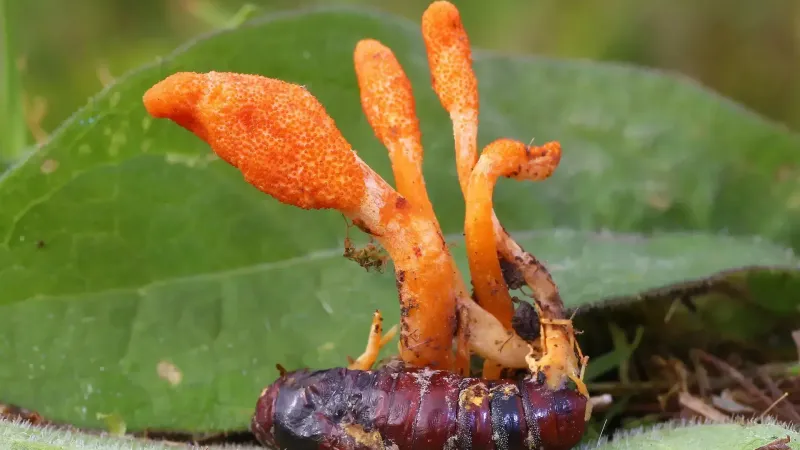
Cordyceps ophioglossoides fruiting bodies
Scientific Classification
Kingdom:Fungi
Division:Ascomycota
Class:Sordariomycetes
Order:Hypocreales
Family:Cordycipitaceae
Genus:Cordyceps
Frequently Asked Questions
- What is Goldenthread Cordyceps?
- Goldenthread Cordyceps (Cordyceps ophioglossoides) is a mushroom species, belonging to the Cordycipitaceae family. It is studied for its biological characteristics and is documented in the ShroomSpy mycology database.
- Is Goldenthread Cordyceps edible?
- Non-edible — not consumed as food.
- What effects does Goldenthread Cordyceps produce?
- Goldenthread Cordyceps is associated with the following effects: Energy. Individual experiences vary based on dose, set, and setting.
- What is the scientific classification of Goldenthread Cordyceps?
- Goldenthread Cordyceps belongs to the kingdom Fungi, division Ascomycota, class Sordariomycetes, order Hypocreales, family Cordycipitaceae, genus Cordyceps. Its scientific name is Cordyceps ophioglossoides.
About
Cordyceps ophioglossoides is a parasitic ascomycete fungus that produces slender, club- to tongue-shaped fruiting bodies (stromata) emerging from the forest floor, typically brown to blackish with a yellowish fertile head and reaching up to about 10 cm tall. Unlike the insect-parasitizing members of the genus, this species is a parasite of underground false truffles in the genus Elaphomyces (deer truffles), to which it is connected by conspicuous golden-yellow mycelial cords (rhizomorphs) — the feature behind its common name "goldenthread cordyceps." It is found in temperate and boreal forests across North America, Europe, and Asia, typically near conifers and hardwoods where its Elaphomyces host grows. Modern molecular work has reclassified it outside the true Cordyceps; it is now widely treated as Tolypocladium ophioglossoides (formerly Elaphocordyceps ophioglossoides).
History
The species was first described scientifically by Elias Magnus Fries in 1821. Its epithet derives from Greek, referencing the adder's-tongue (Ophioglossum) shape of its fruiting body. Long noted by foragers and naturalists for its striking habit of arising from buried truffles, it has occasionally featured in folk medicine, though it has never been a culinary or major commercial species. Phylogenetic studies in the 2000s and 2010s prompted its transfer from Cordyceps to Elaphocordyceps and then to Tolypocladium, clarifying its relationship to other truffle- and insect-associated fungi.
Overview
Ecologically, C. ophioglossoides is a specialist parasite of Elaphomyces false truffles rather than insects — a key distinction from the caterpillar-parasitizing Ophiocordyceps sinensis and the cultivated, insect-host Cordyceps militaris. Foragers typically locate it by tracing its bright yellow rhizomorphs downward from the stroma to the host truffle. It is not cultivated commercially and is not consumed as food, though its chemistry continues to draw research interest. Its club-shaped stroma, golden mycelial threads, and false-truffle host together distinguish it from the orange, insect-borne fruiting bodies of C. militaris.
Physical Characteristics
Caps:
The fruiting body is elongated and club-shaped, typically 3-10 cm in height, with a yellow to orange-brown color and a smooth texture.
Gills:
None
Cognitive Effects
Energy
Cordyceps ophioglossoides polysaccharides may support ATP production pathways and reduce fatigue, consistent with the broader Cordyceps genus reputation for energy support.
Pharmacology
Helps With
Immune System
Polysaccharides from C. ophioglossoides fruiting bodies have shown immunomodulatory effects in macrophage activation assays, consistent with the Cordyceps genus profile.
Oxidative Stress
Antioxidant compounds in C. ophioglossoides may scavenge free radicals; DPPH radical scavenging activity has been demonstrated in ethanol extracts.
Fatigue
Traditional use of Cordyceps species for fatigue and weakness supports exploration of C. ophioglossoides for similar adaptogenic applications, though specific clinical data is limited.
Chemical Constituents
Medicinal Chemistry
Mushroom Ratings
0.0
Based on 0 Reviews
5
★4
★3
★2
★1
★Share your thoughts
If you've consumed this mushroom, share your thoughts with our community