Last updated:
Cortinarius rubellus
"Deadly Webcap, Deadly Cort"
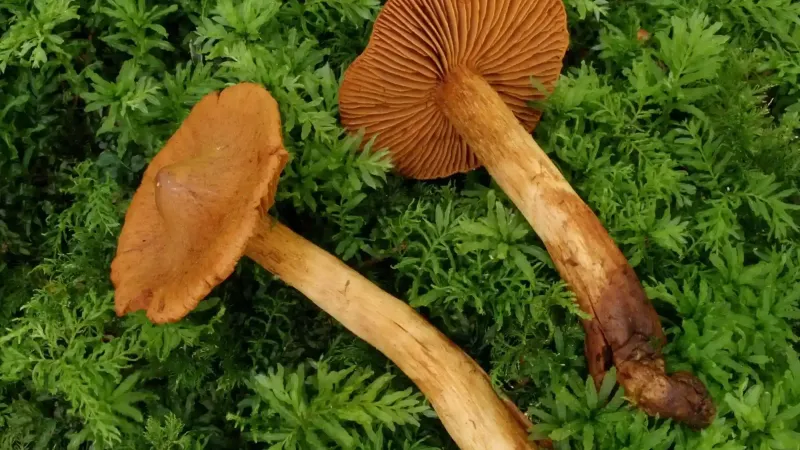
Cortinarius rubellus fruiting bodies
Scientific Classification
Kingdom:Fungi
Division:Basidiomycota
Class:Agaricomycetes
Order:Agaricales
Family:Cortinariaceae
Genus:Cortinarius
Frequently Asked Questions
- What is Deadly Webcap?
- Deadly Webcap (Cortinarius rubellus) is a mushroom species, belonging to the Cortinariaceae family. It is studied for its biological characteristics and is documented in the ShroomSpy mycology database.
- Is Deadly Webcap edible?
- DEADLY POISONOUS - never eat. Contains orellanine, a potent nephrotoxin that causes severe, often irreversible kidney failure. Symptoms are dangerously delayed, typically appearing 3 days to 2-3 weeks after ingestion, so poisoning is frequently missed until renal damage is advanced. Many victims require long-term dialysis or a kidney transplant, and deaths have occurred. There is no specific antidote.
- What is the scientific classification of Deadly Webcap?
- Deadly Webcap belongs to the kingdom Fungi, division Basidiomycota, class Agaricomycetes, order Agaricales, family Cortinariaceae, genus Cortinarius. Its scientific name is Cortinarius rubellus.
About
Cortinarius rubellus, the Deadly Webcap, is a rusty orange to reddish-brown mushroom of coniferous and mixed forests, recognized by its cobweb-like partial veil and rusty-brown spore print. It typically fruits in late summer and autumn as a mycorrhizal partner of conifers and, sometimes, deciduous trees. Despite its unremarkable appearance, it is one of the most dangerous mushrooms in the world: it contains orellanine, a potent nephrotoxin that causes severe, often irreversible kidney failure. There is no specific antidote.
History
The deadly potential of webcaps went unrecognized for centuries because Cortinarius was long believed to be a harmless genus. The nephrotoxicity of orellanine was first identified in the 1950s after a mass poisoning in Poland, where dozens of people developed kidney failure traced to webcaps gathered from a single location. C. rubellus (formerly known as C. speciosissimus, and also reported as C. ranierensis or C. orellanoides) was later confirmed to belong to the lethal Cortinarius orellanus complex. A high-profile case involving the family of author Nicholas Evans renewed public awareness of these mushrooms in the modern era.
Overview
Ecologically, Cortinarius rubellus forms mycorrhizal relationships with forest trees and plays a role in nutrient cycling. It has no culinary or medicinal value and is never cultivated. Its danger lies in delayed toxicity: after ingestion, symptoms such as flu-like illness, headache, and vomiting are typically delayed by 3 to 20 days, by which point severe interstitial nephritis and irreversible renal damage may already be advanced. Many victims require long-term dialysis or a kidney transplant, and deaths have occurred. Foragers risk confusing it with chanterelles and with other webcaps in the same toxic complex, so any rusty-brown, cobweb-veiled mushroom should be left alone.
Physical Characteristics
Caps:
The cap is convex to broadly bell-shaped, measuring 3-10 cm in diameter, with a smooth, moist surface that is reddish-brown to orange-brown in color.
Gills:
Gills are attached to the stem, closely spaced, and initially pale yellow to orange, becoming darker with age.
Mushroom Ratings
0.0
Based on 0 Reviews
5
★4
★3
★2
★1
★Share your thoughts
If you've consumed this mushroom, share your thoughts with our community