Last updated:
Craterellus cinereus
"Gray Chanterelle, Black Chanterelle"
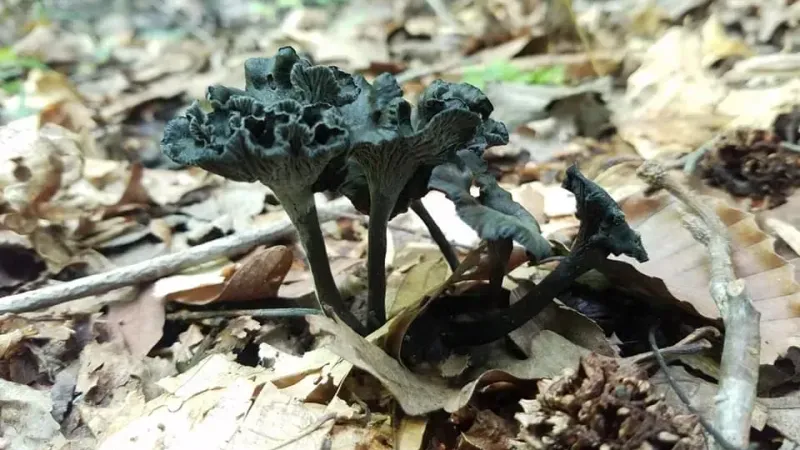
Craterellus cinereus fruiting bodies
Scientific Classification
Kingdom:Fungi
Division:Basidiomycota
Class:Agaricomycetes
Order:Cantharellales
Family:Cantharellaceae
Genus:Craterellus
Frequently Asked Questions
- What is Gray Chanterelle?
- Gray Chanterelle (Craterellus cinereus) is a mushroom species, belonging to the Cantharellaceae family. It is studied for its biological characteristics and is documented in the ShroomSpy mycology database.
- Is Gray Chanterelle edible?
- edible - considered a choice mushroom, but should be cooked before consumption to enhance flavor and digestibility.
- What effects does Gray Chanterelle produce?
- Gray Chanterelle is associated with the following effects: Energy. Individual experiences vary based on dose, set, and setting.
- What is the scientific classification of Gray Chanterelle?
- Gray Chanterelle belongs to the kingdom Fungi, division Basidiomycota, class Agaricomycetes, order Cantharellales, family Cantharellaceae, genus Craterellus. Its scientific name is Craterellus cinereus.
About
Craterellus cinereus, commonly known as the gray chanterelle or black chanterelle, is a distinctive mushroom characterized by its funnel-shaped, gray to brownish-gray cap and the prominent ridge-like false gills that run down its stem in place of true gills. It grows on the ground in deciduous and coniferous woodland and is closely related to the black trumpet (Craterellus cornucopioides). It is valued as an edible mushroom, offering a rich, earthy flavor used to add depth to sauces and other dishes.
History
Craterellus cinereus belongs to the order Cantharellales alongside the true chanterelle (Cantharellus cibarius) and the black trumpet, a group long foraged and prized in European and North American cuisines. The species has also been treated under the name Cantharellus cinereus, reflecting its close relationship to both genera. The genus name Craterellus derives from the Latin for a small mixing cup or bowl, referring to the funnel shape of the fruiting body, while cinereus is Latin for ash-colored, describing its typical gray coloration.
Like its relative the black trumpet, this dark, funnel-shaped mushroom blends into the leaf litter of the forest floor and is easily overlooked. As interest in wild-mushroom foraging has grown, the broader group of dark Craterellus species has gained appreciation both for its culinary value and for its ecological role in the forest.
Overview
Craterellus cinereus is a wild-harvested woodland mushroom rather than a commercially cultivated one. Its dark coloration, the absence of true gills (replaced by shallow forked ridges), and its funnel-shaped cap distinguish it from look-alikes such as the false chanterelle (Hygrophoropsis aurantiaca), which is more orange and bears true gills.
Within the order Cantharellales, C. cinereus and its relatives are noted in the research literature for their high antioxidant phenolic content and laboratory cytotoxic activity against cultured cancer cells. Field guides report no poisonous look-alikes among the dark Craterellus species, which are all regarded as edible, though wild mushrooms should always be cooked and confidently identified before consumption.
Physical Characteristics
Caps:
The cap is funnel-shaped, measuring 3-10 cm in diameter, with a wavy margin. It is gray to brownish-gray in color and has a smooth, slightly sticky texture when moist.
Gills:
The species lacks true gills; instead, it has shallow, forked ridges that run down the stem, which are pale to grayish in color.
Cognitive Effects
Energy
C. cinereus provides a nutritious package of B vitamins and minerals supporting cellular energy metabolism when used as a culinary ingredient.
Nutrition Facts
Serving Size100
Amount Per Serving
Calories260
% Daily Value*
Total Fat 2.5 g3%
Saturated Fat 0 g0%
Trans Fat 0 g
Cholesterol 0 mg0%
Sodium 12 mg1%
Total Carbohydrate 48 g17%
Dietary Fiber 22 g79%
Total Sugars 0 g
Protein 17 g34%
Vitamin A 0 µg 0%•Thiamin B1 0 mg 0%
Riboflavin B2 0 mg 0%•Niacin B3 0 mg 0%
Vitamin B6 0 mg 0%•Folate B9 0 µg 0%
Vitamin B12 0 mg 0%•Vitamin C 0 mg 0%
Vitamin D 8 µg 40%•Vitamin E 0 mg 0%
Vitamin K 0 µg 0%•Calcium 0 mg 0%
Copper 0 mg 0%•Iron 0 mg 0%
Magnesium 0 mg 0%•Manganese 0 mg 0%
Phosphorus 290 mg 23%•Potassium 1700 mg 36%
Selenium 14 µg 25%•Zinc 3.5 mg 32%
Vit A 0 µg 0%•B1 0 mg 0%
B2 0 mg 0%•B3 0 mg 0%
B6 0 mg 0%•B9 0 µg 0%
B12 0 mg 0%•Vit C 0 mg 0%
Vit D 8 µg 40%•Vit E 0 mg 0%
Vit K 0 µg 0%•Calcium 0 mg 0%
Copper 0 mg 0%•Iron 0 mg 0%
Mg 0 mg 0%•Mn 0 mg 0%
Phosph. 290 mg 23%•Pot. 1700 mg 36%
Selenium 14 µg 25%•Zinc 3.5 mg 32%
* Percent Daily Values are based on a 2,000 calorie diet.
Mushroom Ratings
0.0
Based on 0 Reviews
5
★4
★3
★2
★1
★Share your thoughts
If you've consumed this mushroom, share your thoughts with our community