Last updated:
Daldinia eschscholzii
"Black Heart, Daldinia"
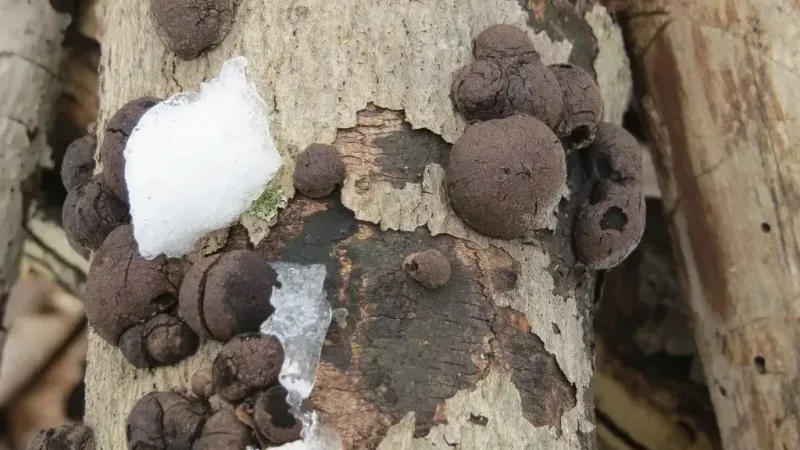
Daldinia eschscholzii fruiting bodies
Scientific Classification
Kingdom:Fungi
Division:Ascomycota
Class:Sordariomycetes
Order:Xylariales
Family:Daldiniaceae
Genus:Daldinia
Frequently Asked Questions
- What is Black Heart?
- Black Heart (Daldinia eschscholzii) is a mushroom species, belonging to the Daldiniaceae family. It is studied for its biological characteristics and is documented in the ShroomSpy mycology database.
- Is Black Heart edible?
- Inedible. The fruiting bodies are hard and woody with no culinary value; this species is not consumed.
- What is the scientific classification of Black Heart?
- Black Heart belongs to the kingdom Fungi, division Ascomycota, class Sordariomycetes, order Xylariales, family Daldiniaceae, genus Daldinia. Its scientific name is Daldinia eschscholzii.
About
Daldinia eschscholzii is a distinctive wood-decaying fungus in the family Daldiniaceae (order Xylariales), characterized by its dark, often black to dark-brown, irregularly shaped fruiting bodies that resemble small, hard, woody lumps. It grows on dead and decaying hardwood and is widely distributed in temperate and subtropical regions. D. eschscholzii is not consumed; its fruiting bodies are hard and woody with no culinary value, but it plays an important ecological role as a wood decomposer.
History
The genus Daldinia belongs to the Xylariales, a group of ascomycete fungi long studied by mycologists for their tough, carbonaceous fruiting bodies and their role in wood decay. Daldinia eschscholzii sits within a complex of closely related, sometimes cryptic species, and its taxonomy has been refined through molecular and morphological study, including the polyphasic revision of the genus by Stadler and colleagues. The species is named after the naturalist Johann Friedrich von Eschscholtz.
Overview
Ecologically, Daldinia eschscholzii is a saprotroph that breaks down lignin and cellulose in dead wood, contributing to nutrient cycling in forest ecosystems. It is found in the wild rather than cultivated commercially, as it is not used for food. The species has drawn research interest as a source of secondary metabolites, but its primary significance remains ecological. Key field features include its dark, irregularly shaped, hard fruiting bodies growing directly on woody substrate.
Physical Characteristics
Caps:
The fruiting body is irregularly shaped, typically 2-10 cm in diameter, with a dark brown to black color and a rough, crusty texture.
Gills:
None
Pharmacology
Helps With
Bacterial Suppression
Daldinia eschscholzii produces daldinones, localized naphthalenone pigments with activity against gram-positive bacteria including Staphylococcus aureus.
Viral Suppression
Volatile secondary metabolites of D. eschscholzii including daldinal have shown in vitro antiviral activity, consistent with its traditional use as repellent smoke in Africa.
Chemical Constituents
Medicinal Chemistry
Mushroom Ratings
0.0
Based on 0 Reviews
5
★4
★3
★2
★1
★Share your thoughts
If you've consumed this mushroom, share your thoughts with our community