Last updated:
Exidia glandulosa
"Witch's Butter, Black Witch's Butter"
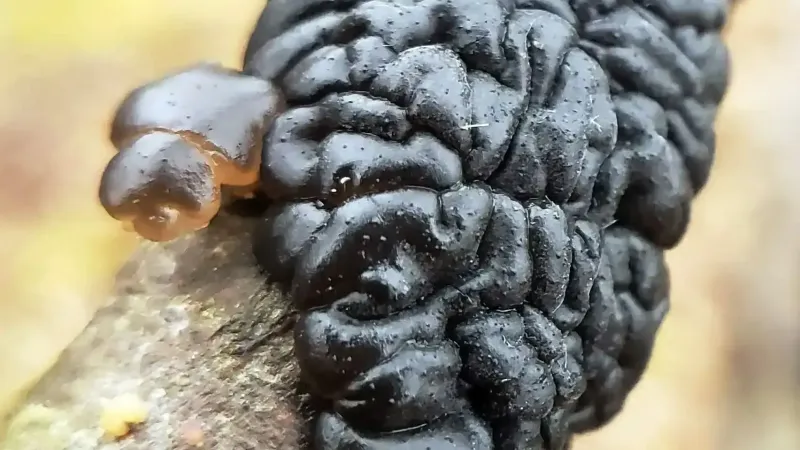
Exidia glandulosa fruiting bodies
Scientific Classification
Kingdom:Fungi
Division:Basidiomycota
Class:Agaricomycetes
Order:Auriculariales
Family:Auriculariaceae
Genus:Exidia
Frequently Asked Questions
- What is Witch's Butter?
- Witch's Butter (Exidia glandulosa) is a mushroom species, belonging to the Auriculariaceae family. It is studied for its biological characteristics and is documented in the ShroomSpy mycology database.
- Is Witch's Butter edible?
- non-edible - Exidia glandulosa is not considered toxic, but it is regarded as inedible because of its tough, rubbery gelatinous texture and lack of any worthwhile flavor.
- What is the scientific classification of Witch's Butter?
- Witch's Butter belongs to the kingdom Fungi, division Basidiomycota, class Agaricomycetes, order Auriculariales, family Auriculariaceae, genus Exidia. Its scientific name is Exidia glandulosa.
About
Exidia glandulosa is a gelatinous, blackish jelly fungus commonly known as Witch's Butter or Black Witch's Butter. Its fruiting bodies are sessile and variable in shape, typically 15 to 50 mm wide, with an upper surface that is wavy, folded and dotted with numerous wart-like projections - the feature reflected in the epithet glandulosa, meaning "full of glands." It grows in crowded groups on stumps, logs and fallen branches of broad-leaved trees, especially ash and oak, and is common throughout the year, shrinking to a black crust in dry weather and swelling again after rain.
History
The species was formally described by the French mycologist Jean Florent Saint-Amans and later placed in the genus Exidia by Elias Fries. Its dark, slippery fruiting bodies earned it a place in European folklore: in Sweden it was known as trollsmor ("troll's butter") and was thrown into Midsummer bonfires of nine woods to ward off evil spirits. It appears in old herbal and folk traditions among the "witch-associated" fungi, and a traditional Chinese medicine use has been recorded for moistening the lungs and easing a dry cough, though this attribution overlaps heavily with the related jelly fungi Tremella and is not well supported by modern evidence.
Overview
Exidia glandulosa is a saprotrophic wood-decay fungus in the order Auriculariales, the same group as the edible wood ear (Auricularia auricula-judae). It plays an ecological role in breaking down dead hardwood and recycling nutrients in temperate forests across Europe and North America. It is not toxic, but its tough, rubbery texture and absence of flavor make it inedible, and it is not cultivated or harvested commercially. It is most reliably distinguished from similar jelly fungi by its blackish color, warty surface and growth on dead broad-leaved wood - in contrast to the bright yellow Tremella mesenterica and the cinnamon-brown, leaf-lobed Tremella foliacea.
Physical Characteristics
Caps:
The fruiting body is gelatinous and sessile (lacking a true cap or stem), variable in shape - rounded, flattened, disc-shaped or convoluted - and typically 15 to 50 mm wide. It is blackish, with an upper surface that is wavy, folded and covered in numerous wart-like glandular projections; the underside is tomentose (felty). It dries to a thin black crust and swells up again when wet.
Gills:
None
Mushroom Ratings
0.0
Based on 0 Reviews
5
★4
★3
★2
★1
★Share your thoughts
If you've consumed this mushroom, share your thoughts with our community