Last updated:
Hydnellum Peckii
"bleeding tooth fungus, strawberry tooth fungus, Strawberries and Cream mushroom"
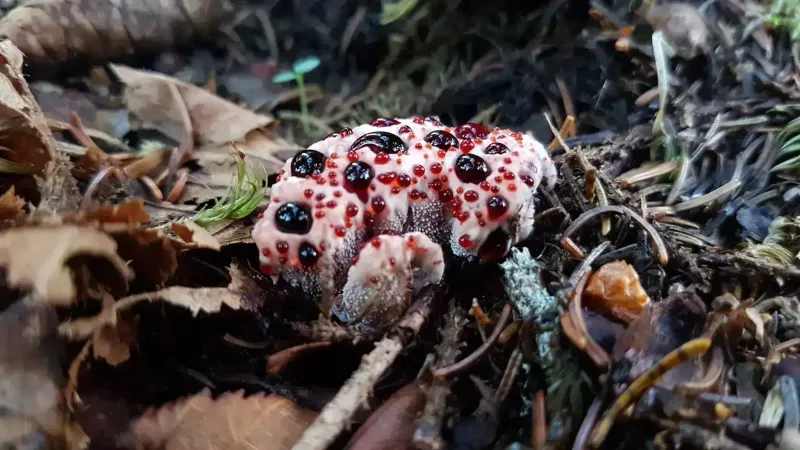
Hydnellum peckii fruiting bodies
Scientific Classification
Kingdom:Fungi
Division:Basidiomycota
Class:Agaricomycetes
Order:Thelephorales
Family:Bankeraceae
Genus:Hydnellum
Frequently Asked Questions
- What is bleeding tooth fungus?
- bleeding tooth fungus (Hydnellum Peckii) is a mushroom species, belonging to the Bankeraceae family. It is studied for its biological characteristics and is documented in the ShroomSpy mycology database.
- Is bleeding tooth fungus edible?
- Non-edible. Hydnellum peckii is not toxic, but it is inedible due to its extremely tough, woody flesh and intensely bitter taste. It is not used as a food mushroom.
- What is the scientific classification of bleeding tooth fungus?
- bleeding tooth fungus belongs to the kingdom Fungi, division Basidiomycota, class Agaricomycetes, order Thelephorales, family Bankeraceae, genus Hydnellum. Its scientific name is Hydnellum Peckii.
About
Hydnellum peckii, commonly known as the "bleeding tooth fungus" or "Strawberries and Cream mushroom," is a distinctive and visually striking fungus named for the bright red, blood-like droplets it exudes from the surface of its velvety, pale-to-pinkish cap. The underside bears spines (teeth) rather than gills. It is an ectomycorrhizal species that forms a symbiotic partnership with the roots of conifers such as pine and spruce, and it is found across North America and parts of Europe. Although vividly beautiful, H. peckii is too tough and bitter to eat; it is not toxic, simply inedible.
History
Hydnellum peckii was first described scientifically in 1886 by the American mycologist Howard James Banker, who named it in honor of the mycologist Charles Horton Peck. Its arresting "bleeding" appearance has long made it a favorite subject for naturalists and photographers. Over time the species has shifted from a botanical curiosity to a subject of scientific interest, particularly for the colored pigments it produces, which have been investigated as natural dyes.
Overview
Hydnellum peckii is best recognized by two features: the spiny (toothed) underside of its cap and the red guttation droplets that ooze from young, moist fruiting bodies. As an ectomycorrhizal fungus it depends on a living conifer host rather than decaying matter, so it is not cultivated commercially. It can be distinguished from other Hydnellum species, such as Hydnellum aurantiacum, which lacks the characteristic red "bleeding" exudate. Its striking appearance makes it a fascinating find for both amateur and professional mycologists.
Physical Characteristics
Caps:
The cap is irregularly shaped, typically 2-10 cm in diameter, with a color ranging from pale pink to reddish-brown. It has a velvety to slightly sticky texture.
Gills:
None - this species does not have gills but instead has spines or teeth on the underside of the cap.
Chemical Constituents
Medicinal Chemistry
Mushroom Ratings
0.0
Based on 0 Reviews
5
★4
★3
★2
★1
★Share your thoughts
If you've consumed this mushroom, share your thoughts with our community