Last updated:
Hygrophoropsis aurantiaca
"False Chanterelle, Orange Chanterelle"
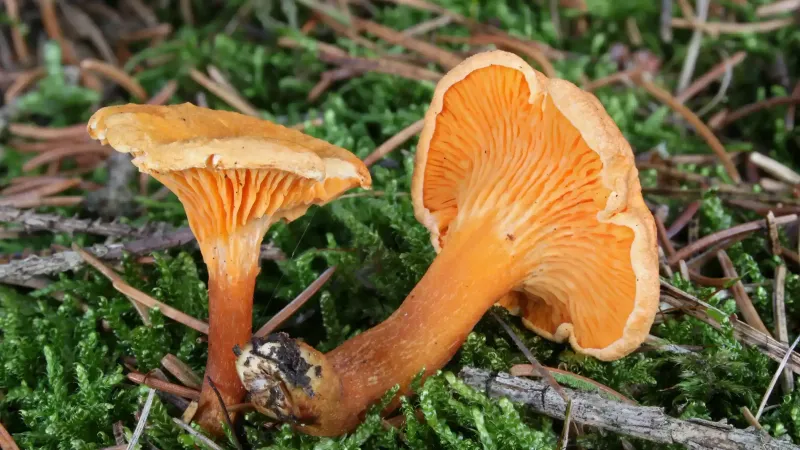
Hygrophoropsis aurantiaca fruiting bodies
Scientific Classification
Kingdom:Fungi
Division:Basidiomycota
Class:Agaricomycetes
Order:Boletales
Family:Hygrophoropsidaceae
Genus:Hygrophoropsis
Frequently Asked Questions
- What is False Chanterelle?
- False Chanterelle (Hygrophoropsis aurantiaca) is a mushroom species, belonging to the Hygrophoropsidaceae family. It is studied for its biological characteristics and is documented in the ShroomSpy mycology database.
- Is False Chanterelle edible?
- Not recommended for consumption. Hygrophoropsis aurantiaca is widely treated as occasionally or doubtfully poisonous: it commonly causes gastrointestinal upset (nausea, vomiting, diarrhea), and some authors report alarming hallucinatory or neurological reactions after eating it. It is not deadly, but it should NOT be eaten. The greatest danger is its close resemblance to the edible true chanterelle (Cantharellus cibarius) and to the toxic jack-o'-lantern (Omphalotus spp.); always rule those out by their thick, blunt forking folds (chanterelle) versus this species' thin, repeatedly forked true gills.
- What is the scientific classification of False Chanterelle?
- False Chanterelle belongs to the kingdom Fungi, division Basidiomycota, class Agaricomycetes, order Boletales, family Hygrophoropsidaceae, genus Hygrophoropsis. Its scientific name is Hygrophoropsis aurantiaca.
About
Hygrophoropsis aurantiaca, the false chanterelle, is a bright orange-yellow to apricot mushroom of conifer and deciduous woodlands that is easily mistaken for the prized edible chanterelle. It is not a recommended edible: it commonly causes gastrointestinal upset, and some reports describe alarming hallucinatory or neurological reactions, so it should be left in the woods. Despite once being grouped with the chanterelles for its colour and decurrent gills, it differs in nearly every other respect and is now placed in the order Boletales.
History
The false chanterelle was described by Elias Fries and given its current combination by René Maire. The genus name Hygrophoropsis means "resembling Hygrophorus," and aurantiaca refers to its orange colour. It was formerly placed in Cantharellus because of its colour, white spore print, and decurrent gills, but mycologists later recognised that its anatomy parallels that of Paxillus rather than the true chanterelles. Molecular work has since moved it into the order Boletales, family Hygrophoropsidaceae — confirming the long-held intuition behind the name "false" chanterelle.
Overview
Hygrophoropsis aurantiaca is a saprotrophic fungus that grows in troops on the ground and on decaying wood, especially in pine and other conifer woods, on heaths, and in rough hill-pastures. The key field marks are its bright orange cap with a wavy, incurved margin, and its thin, crowded, deep-orange, repeatedly forked true gills that run down the stem — in contrast to the true chanterelle's thick, blunt, vein-like folds. Distinguishing it matters: the edible Cantharellus cibarius has shallow ridge-like folds, while the toxic jack-o'-lantern (Omphalotus spp.) has sharp-edged, unforked gills. The false chanterelle has no culinary or established medicinal value and is gathered only by accident; treat the name at face value and do not eat it.
Physical Characteristics
Caps:
Cap 2.5-10 cm wide, bright orange-yellow to apricot-orange, fleshy and soft, broadly convex becoming flat and often slightly depressed at the centre, with a wavy, incurved, faintly downy margin (not sticky).
Gills:
Gills are true plate-like gills (not chanterelle folds): deep orange, thin, crowded, decurrent, and repeatedly forked, easily separated from the cap flesh.
Mushroom Ratings
0.0
Based on 0 Reviews
5
★4
★3
★2
★1
★Share your thoughts
If you've consumed this mushroom, share your thoughts with our community