Last updated:
Laetiporus conifericola
"conifer polypore, pine chicken, western chicken of the woods"
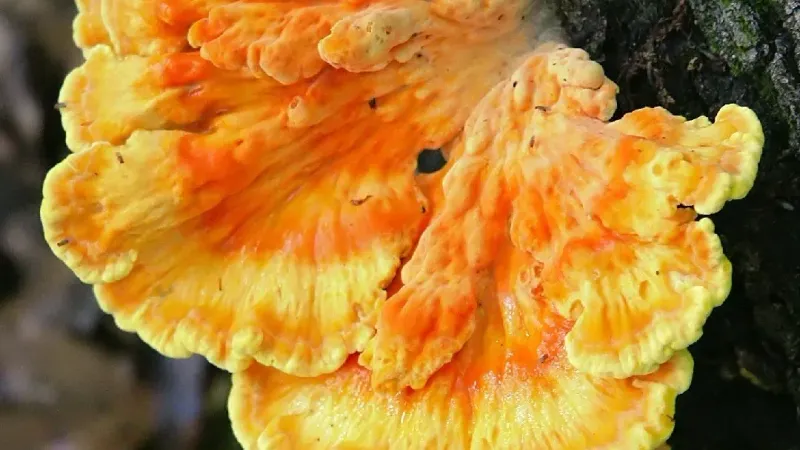
Laetiporus conifericola fruiting bodies
Scientific Classification
Kingdom:Fungi
Division:Basidiomycota
Class:Agaricomycetes
Order:Polyporales
Family:Polyporaceae
Genus:Laetiporus
Frequently Asked Questions
- What is conifer polypore?
- conifer polypore (Laetiporus conifericola) is a mushroom species, belonging to the Polyporaceae family. It is studied for its biological characteristics and is documented in the ShroomSpy mycology database.
- Is conifer polypore edible?
- Edible when young and thoroughly cooked, but with important caveats. Laetiporus conifericola grows on conifers, and specimens from conifer hosts (and the closely related western chicken-of-the-woods complex) cause gastrointestinal upset and, in a minority of people, allergic reactions such as hives or swelling, especially when eaten raw, in large quantities, or with alcohol. Older fruiting bodies turn sour and unpalatable. Never eat raw; cook thoroughly and try a small portion first. Do not confuse with poisonous Laetiporus look-alikes such as conifer-growing L. huroniensis and eucalyptus-growing L. gilbertsonii, both of which have been implicated in poisonings.
- What effects does conifer polypore produce?
- conifer polypore is associated with the following effects: Energy. Individual experiences vary based on dose, set, and setting.
- What is the scientific classification of conifer polypore?
- conifer polypore belongs to the kingdom Fungi, division Basidiomycota, class Agaricomycetes, order Polyporales, family Polyporaceae, genus Laetiporus. Its scientific name is Laetiporus conifericola.
About
Laetiporus conifericola is a bright orange-to-yellow, shelf-like (bracket) polypore native to western North America, where it fruits on living and dead conifers from summer into autumn. It is one of the "chicken of the woods" mushrooms, the western, conifer-loving counterpart to the eastern, hardwood-dwelling Laetiporus sulphureus. Like its relatives it is prized for a meaty, chicken-like texture when young, though conifer-grown specimens are noted for a sourer taste and require thorough cooking.
History
Laetiporus conifericola is a relatively recently recognized member of the Laetiporus genus, separated from the broader "chicken of the woods" group on the basis of its conifer host and western North American range. For much of the twentieth century, western conifer-dwelling collections were simply lumped with Laetiporus sulphureus, which does not actually occur in western North America. As mycologists clarified the genus, L. conifericola was distinguished by where it grows and what it grows on, alongside other western look-alikes such as the eucalyptus-associated Laetiporus gilbertsonii.
Overview
Ecologically, Laetiporus conifericola is a brown-rot fungus: its enzymes break down the cellulose in conifer wood and leave behind a modified brown lignin, causing the characteristic cubical cracking seen on decaying softwoods, and playing a distinct role in forest nutrient cycling. It is foraged rather than cultivated commercially. Key identifying features are its bright yellow-to-orange shelving fruiting bodies, a pored (rather than gilled) underside, and its growth directly on conifers, which separates it from the hardwood-dwelling eastern L. sulphureus. Because conifer-grown chicken-of-the-woods can cause stomach upset or allergic reactions in some people, it should only be eaten young, well cooked, and in modest amounts.
Physical Characteristics
Caps:
The cap is fan-shaped to bracket-like, measuring 5 to 30 cm across, with a smooth to slightly velvety texture. The color ranges from bright yellow to orange, often fading to a paler hue with age.
Gills:
None - this species has pores on the underside of the cap instead of gills.
Cognitive Effects
Energy
Laetiporus conifericola is a protein-rich edible polypore; its high amino acid content may support physical energy and recovery when consumed as food.
Pharmacology
Helps With
Immune System
Like other Laetiporus species, L. conifericola contains beta-glucan polysaccharides that may modulate toll-like receptor signaling to enhance immune surveillance.
Inflammation
Lanostane triterpenoids in Laetiporus spp. may inhibit cyclooxygenase enzymes, contributing to potential anti-inflammatory activity.
Possible Side Effects
Nausea
L. conifericola causes gastrointestinal upset in a notable minority of people when consumed in large quantities or raw; always cook thoroughly.
Allergies
Rare allergic reactions including urticaria and angioedema have been documented with Laetiporus species, especially when eaten raw or with alcohol.
Chemical Constituents
Medicinal Chemistry
Nutrition Facts
Serving Size100
Amount Per Serving
Calories290
% Daily Value*
Total Fat 2.5 g3%
Saturated Fat 0.3 g2%
Trans Fat 0 g
Cholesterol 0 mg0%
Sodium 20 mg1%
Total Carbohydrate 55 g20%
Dietary Fiber 18 g64%
Total Sugars 0 g
Protein 22 g44%
Vitamin A 0 µg 0%•Thiamin B1 0 mg 0%
Riboflavin B2 0 mg 0%•Niacin B3 12 mg 75%
Vitamin B6 0 mg 0%•Folate B9 0 µg 0%
Vitamin B12 0 mg 0%•Vitamin C 0 mg 0%
Vitamin D 8 µg 40%•Vitamin E 0 mg 0%
Vitamin K 0 µg 0%•Calcium 0 mg 0%
Copper 0 mg 0%•Iron 0 mg 0%
Magnesium 0 mg 0%•Manganese 0 mg 0%
Phosphorus 320 mg 26%•Potassium 1800 mg 38%
Selenium 22 µg 40%•Zinc 4.5 mg 41%
Vit A 0 µg 0%•B1 0 mg 0%
B2 0 mg 0%•B3 12 mg 75%
B6 0 mg 0%•B9 0 µg 0%
B12 0 mg 0%•Vit C 0 mg 0%
Vit D 8 µg 40%•Vit E 0 mg 0%
Vit K 0 µg 0%•Calcium 0 mg 0%
Copper 0 mg 0%•Iron 0 mg 0%
Mg 0 mg 0%•Mn 0 mg 0%
Phosph. 320 mg 26%•Pot. 1800 mg 38%
Selenium 22 µg 40%•Zinc 4.5 mg 41%
* Percent Daily Values are based on a 2,000 calorie diet.
Mushroom Ratings
0.0
Based on 0 Reviews
5
★4
★3
★2
★1
★Share your thoughts
If you've consumed this mushroom, share your thoughts with our community