Last updated:
Lignosus sacer
"Tiger Milk Mushroom, Tiger's Milk Fungus"
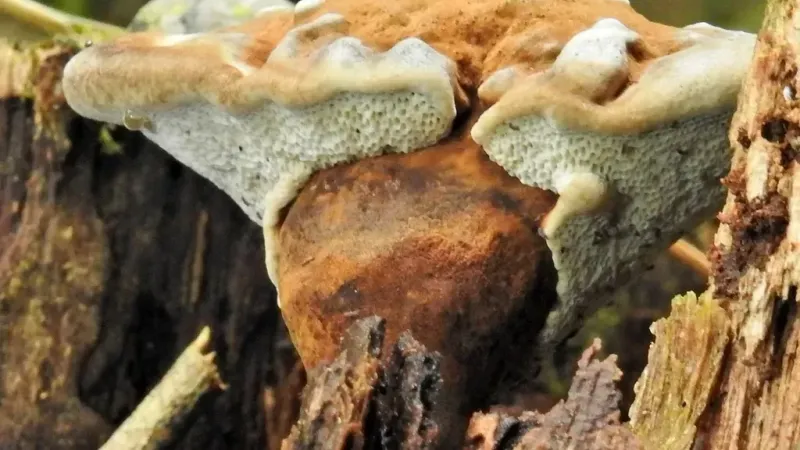
Lignosus sacer fruiting bodies
Scientific Classification
Kingdom:Fungi
Division:Basidiomycota
Class:Agaricomycetes
Order:Polyporales
Family:Polyporaceae
Genus:Lignosus
Frequently Asked Questions
- What is Tiger Milk Mushroom?
- Tiger Milk Mushroom (Lignosus sacer) is a mushroom species, belonging to the Polyporaceae family. It is studied for its biological characteristics and is documented in the ShroomSpy mycology database.
- Is Tiger Milk Mushroom edible?
- Non-edible. Lignosus sacer is a tough, woody bracket fungus valued only for traditional medicinal use of its underground sclerotium, never as food. Wild material has been reported to contain low (trace) levels of toxic metal contents, which may be a concern depending on the amount consumed.
- What effects does Tiger Milk Mushroom produce?
- Tiger Milk Mushroom is associated with the following effects: Memory, Energy, Focus. Individual experiences vary based on dose, set, and setting.
- What is the scientific classification of Tiger Milk Mushroom?
- Tiger Milk Mushroom belongs to the kingdom Fungi, division Basidiomycota, class Agaricomycetes, order Polyporales, family Polyporaceae, genus Lignosus. Its scientific name is Lignosus sacer.
About
Lignosus sacer is a woody polypore of the family Polyporaceae and a member of the genus Lignosus, the group collectively known as tiger milk mushrooms. Unlike a typical fleshy mushroom, its medicinal value lies in a hardened underground sclerotium rather than the bracket-like fruiting body. L. sacer is the African representative of the genus, found in tropical forests of Africa, and is distinguished from its relatives chiefly by microscopic features such as pore size and spore dimensions.
History
The tiger milk mushrooms take their name from Lac tigridis ('tiger's milk'), a term recorded in 17th-century European writings describing a prized, metal-heavy 'concretion' brought from Asia that physicians of the day could not identify. The most famous and best-studied member of the genus is the Southeast Asian Lignosus rhinocerus, long used by Indigenous communities as a tonic and remedy. L. sacer shares this ethnomycological heritage within the genus but is the African species, named from the Latin lignosus ('woody') and sacer ('sacred'); it remains far less studied than its Asian relative, and much of its biology and phylogeny is still poorly documented.
Overview
Lignosus species are regarded among the most valued medicinal fungi where they occur, and the genus is traditionally used as a general tonic and for immune enhancement and a range of ailments including cancer, asthma, sinusitis, bronchitis, nausea and allergic reactions. The sclerotium is the source of this medicinal value. L. sacer itself is not a culinary mushroom and is too tough and woody to eat. Because most pharmacological research has focused on L. rhinocerus, species-specific data for L. sacer is limited, and wild specimens have been reported to carry trace levels of toxic metals - reasons to treat any consumption cautiously and to rely on properly identified, tested material.
Physical Characteristics
Caps:
Forms a tough, leathery to woody bracket (fruiting body) typical of the Polyporaceae rather than a fleshy cap; surface ranges from pale to grayish or dark brown.
Gills:
None - this is a polypore. The underside bears a pored surface (1-3 pores per millimetre) instead of gills.
Cognitive Effects
Memory
Lignosus rhinocerus (Tiger Milk mushroom) compounds including polysaccharides promote NGF expression in PC12 cells; L. sacer shares this genus profile supporting neural health relevant to memory.
Energy
Tiger Milk mushroom is traditionally used as a tonic to increase stamina and reduce fatigue in Malay and Indigenous Southeast Asian communities.
Focus
Preliminary studies on Lignosus rhinocerus / sacer polysaccharides suggest improved cognitive test performance in animal models via neurotrophin pathway stimulation.
Pharmacology
Helps With
Immune System
Lignosus polysaccharides activate TLR2 and dectin-1 signaling in macrophages, stimulating innate immune responses; shown in multiple Malaysian and Chinese research group studies.
Lung Respiration
L. rhinocerus (Tiger Milk mushroom) is the most important traditional medicine plant in Southeast Asia for respiratory ailments including chronic cough, asthma, and bronchitis.
Cancer
Hot water extracts of Lignosus spp. showed cytotoxic activity against MCF-7 breast cancer and HepG2 liver cancer cell lines in vitro studies from University of Malaya.
Immune System
Multiple immunostimulatory beta-glucan fractions from Lignosus extracts activate NK cells and T lymphocytes in both in vitro and in vivo murine models.
Inflammation
Lignosus polysaccharides reduce TNF-α, IL-1β, and IL-6 production in LPS-activated macrophages, supporting potential anti-inflammatory applications.
Chemical Constituents
Medicinal Chemistry
Mushroom Ratings
0.0
Based on 0 Reviews
5
★4
★3
★2
★1
★Share your thoughts
If you've consumed this mushroom, share your thoughts with our community