Last updated:
Meripilus giganteus
"Giant Polypore, Black-staining Polypore"
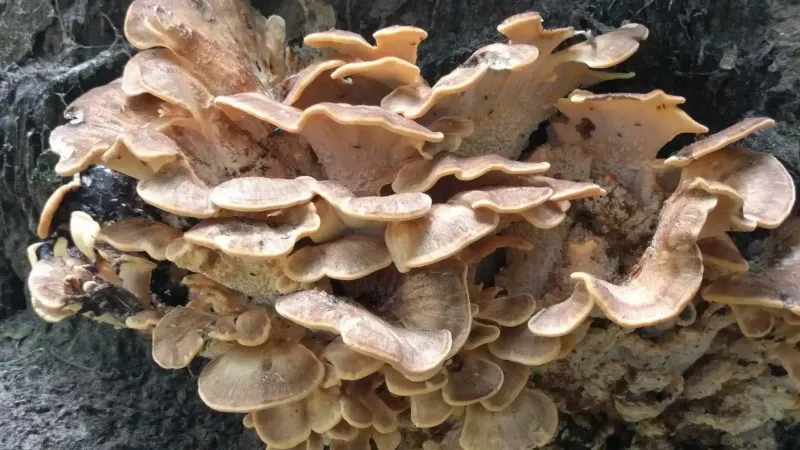
Meripilus giganteus fruiting bodies
Scientific Classification
Kingdom:Fungi
Division:Basidiomycota
Class:Agaricomycetes
Order:Agaricales
Family:Meripilaceae
Genus:Meripilus
Frequently Asked Questions
- What is Giant Polypore?
- Giant Polypore (Meripilus giganteus) is a mushroom species, belonging to the Meripilaceae family. It is studied for its biological characteristics and is documented in the ShroomSpy mycology database.
- Is Giant Polypore edible?
- Edible only when very young and tender; the flesh quickly becomes tough, fibrous and unpalatable with age. The white flesh bruises black, and older or dark-staining specimens are known to cause gastrointestinal upset. Always cook thoroughly and use only young, white-fleshed portions.
- What effects does Giant Polypore produce?
- Giant Polypore is associated with the following effects: Energy. Individual experiences vary based on dose, set, and setting.
- What is the scientific classification of Giant Polypore?
- Giant Polypore belongs to the kingdom Fungi, division Basidiomycota, class Agaricomycetes, order Agaricales, family Meripilaceae, genus Meripilus. Its scientific name is Meripilus giganteus.
About
Meripilus giganteus, the Giant Polypore, is one of the largest soft polypores, forming massive rosette-like clusters of overlapping fan-shaped caps at the base of broad-leaved trees. The yellow-brown to snuff-brown caps and white pore surface both bruise black when handled, a feature that gives the species its other common name, the Black-staining Polypore. It is widespread in temperate hardwood forests and is commonly found on beech, oak and other broad-leaved trees, where it acts as a root and butt-rot fungus.
History
The species was transferred to the genus Meripilus by the Finnish mycologist Petter Karsten, building on the earlier descriptions of Elias Fries. Long familiar to European and North American mycologists as a conspicuous tree-base fungus, M. giganteus has been recorded at the base of hardwood trees in eastern North America, across Europe and in parts of the Himalayan region of India. Traditionally it has been regarded as edible only when young, and it has more recently attracted laboratory interest for its bioactive extracts.
Overview
Meripilus giganteus grows as a soft, fibrous polypore rather than a woody bracket: its flesh lacks the thick-walled specialised hyphae of perennial conk fungi, which is why even large fruiting bodies remain pliable. The whole cluster can reach about 75 cm across, made up of many individual fan-shaped caps that share a single fused base. The white tubes, pores and flesh stain black on bruising, and the fungus has a mild odour and slightly sour taste. As a wood-decay fungus it contributes to nutrient cycling and can weaken the root systems of host trees. Laboratory studies of its methanolic and other extracts report antibacterial activity against gram-positive bacteria, antioxidant activity, activity against the MCF-7 breast-cancer cell line and inhibition of acetylcholinesterase, the last suggesting possible relevance to Alzheimer's and related conditions.
Physical Characteristics
Caps:
Forms a large rosette-like tuft of overlapping, fan-shaped caps up to about 75 cm (750 mm) across; individual caps are 7.5-20 cm wide, pliable and rather thin, yellow-brown to snuff-brown with wavy, cream to yellowish margins.
Gills:
None; the fertile underside is a pore (tube) surface, white and very soft, bruising black where handled or cut.
Cognitive Effects
Energy
M. giganteus is a protein-rich polypore with significant B-vitamin content supporting cellular energy metabolism.
Pharmacology
Helps With
Immune System
Like many large wood-decomposing polypores, M. giganteus may contain beta-glucans that activate macrophage and NK cell immune pathways.
Possible Side Effects
Nausea
Older or darkened specimens of M. giganteus cause GI distress; only young white-fleshed portions should be consumed, and always cook thoroughly.
Chemical Constituents
Medicinal Chemistry
Nutrition Facts
Serving Size100
Amount Per Serving
Calories275
% Daily Value*
Total Fat 2.8 g4%
Saturated Fat 0 g0%
Trans Fat 0 g
Cholesterol 0 mg0%
Sodium 16 mg1%
Total Carbohydrate 50 g18%
Dietary Fiber 20 g71%
Total Sugars 0 g
Protein 19 g38%
Vitamin A 0 µg 0%•Thiamin B1 0 mg 0%
Riboflavin B2 0 mg 0%•Niacin B3 0 mg 0%
Vitamin B6 0 mg 0%•Folate B9 0 µg 0%
Vitamin B12 0 mg 0%•Vitamin C 0 mg 0%
Vitamin D 0 µg 0%•Vitamin E 0 mg 0%
Vitamin K 0 µg 0%•Calcium 0 mg 0%
Copper 0 mg 0%•Iron 0 mg 0%
Magnesium 0 mg 0%•Manganese 0 mg 0%
Phosphorus 330 mg 26%•Potassium 1850 mg 39%
Selenium 0 µg 0%•Zinc 0 mg 0%
Vit A 0 µg 0%•B1 0 mg 0%
B2 0 mg 0%•B3 0 mg 0%
B6 0 mg 0%•B9 0 µg 0%
B12 0 mg 0%•Vit C 0 mg 0%
Vit D 0 µg 0%•Vit E 0 mg 0%
Vit K 0 µg 0%•Calcium 0 mg 0%
Copper 0 mg 0%•Iron 0 mg 0%
Mg 0 mg 0%•Mn 0 mg 0%
Phosph. 330 mg 26%•Pot. 1850 mg 39%
Selenium 0 µg 0%•Zinc 0 mg 0%
* Percent Daily Values are based on a 2,000 calorie diet.
Mushroom Ratings
0.0
Based on 0 Reviews
5
★4
★3
★2
★1
★Share your thoughts
If you've consumed this mushroom, share your thoughts with our community